
Photo: Wikipedia
Demographics of St Charles, MO
Affluence Level in St Charles, MO
A middle-class area roughly in line with national averages across income, home values, education, and employment.
People of St Charles, MO
The people of St. Charles, Missouri, today number 71,048, forming a predominantly white (77.5%) and college-educated (44.2%) population that blends historic German-Catholic roots with newer suburban diversity. The city’s identity is shaped by its position as a historic river town that has evolved into a family-oriented suburb of St. Louis, marked by a strong sense of local heritage and a growing, though still modest, Hispanic (6.6%) and Black (7.7%) presence. With a foreign-born share of just 4.1%, St. Charles remains less diverse than the national average, but its demographic story is one of steady, incremental change rather than rapid transformation.
How the city was settled and grew
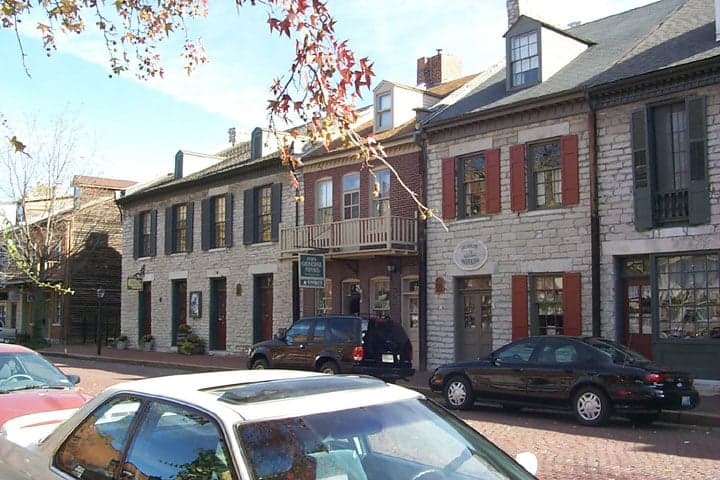
St. Charles was founded in 1769 by French fur trader Louis Blanchette, making it one of the oldest settlements on the Missouri River. The original population was a mix of French-Canadian voyageurs and a small number of enslaved Black laborers. The city’s character shifted dramatically after the Louisiana Purchase and the arrival of German immigrants in the 1830s and 1840s. These Germans, many fleeing economic hardship and political unrest, were drawn by cheap land and the promise of work on the riverfront and in emerging industries like milling and brewing. They settled heavily in what is now Frenchtown, a historic district of brick row houses and worker cottages, and in the Old Town area along Main Street, where German-language churches and saloons once dominated. By 1900, St. Charles was overwhelmingly German-American and Catholic, a cultural imprint still visible in its annual Oktoberfest and the presence of St. Joseph Catholic Church. A smaller wave of Irish immigrants arrived later in the 19th century, settling near the railroad yards in the Benton Park neighborhood, though they largely assimilated into the German mainstream.
Modern era (post-1965)
The post-1965 era brought suburbanization, not immigration, as the dominant force. The completion of Interstate 70 in the 1960s and the opening of the Missouri Research Park in the 1980s turned St. Charles into a bedroom community for St. Louis professionals. This period saw the rise of master-planned subdivisions like New Town at St. Charles, a neo-traditional development that began in 2004 and attracted a mix of young families and empty-nesters, and Hickory Hills, a 1970s-era subdivision of ranch homes popular with middle-class white families. The city’s Black population, historically small due to restrictive covenants and de facto segregation, began to grow modestly after the 1990s, with many Black families settling in the Harvester area near the city’s southern edge, where newer, more affordable housing stock exists. The Hispanic population, now 6.6%, grew primarily through domestic migration from Texas and California, not direct immigration, and is concentrated in the Mid Rivers Mall corridor, where service-sector jobs are plentiful. East/Southeast Asian residents (2.5%) and Indian-subcontinent residents (1.4%) are a recent addition, largely professionals drawn to jobs at Boeing, BJC Healthcare, and the nearby University of Missouri–St. Louis; they tend to settle in the Weldon Spring area, just west of the city limits, rather than within St. Charles proper.
The future
The population of St. Charles is slowly diversifying, but the pace is moderate. The white share has declined from roughly 85% in 2000 to 77.5% today, driven primarily by the growth of Hispanic and Black households. The foreign-born share remains low at 4.1%, suggesting that future diversity will come more from domestic migration than from new immigration. The city is not tribalizing into distinct ethnic enclaves; instead, newer groups are dispersing across the suburban landscape, with the exception of the Hispanic community’s slight concentration near the mall corridor. The biggest demographic pressure point is age: St. Charles has an aging population, with a median age of 38.5, and the school district has seen flat enrollment for a decade. The next 10-20 years will likely see continued slow diversification, with the Hispanic share possibly reaching 10-12% and the Black share approaching 10%, while the white share settles around 70-72%. The city will remain a predominantly white, middle-class suburb, but with a noticeably more multiethnic character than its German-American past.
For someone moving in now, St. Charles offers a stable, family-oriented environment with good schools and a strong sense of local history. The demographic changes are gradual enough to avoid cultural friction, but real enough to provide a more varied social fabric than the city had a generation ago. It is becoming a place where traditional Midwestern values coexist with a modest, steady diversification—a safe bet for conservative-leaning families who want suburban comfort without complete demographic stasis.

* Values derived from national, state, county, city and local statistics and may differ in a specific area. Last updated: 2026-04-30T02:24:07.000Z
Narrative content on this page is AI-generated and may contain mistakes. Verify any details that matter before acting on them.
ReloMaps may earn a commission from affiliate links at no extra cost to you.

