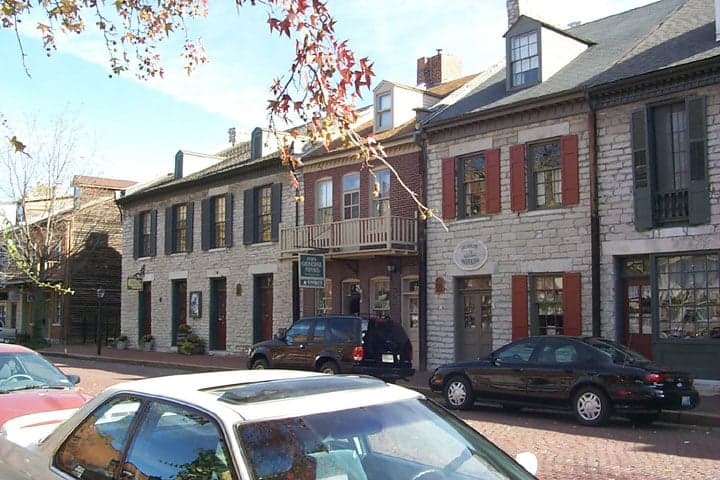
Photo: Wikipedia
Strategic Assessment of St Charles, MO
Meaningful friction. Expect exposure to either population pressure, blast zones, or natural disaster risk. Consider buying a retreat property.
What does the Strategic Assessment tell us?
Our Strategic Assessment grades tactical survivability of an area. Major population centers, military targets, fallout zones, natural disasters, and border exposure all drive risk — lower exposure means a more defensible position in a crisis.
This is heavily inspired by Joel Skousen's Strategic Relocation book. Highly recommended you checkout the book ($)What does this tell us?
Our Strategic Assessment grades tactical survivability of an area. Major population centers, military targets, fallout zones, natural disasters, and border exposure all drive risk — lower exposure means a more defensible position in a crisis.
This is heavily inspired by Joel Skousen's Strategic Relocation book. Highly recommended you checkout the book ($)Strategic Pillars

Key Distances
Regional Safe Places
Below is our recommended "safe zones" in Missouri and the surrounding area based on our strategic heuristics. For most people, it's unrealistic to live in a “safe zone” full-time due to work, family or other personal reasons. They tend to be more rural. However, many of these areas are perfect for second homes and retreat properties that double as a vacation home or even a short-term rental.


Important Note: For informational purposes only. This does not mean nothing bad ever happens in the green zones. Please use common sense. This is based on public data and modeled with AI. We tried to take a conservative approach but mistakes happen. We update this regularly as new information becomes available.
Solar Generator Recommendations
Backup power matters more here than in safer locations. We've picked three solar generators across budgets and capacity tiers — start with the budget unit if you only need a few essentials, or step up if you want to run a fridge and HVAC for days at a time.

Jackery Portable Power Station Explorer 300
Budget OptionPower on the Go: Weighing only 11 lbs, it's convenient to set up and store with book-sized foldable solar panels

BLUETTI Portable Power Station AC180
Designed for both indoor and outdoor scenarios, AC180 is highly capable as it has a robost capacity and continuous output power.

EF ECOFLOW DELTA Pro Ultra Power Station
Upgraded PickEcoFlow DELTA Pro Ultra is a whole-home energy system designed to grow with your family. Integrated with the Smart Home Panel 2, it scales to meet your evolving energy needs — keeping your home powered, intelligent, and secure through every stage of life.
We earn a commission, at no additional cost to you.
Strategic Assessment Analysis
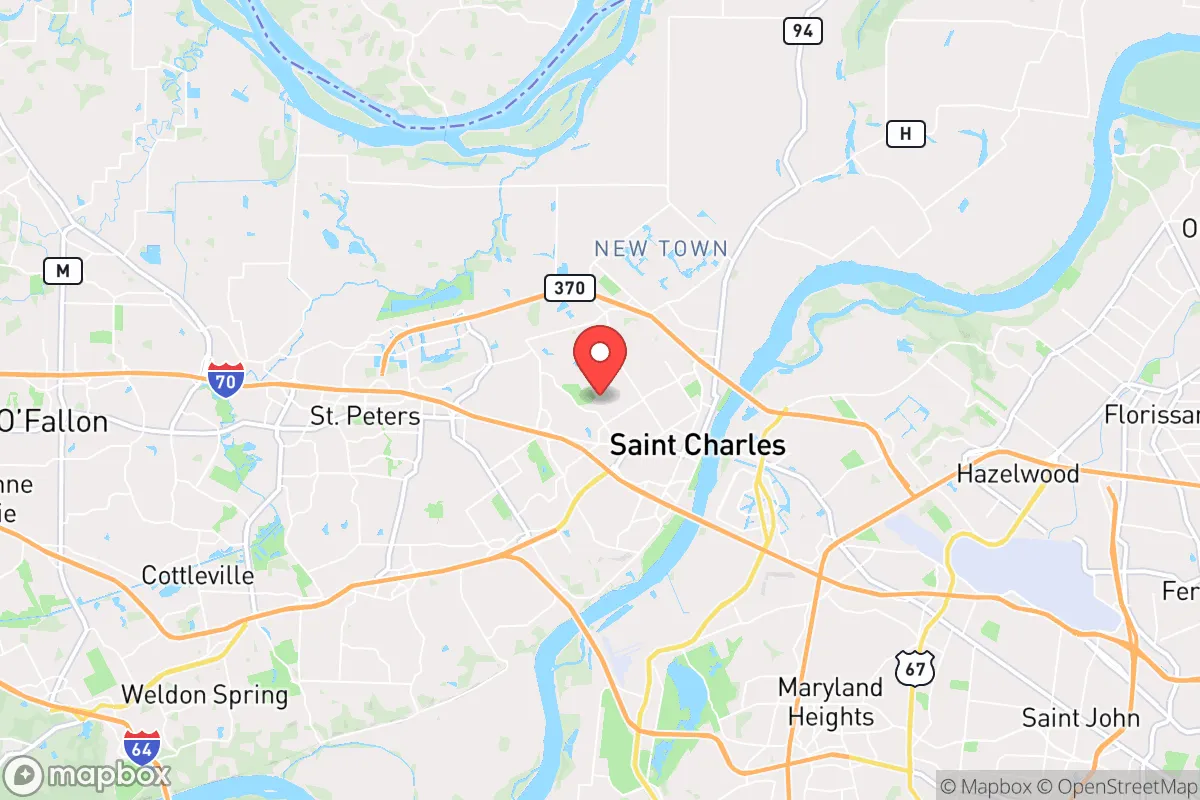
St. Charles, Missouri, offers a strategic sweet spot for those prioritizing resilience: it sits far enough from the immediate blast zones of major targets to avoid the worst of a fallout event, yet close enough to a major river and interstate network to support long-term survival logistics. The city’s position along the Missouri River, combined with its status as a historic gateway to the West, gives it a natural buffer against the chaos that would engulf St. Louis proper—about 20 miles east—while still providing access to the region’s agricultural and industrial resources. For a relocator thinking in terms of decades, not just next year, St. Charles represents a defensible, resource-rich anchor point in the Midwest’s “flyover” zone, where population density drops and self-sufficiency becomes more achievable.
Geographic position and natural advantages for long-term survival
St. Charles sits at the confluence of the Missouri and Mississippi Rivers, a geographic fact that cuts both ways. On the plus side, this means abundant surface water—critical for any grid-down scenario—and fertile floodplain soil that can support serious gardening or small-scale farming. The surrounding area, including the Missouri River hills and the rolling terrain of St. Charles County, offers natural defensibility: elevated ground north and west of the city provides vantage points and limits the spread of ground-level contamination. The city’s location along Interstate 70 and Highway 364 also gives you multiple egress routes west toward the Ozarks or north toward Iowa, both of which are lower-risk zones in a national crisis. For a prepper, the key advantage here is that St. Charles is not a primary target—no major military bases, no nuclear power plants within 30 miles, and no major government command centers. The nearest high-value target is the St. Louis metro area, which includes Lambert International Airport and the Arch—both symbolic but not likely to draw a first-strike warhead. That puts St. Charles in a “gray zone” where you’re close enough to benefit from regional infrastructure but far enough to avoid the immediate fallout.
Risks, exposures, and proximity to fallout-relevant landmarks
The biggest risk for St. Charles is its proximity to St. Louis, which is a major transportation and industrial hub. In a mass-casualty event—whether from a pandemic, civil unrest, or a limited nuclear exchange—St. Louis would become a dead zone of panic, looting, and radiation. St. Charles sits just 20 miles upriver, meaning fallout from a ground burst on St. Louis could drift northwest, depending on wind patterns. The Missouri River itself is a double-edged sword: it provides water but also acts as a vector for contamination and refugees fleeing the city. The nearby Callaway Nuclear Plant, about 50 miles west, is another concern—though it’s far enough that a meltdown wouldn’t directly threaten St. Charles, prevailing winds could carry radioactive particles into the area. Additionally, the city’s position along the Mississippi River makes it a natural choke point for barge traffic and rail lines, which could become targets for sabotage or collateral damage in a broader conflict. For a conservative relocator, the calculus is this: St. Charles is not a safe haven, but it’s a defensible staging ground. You’ll need to plan for a 50-mile buffer zone to the east and south, and you’ll want to stockpile potassium iodide and water filtration systems rated for heavy metals and radionuclides.
Practical resilience for a relocator: food, water, energy, and defensibility
St. Charles’s practical resilience hinges on its agricultural hinterland and its relatively low population density compared to the inner suburbs. The city itself has about 70,000 residents, but the surrounding county is still dotted with farms, orchards, and livestock operations. That means local food production is viable—you can buy land within 15 minutes of downtown for under $10,000 an acre, and the growing season runs from April to October. Water is the strongest suit: the Missouri River is a reliable source, but you’ll need a hand pump or solar-powered well because municipal water treatment will fail in a prolonged grid-down scenario. Energy-wise, St. Charles is served by Ameren Missouri, which relies heavily on coal and natural gas—both vulnerable to supply chain disruptions. Solar is a smart investment here, as the region gets about 200 sunny days per year, enough to run a modest off-grid setup. Defensibility is mixed: the city’s layout is suburban sprawl, with cul-de-sacs and strip malls that make it hard to secure a perimeter. But the older neighborhoods near the historic Main Street district have narrower streets and brick buildings that could be fortified. The real play is to buy property on the western edge of the county, near the Missouri River bluffs, where you have natural cover and line-of-sight advantages. For a single individual or a family, the key is to establish a network of like-minded neighbors—St. Charles has a strong gun culture (Missouri is a constitutional carry state) and a growing number of homesteading groups, which makes mutual aid a realistic option.
The overall strategic picture for St. Charles is one of calculated risk. It’s not a remote bunker in the mountains, but it’s not a death trap like downtown St. Louis either. For a conservative relocator who wants to stay within striking distance of Midwest infrastructure while maintaining a realistic escape route, St. Charles offers a workable balance. The city’s history as a frontier settlement—Lewis and Clark launched from here—is a reminder that this area has always been a launching point for people heading into uncertainty. If you’re willing to invest in off-grid water, solar, and a solid defensive plan, St. Charles can serve as a base camp for the next decade. Just don’t expect to ride out a major event without getting your hands dirty. The soil is good, the river is close, and the neighbors are armed. That’s about as much as you can ask for in 2026.

* Values derived from national, state, county, city and local statistics and may differ in a specific area. Last updated: 2026-04-30T02:24:07.000Z
Narrative content on this page is AI-generated and may contain mistakes. Verify any details that matter before acting on them.
ReloMaps may earn a commission from affiliate links at no extra cost to you.

