Photo: Wikipedia
Demographics of St Cloud, MN
Affluence Level in St Cloud, MN
A below-average socioeconomic profile. Incomes, home values, and educational attainment trail the U.S., with higher poverty and unemployment.
People of St Cloud, MN
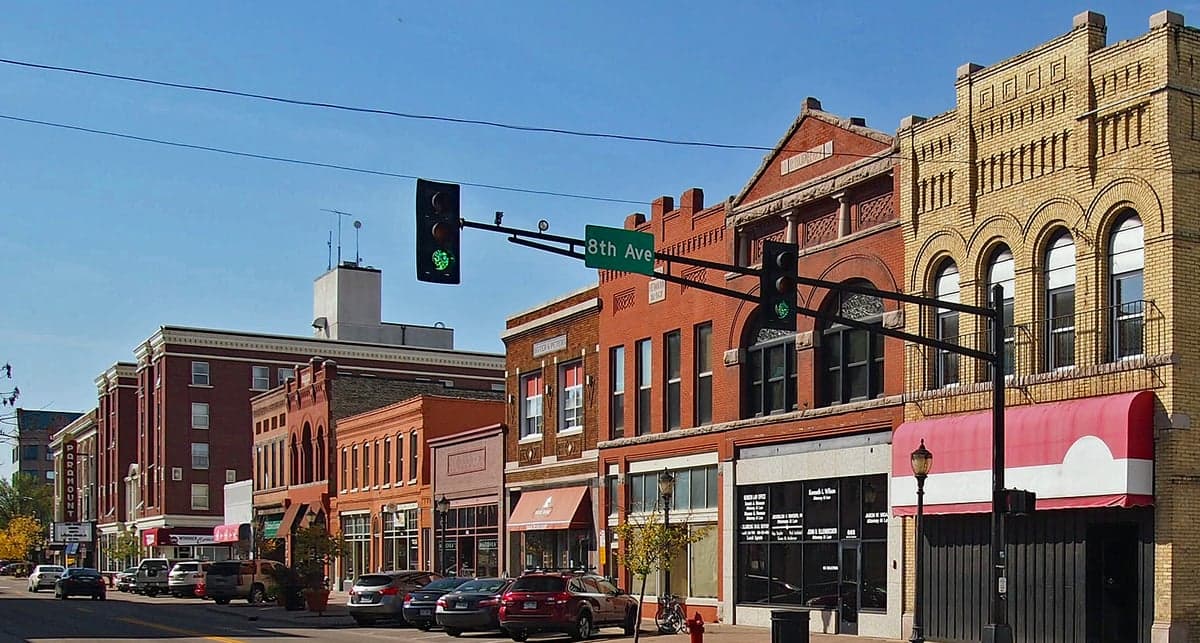
The people of St. Cloud, Minnesota, today number 69,926, forming a community that is notably more diverse than the surrounding region, with a white population of 67.0% and a significant Black population of 17.3%. The city carries a distinct character as a regional hub for healthcare, education, and manufacturing, with a college-educated rate of 29.4% that reflects the influence of St. Cloud State University. Its identity is shaped by a mix of long-standing German and Scandinavian roots, a growing Somali and East African community, and a smaller but established Southeast Asian population, creating a city that is both culturally traditional and visibly changing.
How the city was settled and grew
St. Cloud’s original population was drawn by the promise of the lumber and granite industries in the mid-19th century. The city was founded in 1856 at a Mississippi River crossing, and the first major wave of settlers were Yankee entrepreneurs and German immigrants who built the early mills and quarries. These groups established the Southside Neighborhood, where many of the original wood-frame homes still stand, and the Westside, which became the heart of the German Catholic community centered around St. Mary’s Cathedral. A second wave of Scandinavian immigrants—primarily Swedes and Norwegians—arrived in the 1880s and 1890s, settling in the Eastside along the river and working in the granite sheds. By 1900, the city was overwhelmingly white and northern European, with a population of about 8,000. The railroad and the establishment of the state teachers college (now St. Cloud State) in 1869 solidified the city’s role as a commercial and educational center for central Minnesota.
Modern era (post-1965)
The post-1965 era brought the most significant demographic shifts. The Immigration and Nationality Act of 1965 opened doors for new groups, but the first major non-European arrivals were Hmong refugees from Laos, who began resettling in St. Cloud in the late 1970s and 1980s. They concentrated in the Pantown neighborhood, an older area near the university that offered affordable housing, and established a small but visible East/Southeast Asian community that now makes up 3.2% of the population. The most transformative wave began in the mid-1990s, when Somali refugees fleeing civil war started arriving through secondary migration from the Twin Cities. They settled heavily in the Lake George area and the Northside, where rental properties and social services were accessible. By 2020, the Black population—overwhelmingly Somali and other East African groups—had grown to 17.3%, making St. Cloud one of the most diverse cities in greater Minnesota. The Hispanic population, at 5.5%, grew more gradually, with Mexican and Central American families moving into the Midtown corridor for work in manufacturing and food processing. The Indian subcontinent population (1.1%) is a smaller, more recent addition, largely tied to professional jobs at CentraCare Health and St. Cloud State.
The future
St. Cloud’s population is heading toward greater diversity, but the trend is not uniform across the city. The white population, while still the majority at 67.0%, is aging and declining in the core neighborhoods, while the Somali and East African community is young and growing, with higher birth rates and continued secondary migration from the Twin Cities. The East/Southeast Asian community appears to be plateauing, with younger generations assimilating and moving to suburban areas like Sauk Rapids and Waite Park. The Hispanic population is growing steadily but slowly, driven by labor demand in the service and construction sectors. The city is not homogenizing; rather, it is tribalizing into distinct enclaves. The Westside and Southside remain overwhelmingly white and older, while the Northside and Lake George area are becoming predominantly Somali and Black. This spatial separation is reinforced by school choice patterns and housing market dynamics. Over the next 10-20 years, St. Cloud will likely become a majority-minority city, with the white share dropping below 50% by 2040 if current trends hold. The foreign-born share, currently 5.2%, is expected to rise, though the rate of growth may slow if national immigration policy tightens.
For someone moving to St. Cloud now, the city offers a choice of distinct communities. The Westside and Southside provide a traditional, largely white, middle-class environment with strong Catholic and Lutheran roots. The Northside and Lake George area offer a vibrant, family-oriented East African community with growing businesses and mosques. The Pantown and Midtown areas are more mixed and transitional, with a younger, more transient population. The city is becoming a place where demographic change is visible and sometimes contested, but it remains a functional regional hub with a stable economy and a cost of living below the national average. New residents should expect a community that is both welcoming and divided, where the future is being written in real time.

* Values derived from national, state, county, city and local statistics and may differ in a specific area. Last updated: 2026-04-24T11:42:43.000Z
Narrative content on this page is AI-generated and may contain mistakes. Verify any details that matter before acting on them.
ReloMaps may earn a commission from affiliate links at no extra cost to you.

