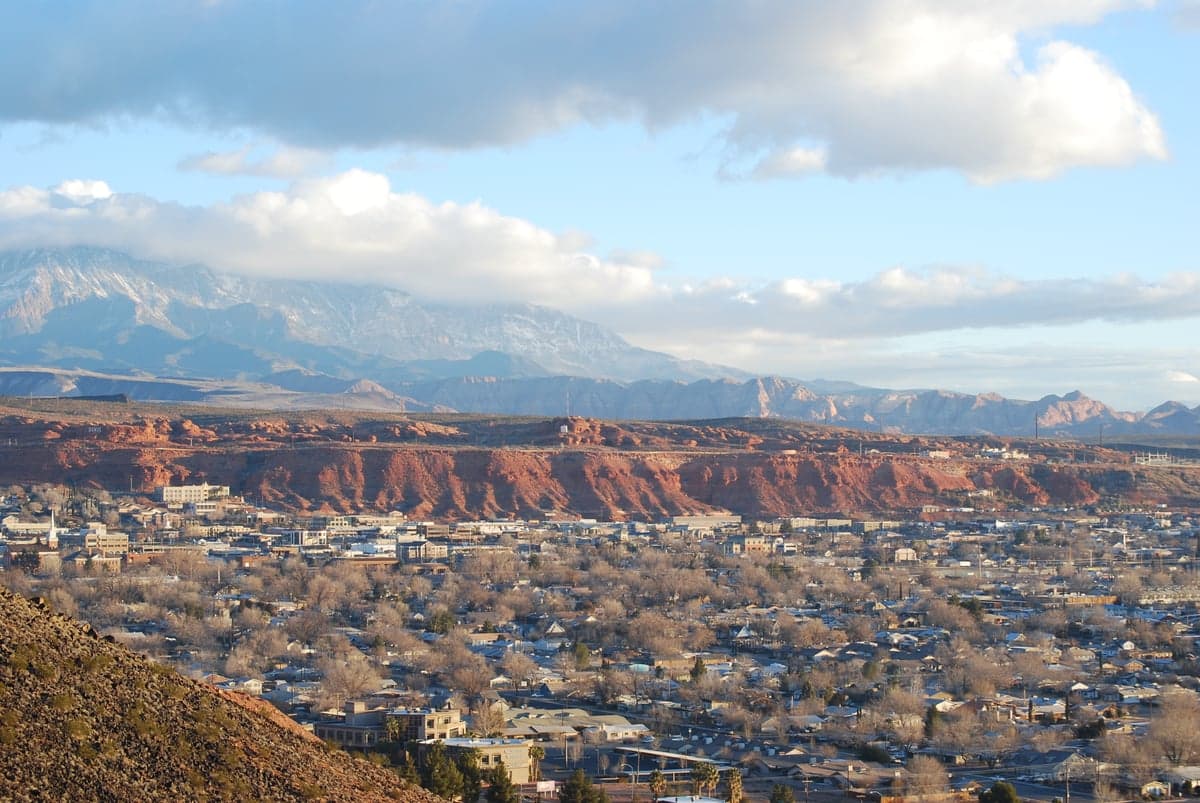
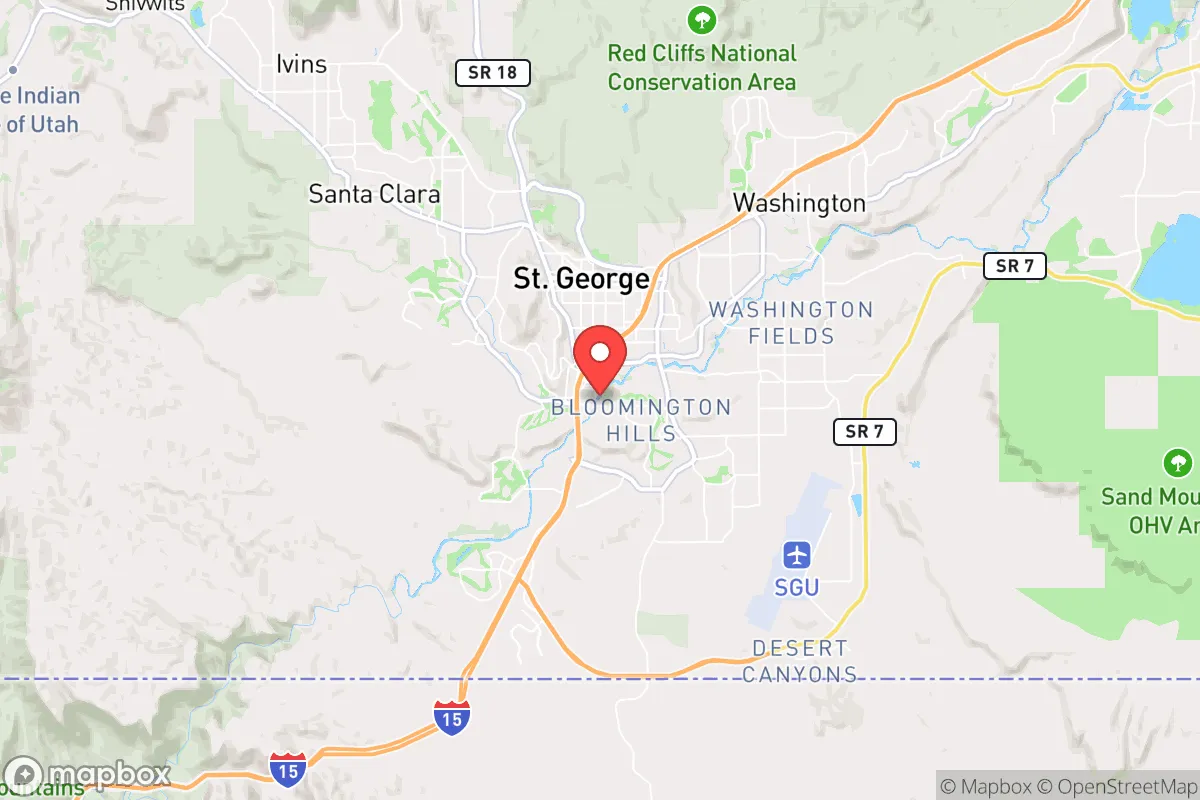
Photo: Wikipedia
Demographics of St. George, UT
Affluence Level in St. George, UT
A middle-class area roughly in line with national averages across income, home values, education, and employment.
People of St. George, UT
The people of St. George, Utah, today number roughly 99,184, forming a predominantly white (80.7%) and politically conservative community with a notably low foreign-born population of just 4.7%. The city is characterized by a strong Latter-day Saint (Mormon) cultural influence, a rapidly growing retiree and remote-worker base drawn to the red-rock landscape, and a Hispanic minority of 12.7% that is the city’s largest and fastest-growing non-white group. With 34.1% of adults holding a college degree, St. George is more educated than the national average but remains a family-oriented, suburban-style city where religious affiliation and outdoor recreation define daily life.
How the city was settled and grew
St. George was founded in 1861 as a cotton-growing mission for the Church of Jesus Christ of Latter-day Saints, settled by roughly 300 Mormon families sent by Brigham Young to establish a warm-climate agricultural outpost. These original settlers—largely of English and Scandinavian descent—built the town around the St. George Tabernacle and the Ancestor Square district, which remains the historic core. The early economy relied on cotton, grapes, and later mining, but the city remained small and isolated through the early 20th century, reaching only about 5,000 residents by 1950. The Bloomington Hills neighborhood, developed in the 1960s, was one of the first planned subdivisions to absorb the post-war wave of Mormon families migrating from other parts of Utah and Idaho, drawn by the mild winters and expanding Dixie College (now Utah Tech University).
Modern era (post-1965)
After the 1965 Hart-Cellar Act, St. George saw minimal direct immigration—its foreign-born share remains under 5%—but the city experienced explosive domestic in-migration starting in the 1980s, driven by retirees from California and the Pacific Northwest seeking lower costs and warmer weather. This wave settled heavily in the SunRiver and Green Valley active-adult communities, which are now predominantly white and over-55. The Hispanic population, which grew from negligible to 12.7% by 2020, arrived primarily as labor for construction and hospitality during the 1990s and 2000s boom, concentrating in the Dixie Downs and Washington Fields neighborhoods south of the city center. East/Southeast Asian residents (1.1%) are a small but visible presence, many working in healthcare and education, with a cluster near the Utah Tech University campus. The Black population (0.5%) and Indian-subcontinent population (0.0%) remain statistically negligible, reflecting the city’s limited draw for these groups compared to larger Western metros.
The future
St. George’s population is projected to exceed 130,000 by 2035, driven by continued domestic migration from California, Arizona, and Nevada—a trend that is likely to reinforce the city’s white, conservative, and LDS character rather than diversify it. The Hispanic share is expected to grow modestly, possibly reaching 15-18% by 2040, as second-generation families remain in the area and new construction labor continues to attract immigrants. However, the city is not tribalizing into distinct ethnic enclaves; instead, neighborhoods like Desert Canyons and Little Valley are absorbing new arrivals of all backgrounds into relatively integrated, master-planned subdivisions. The foreign-born share will likely stay below 8%, as high housing costs (median home price over $500,000) and a service-oriented economy limit the pull for low-wage immigrants. The most significant demographic shift will be the aging of the population: the 65+ cohort, already over 20%, will grow as retiree in-migration continues, while the under-18 share shrinks.
For a conservative-leaning individual or family considering relocation, St. George is becoming a more expensive but still culturally homogeneous city where growth is driven by domestic retirees and remote workers, not international immigration. The city’s identity as a safe, religious, and outdoor-oriented community is likely to persist, with the Hispanic minority slowly integrating into the broader social fabric rather than forming separate enclaves. New arrivals should expect a place where the population is getting older, whiter, and more affluent, but where the foundational LDS culture remains the dominant social and political force.

* Values derived from national, state, county, city and local statistics and may differ in a specific area. Last updated: 2026-04-22T01:36:39.000Z
Narrative content on this page is AI-generated and may contain mistakes. Verify any details that matter before acting on them.
ReloMaps may earn a commission from affiliate links at no extra cost to you.

