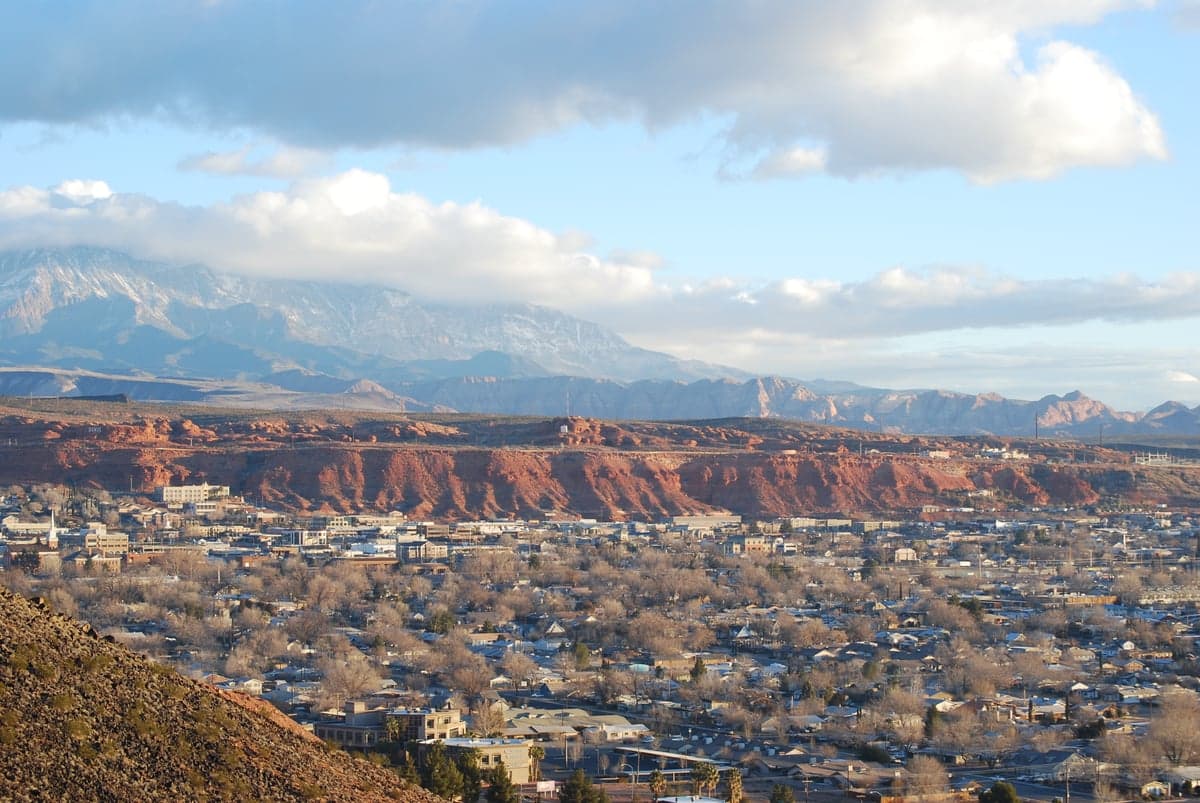
Photo: Wikipedia
Personal Sovereignty in St. George, UT
Viable for self-reliance. Generally workable, though some barriers may limit total independence.
What does Personal Sovereignty tell us?
Personal Sovereignty measures your capacity for self-reliance and independence with minimal government friction. Higher scores mean fewer barriers between you and the way you want to live... but it assumes you have the space you need and good neighbors.
What does this tell us?
Personal Sovereignty measures your capacity for self-reliance and independence with minimal government friction. Higher scores mean fewer barriers between you and the way you want to live... but it assumes you have the space you need and good neighbors.
State Policy
Energy independence: Self-sufficient (80% of energy produced in-state)
Personal Liberty
Homesteading

Personal Liberty Analysis
St. George, Utah offers a notably high degree of personal sovereignty compared to most of the American West, driven by a state-level legal framework that prioritizes limited government, property rights, and individual self-determination. For those concerned with preserving autonomy against federal overreach or cultural erosion, this region provides a practical environment where the default posture of local and state government is non-interference. The combination of a light tax burden, permissive gun laws, and a culture that still values self-reliance makes it a serious consideration for preppers, homesteaders, and families seeking to insulate themselves from broader societal instability.
Tax burden and regulatory posture for individuals and families
Utah’s tax structure is deliberately designed to minimize the state’s claim on your income and property, which directly supports personal financial sovereignty. The state levies a flat 4.85% individual income tax on all earnings, with no progressive brackets that penalize higher earners or small business owners. Property taxes in Washington County are among the lowest in the state, with effective rates typically around 0.5% to 0.7% of assessed value, and the state offers a generous homestead exemption that shields a portion of primary residence value from taxation. There is no state-level estate or inheritance tax, meaning wealth you build can pass to heirs without additional government confiscation. On the regulatory side, Utah has a right-to-work law, no state-level occupational licensing for many trades, and a general legislative culture that resists adopting federal or California-style environmental and land-use mandates. For a survivalist mindset, this means fewer bureaucratic hurdles to building a workshop, storing supplies, or running a home-based business—activities that in other states would trigger inspections, permits, or zoning complaints.
Self-defense rights and gun law specifics in Utah
Utah is a constitutional carry state, meaning any law-abiding adult 21 or older can carry a concealed firearm without a permit—no training course, background check beyond the purchase, or government permission slip required. This is a foundational liberty for those who view self-defense as a natural right, not a privilege. The state also has preemption laws that prevent cities like St. George from enacting their own gun bans or magazine restrictions, so local ordinances cannot undermine state-level protections. Stand-your-ground laws are in effect, with no duty to retreat in any place where you have a legal right to be. For preppers, this extends to long guns and ammunition: there are no state-level restrictions on magazine capacity, no assault weapon bans, and no waiting periods beyond the federal NICS check. The St. George area also has multiple gun ranges and a strong culture of firearms training, making it easy to maintain proficiency. The only notable limitation is that Utah does require a permit for carrying a loaded firearm in a vehicle without a concealed carry permit, but the permit itself is shall-issue and relatively inexpensive.
Self-reliance and homesteading viability: lot sizes, zoning, and off-grid feasibility
St. George’s rapid growth has pushed residential development toward smaller lots in subdivisions, but the surrounding unincorporated areas of Washington County still offer genuine homesteading opportunities. Zoning in the county allows for residential lots as small as 0.5 acres in some rural zones, but parcels of 1 to 5 acres are common and affordable—often under $50,000 per acre for raw land. The city itself has relatively strict water-use regulations due to the desert climate, but county land is less restrictive: you can install rainwater catchment systems, solar panels, and even small-scale livestock (chickens, goats, rabbits) on parcels over one acre without special permits. Off-grid living is legally feasible in the county, though you must comply with basic septic and well-drilling requirements. The state has a strong right-to-farm law that protects agricultural activities from nuisance lawsuits, which is critical if you plan to raise animals or grow food. For preppers, the major constraint is water—the region averages only 8 inches of rain annually, so a reliable well or a large cistern system is essential. Solar is excellent, with over 300 sunny days per year, making energy independence straightforward.
Personal liberties: parental rights, medical autonomy, speech, and property
Utah has some of the strongest parental rights laws in the nation, which is a key consideration for families concerned about government overreach in education and healthcare. The state’s Parents’ Bill of Rights (HB 243) explicitly affirms that parents have the fundamental right to direct their children’s upbringing, education, and medical care, and it requires schools to obtain parental consent before administering surveys or providing certain health services. Medical autonomy is also relatively strong: Utah does not have a state-level vaccine mandate for adults, and while school immunization requirements exist, they include broad philosophical and religious exemptions. On free speech, the state has no hate speech laws that criminalize political or religious expression, and the city of St. George has a generally conservative culture that respects First Amendment rights. Property rights are protected by Utah’s strict eminent domain laws, which limit government seizure of private land for economic development. For preppers, this means you can store supplies, build structures, and live according to your own values without fear of local government inventing new restrictions.
Overall, St. George and its surrounding county offer a level of personal sovereignty that is rare in the modern United States. The combination of low taxes, constitutional carry, strong parental rights, and a regulatory environment that still permits self-reliance makes it a viable destination for those seeking to opt out of the growing surveillance and control culture found in coastal states. While no location is a perfect fortress against federal overreach or societal collapse, Washington County’s legal and cultural foundations are aligned with the principles of individual liberty and preparedness. For a conservative-leaning individual or family looking to build a life with maximum personal autonomy, St. George ranks among the top options in the Intermountain West.

* Values derived from national, state, county, city and local statistics and may differ in a specific area. Last updated: 2026-04-22T01:36:39.000Z
Narrative content on this page is AI-generated and may contain mistakes. Verify any details that matter before acting on them.
ReloMaps may earn a commission from affiliate links at no extra cost to you.

