 Popular
Photo: Wikipedia
Demographics of St. Louis, MO
Affluence Level in St. Louis, MO
A below-average socioeconomic profile. Incomes, home values, and educational attainment trail the U.S., with higher poverty and unemployment.
People of St. Louis, MO
The people of St. Louis, Missouri today number 293,109, making it a mid-sized city with a distinctive biracial character: 44.4% White and 42.9% Black, with a small but growing Hispanic population at 5.1% and East/Southeast Asian communities at 2.5%. The city is notably less diverse than the national average in foreign-born residents, with only 3.9% born outside the United States, and it has a higher-than-average college attainment rate of 40.2%. St. Louisans are known for a strong sense of neighborhood identity, a Midwestern reserve mixed with a fierce civic pride, and a population that has been steadily declining for decades, though the rate of loss has slowed in recent years.
How the city was settled and grew
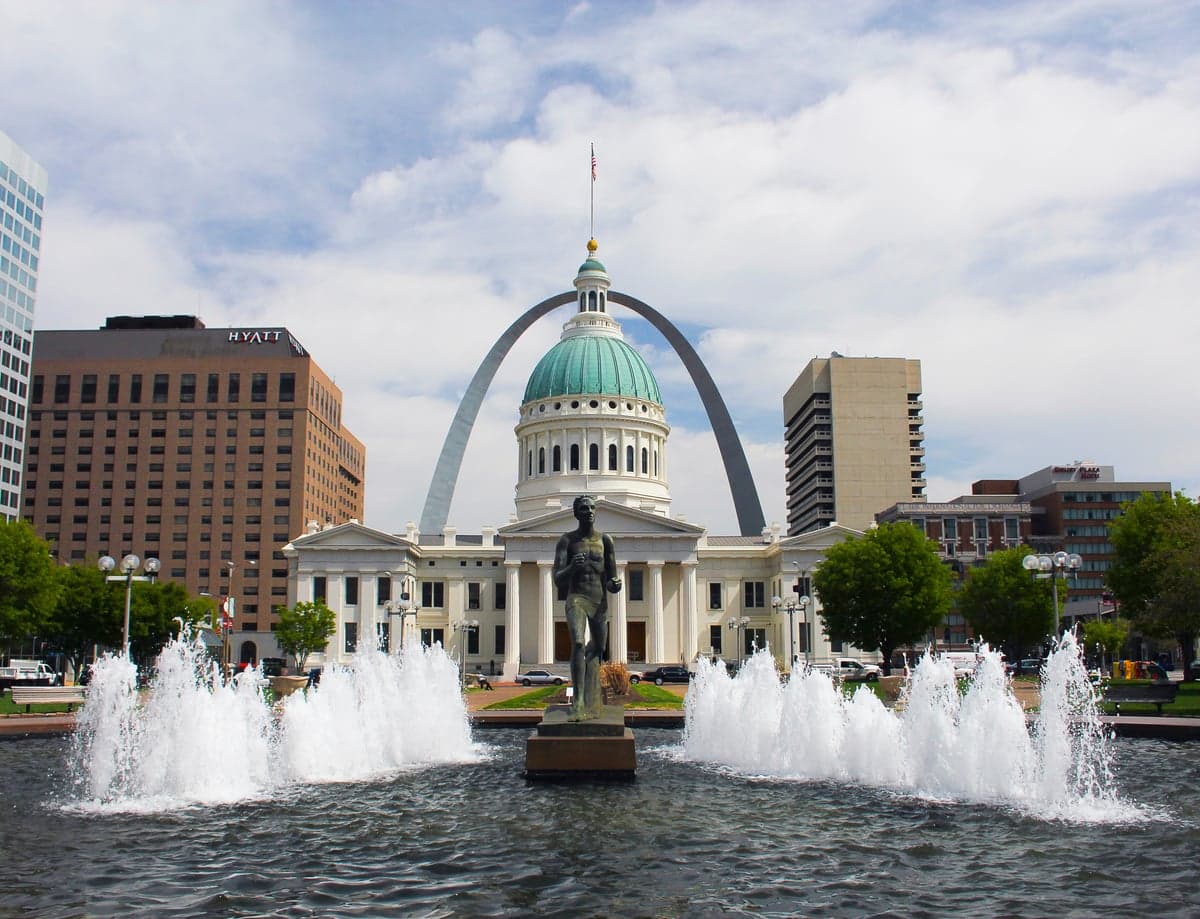
St. Louis was founded in 1764 by French fur traders Pierre Laclède and Auguste Chouteau, who established a trading post on the west bank of the Mississippi River. The city’s early population was overwhelmingly French Creole, concentrated in the original settlement around what is now the Laclede’s Landing district and the riverfront. After the Louisiana Purchase in 1803, American settlers from the Upper South—primarily Kentucky, Tennessee, and Virginia—flooded in, drawn by land speculation and the city’s role as the gateway to the West. By the 1840s, massive waves of German and Irish immigrants arrived, fleeing famine and political upheaval. The Germans settled heavily in Soulard and South St. Louis, building breweries and Catholic parishes that still define those neighborhoods. The Irish concentrated in the Kerry Patch area near the riverfront and later in Dogtown. By 1900, St. Louis was the fourth-largest city in the United States, a manufacturing and railroad hub that attracted Southern Blacks during the Great Migration, who established communities in The Ville and Mill Creek Valley (the latter now largely demolished for urban renewal). The city’s peak population of 856,796 in 1950 was a mosaic of European ethnic enclaves and a growing Black middle class.
Modern era (post-1965)
After the 1965 Hart-Cellar Act, St. Louis did not see the large-scale immigration from Asia or Latin America that transformed other American cities. Instead, the post-1965 period was defined by rapid suburbanization and White flight. Between 1950 and 2020, the city lost two-thirds of its population, with White residents moving to St. Louis County and beyond. The Black population, which had been concentrated in North St. Louis neighborhoods like Fountain Park and Walnut Park, became the majority by the 1980s as Whites departed. The city’s foreign-born population remained low—3.9% today—with the largest immigrant groups being Bosnians (who arrived as refugees in the 1990s and settled in South St. Louis near Gravois Park), Mexicans (concentrated in Cherokee Street and Dutchtown), and a smaller East/Southeast Asian community (Vietnamese and Chinese) in the University City area just outside the city limits. The Indian-subcontinent population is tiny at 0.9%, mostly professionals in the medical and tech sectors, without a distinct ethnic enclave within the city. The modern era has seen a modest reversal of population loss since 2010, driven by young professionals and empty-nesters moving into Downtown West, Central West End, and Benton Park, but this influx has not yet offset the ongoing decline in North St. Louis.
The future
The population of St. Louis is heading toward a more polarized geography. The city is not homogenizing; rather, it is tribalizing into distinct zones: a growing, wealthier, and Whiter core (Downtown, Central Corridor, and South City) and a shrinking, poorer, and Blacker north side. The Hispanic population is the fastest-growing demographic, projected to reach 8-10% by 2040, driven by Mexican and Central American families settling in Dutchtown and Gravois Park. East/Southeast Asian communities are plateauing, with little new immigration, while the Indian-subcontinent population is likely to grow slowly as Washington University and BJC HealthCare recruit skilled workers. The overall population is expected to stabilize around 280,000-290,000 by 2035, as redevelopment in the core offsets continued losses in the north. For a newcomer, this means choosing a neighborhood matters more than ever: the city offers a vibrant, walkable urban experience in the Central Corridor, but large swaths of North St. Louis face depopulation and disinvestment.
St. Louis is becoming a smaller, more economically stratified city where opportunity is increasingly tied to geography. For someone moving in now, the city offers affordable housing, strong cultural institutions, and a tight-knit community feel, but the demographic trajectory points toward a continued concentration of resources in a few core neighborhoods while the north side struggles. The city’s future depends on whether it can attract and retain a more diverse immigrant population and reverse the long-term decline in its Black neighborhoods.

* Values derived from national, state, county, city and local statistics and may differ in a specific area. Last updated: 2026-04-22T01:27:35.000Z
Narrative content on this page is AI-generated and may contain mistakes. Verify any details that matter before acting on them.
ReloMaps may earn a commission from affiliate links at no extra cost to you.

