
Photo: Wikipedia
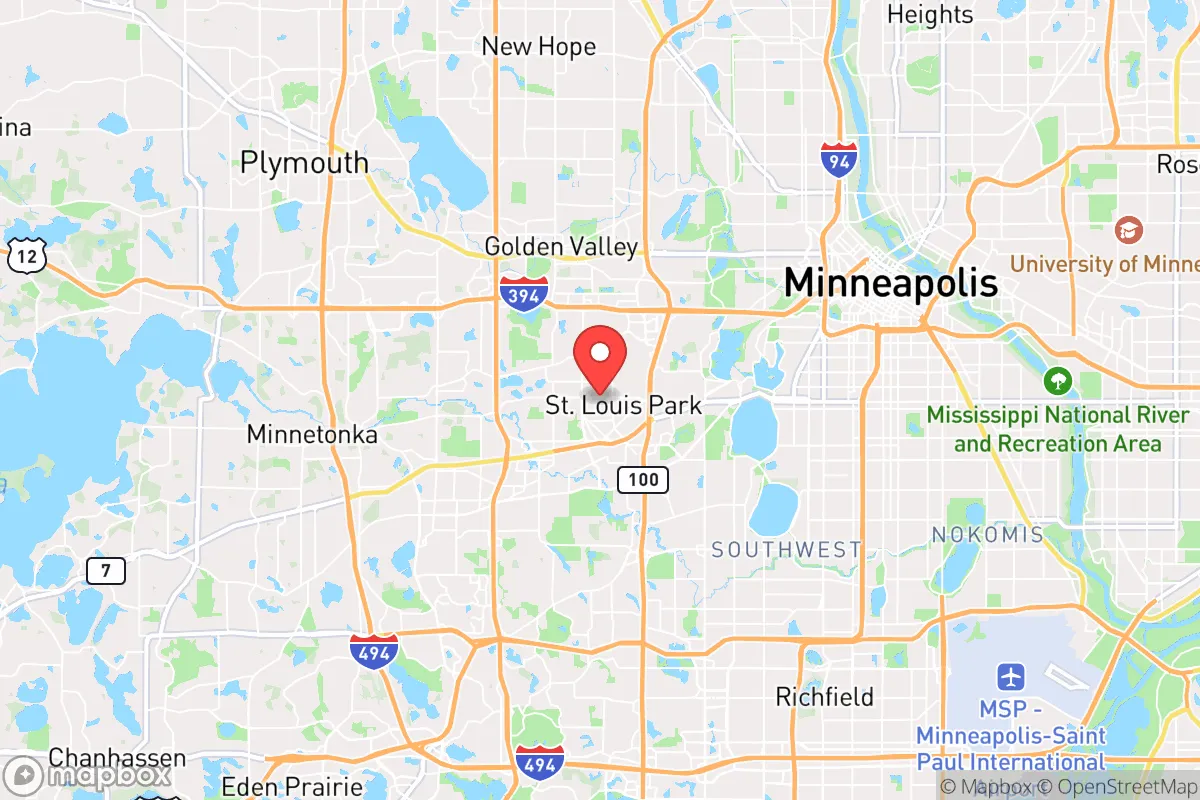
Personal Sovereignty in St Louis Park, MN
Viable for self-reliance. Generally workable, though some barriers may limit total independence.
What does Personal Sovereignty tell us?
Personal Sovereignty measures your capacity for self-reliance and independence with minimal government friction. Higher scores mean fewer barriers between you and the way you want to live... but it assumes you have the space you need and good neighbors.
What does this tell us?
Personal Sovereignty measures your capacity for self-reliance and independence with minimal government friction. Higher scores mean fewer barriers between you and the way you want to live... but it assumes you have the space you need and good neighbors.
State Policy
Energy independence: Importer (20% of energy produced in-state)
Personal Liberty
Homesteading

Personal Liberty Analysis
St. Louis Park, Minnesota, presents a complex picture for those prioritizing personal sovereignty, where a progressive state framework significantly constrains individual autonomy despite the city's own moderate-to-liberal local governance. As a first-ring suburb of Minneapolis, residents operate under Minnesota's increasingly assertive state-level policies that directly impact tax burden, self-defense rights, medical autonomy, and property freedom. For a conservative-leaning individual or family evaluating relocation through a survivalist or prepper lens, the sobering reality is that St. Louis Park sits within a state that has systematically reduced personal sovereignty across multiple domains since 2020, making it a location where strategic compliance and legal awareness are essential rather than a haven for unfettered liberty.
Tax burden and regulatory posture in Hennepin County
Minnesota's tax climate ranks among the most aggressive in the nation, and St. Louis Park residents bear the full weight of this system. The state imposes a progressive income tax with a top marginal rate of 9.85% on income over $190,000 (single filers), one of the highest in the country. Property taxes in St. Louis Park are substantial, with the effective rate hovering around 1.3% of assessed value, and Hennepin County adds its own levies for transit, parks, and social services. Sales tax in the city is 8.025%, combining the state's 6.875% rate with Hennepin County's 0.15% and local transit and special taxing districts. For a prepper mindset, the regulatory posture is equally concerning: Minnesota has a robust state building code, strict environmental regulations on land use, and a Department of Revenue that aggressively pursues tax compliance. The state's regulatory apparatus extends to vehicle emissions testing in the metro area, restrictions on well drilling and septic systems, and a complex permitting process for any significant property modification. While St. Louis Park itself has a relatively business-friendly zoning code compared to Minneapolis, the overarching state regulatory environment creates a high baseline of government involvement in daily economic decisions.
Self-defense and gun law specifics in Minnesota
For those prioritizing the right to keep and bear arms, Minnesota has moved decisively toward restriction in recent years, and St. Louis Park residents must navigate a challenging legal landscape. The state now requires a permit to purchase for handguns and assault-style rifles, with a 30-day waiting period for handgun purchases. Permit to carry (concealed carry) is shall-issue, meaning the sheriff must issue if statutory requirements are met, but the process includes a background check, training course, and a $100 fee. Crucially, Minnesota enacted a "red flag" law (Extreme Risk Protection Order) in 2023, allowing law enforcement or family members to petition a court to temporarily seize firearms from an individual deemed a risk. St. Louis Park has its own city ordinances that further restrict firearm possession in city parks and public buildings. The state also bans private transfers of firearms without a background check through a licensed dealer (universal background check law). For a survivalist, the practical implications are significant: magazine capacity is not restricted at the state level (as of 2026), but the legal infrastructure for firearm confiscation exists, and local law enforcement in Hennepin County has shown willingness to enforce these laws. Stand-your-ground doctrine does not exist in Minnesota; the state imposes a duty to retreat in public spaces before using deadly force, except within one's home.
Self-reliance and homesteading viability in a first-ring suburb
St. Louis Park's suburban density and zoning codes present substantial barriers to the self-reliant lifestyle that preppers often seek. Typical lot sizes in the city range from 6,000 to 10,000 square feet, with many homes on smaller parcels in the older neighborhoods near the Minneapolis border. The city's zoning code restricts accessory dwelling units (ADUs) to one per lot and imposes strict setback requirements, limiting the ability to build detached workshops, greenhouses, or storage structures. Raising livestock is heavily regulated: chickens are allowed only with a permit and strict coop requirements, and no roosters are permitted. Larger animals like goats, pigs, or cattle are outright prohibited. Gardening is permitted, but front-yard vegetable gardens may face HOA restrictions in some subdivisions. Off-grid feasibility is virtually nonexistent—the city requires connection to municipal water and sewer, and solar panel installation requires permits and interconnection agreements with Xcel Energy. Rainwater collection is legal but limited to 2,500 gallons of storage without a permit, and well drilling is prohibited within city limits. For those seeking true self-reliance, St. Louis Park functions as a bedroom community where dependence on municipal infrastructure and grocery stores is baked into the lifestyle. The nearest rural areas with larger parcels (5+ acres) are 30-45 minutes west in Carver or Wright counties, where zoning is more permissive and property taxes lower.
Personal liberties: parental rights, medical autonomy, speech, and property
On the spectrum of personal liberties, Minnesota's state-level policies create a mixed but generally restrictive environment for conservative values. Parental rights have been a flashpoint: the state passed a "trans refuge" law in 2023 that allows minors to receive gender-affirming care without parental consent in certain circumstances, and school districts in the metro area, including St. Louis Park Public Schools, have implemented policies that some parents view as undermining their authority. Medical autonomy is constrained by the state's vaccine mandates for school attendance (though exemptions exist) and the absence of a religious exemption for COVID-19 vaccine requirements in healthcare settings. Speech protections are constitutionally guaranteed, but the state has enacted campaign finance laws and social media regulations that some argue chill political expression. Property rights are significantly curtailed by Minnesota's robust eminent domain authority, environmental regulations on land use, and the Metropolitan Council's regional planning powers that can override local zoning decisions. For a conservative individual, the cumulative effect is a state apparatus that actively intervenes in family decisions, healthcare choices, and property use, with St. Louis Park's local government generally aligning with these progressive policies rather than resisting them.
In the broader context of personal sovereignty across the United States, St. Louis Park ranks as a location where individual autonomy is heavily mediated by government at both the state and local level. Compared to states like Texas, Florida, or South Dakota—where tax burdens are lower, gun rights are stronger, and parental rights are more explicitly protected—Minnesota represents a high-regulation environment. For the survivalist or prepper who values self-reliance, the city's infrastructure dependence, restrictive zoning, and progressive legal framework make it a challenging base of operations. The strategic calculation for a conservative individual or family is whether the trade-offs—proximity to employment, quality schools, and urban amenities—outweigh the significant constraints on personal freedom. For those unwilling to accept these limitations, the exurban and rural areas of western Minnesota or neighboring states like Wisconsin or South Dakota offer substantially greater sovereignty, though with corresponding trade-offs in access and community. St. Louis Park is a place to live within the system, not to build an independent life outside it.

* Values derived from national, state, county, city and local statistics and may differ in a specific area. Last updated: 2026-04-24T08:04:19.000Z
Narrative content on this page is AI-generated and may contain mistakes. Verify any details that matter before acting on them.
ReloMaps may earn a commission from affiliate links at no extra cost to you.

