
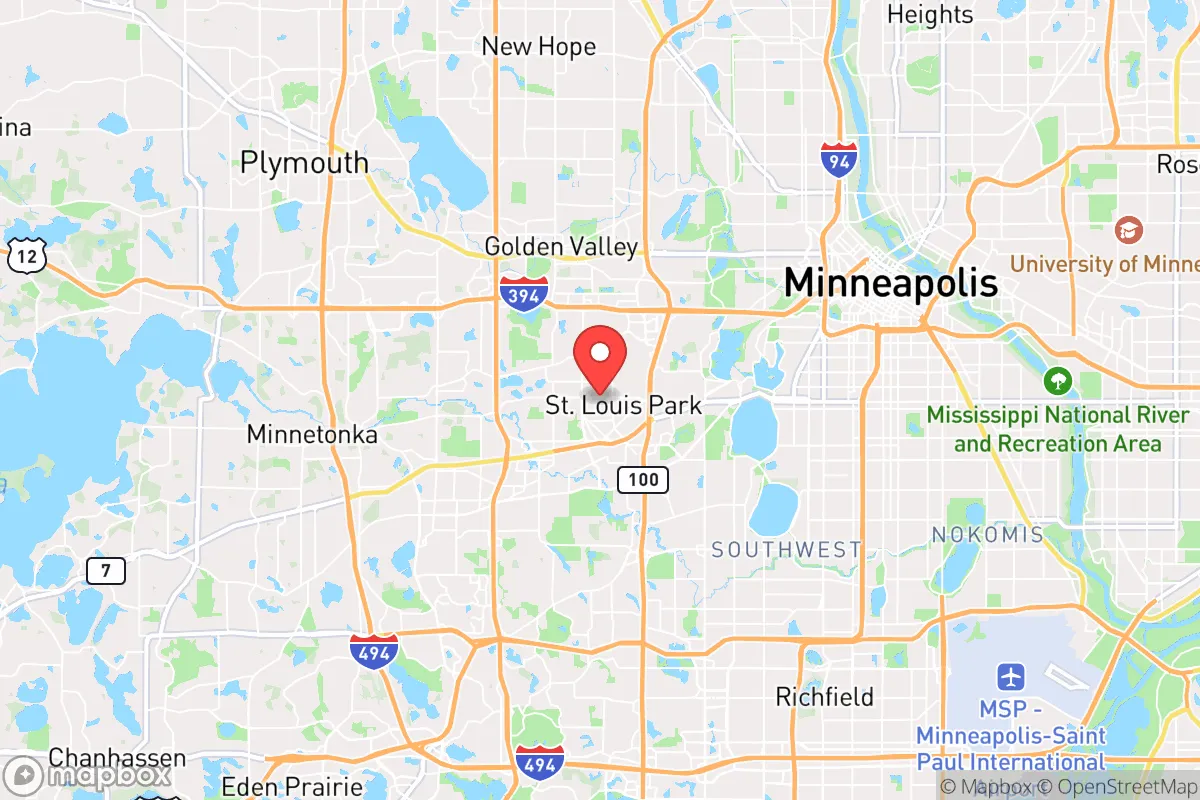
Photo: Wikipedia
Quality of Life in St Louis Park, MN
Above-average quality of iife. The area offers a reasonable cost of living, decent mobility, and a mix of neighborhood amenities.
What does Quality of Life tell us?
Quality of Life blends cost of living, nearby amenities, socioeconomic signals, and neighborhood character. City-level scores represent the whole municipality; individual neighborhoods can differ.
What does this tell us?
Quality of Life blends cost of living, nearby amenities, socioeconomic signals, and neighborhood character. City-level scores represent the whole municipality; individual neighborhoods can differ.
Cost of Living
35% above national average
The Real Cost of Living in St Louis Park, MN for 2026
| Tier | Individual | Family (4) |
|---|---|---|
| Survival | $25k | $48k |
| Comfortable | $72k | $106k |
| Luxury | $161k+ | $250k+ |
| Elite (Top 5%) | $190k+ | $294k+ |
94%
The Area Signal
A metric tracking the socioeconomic signals of the area.
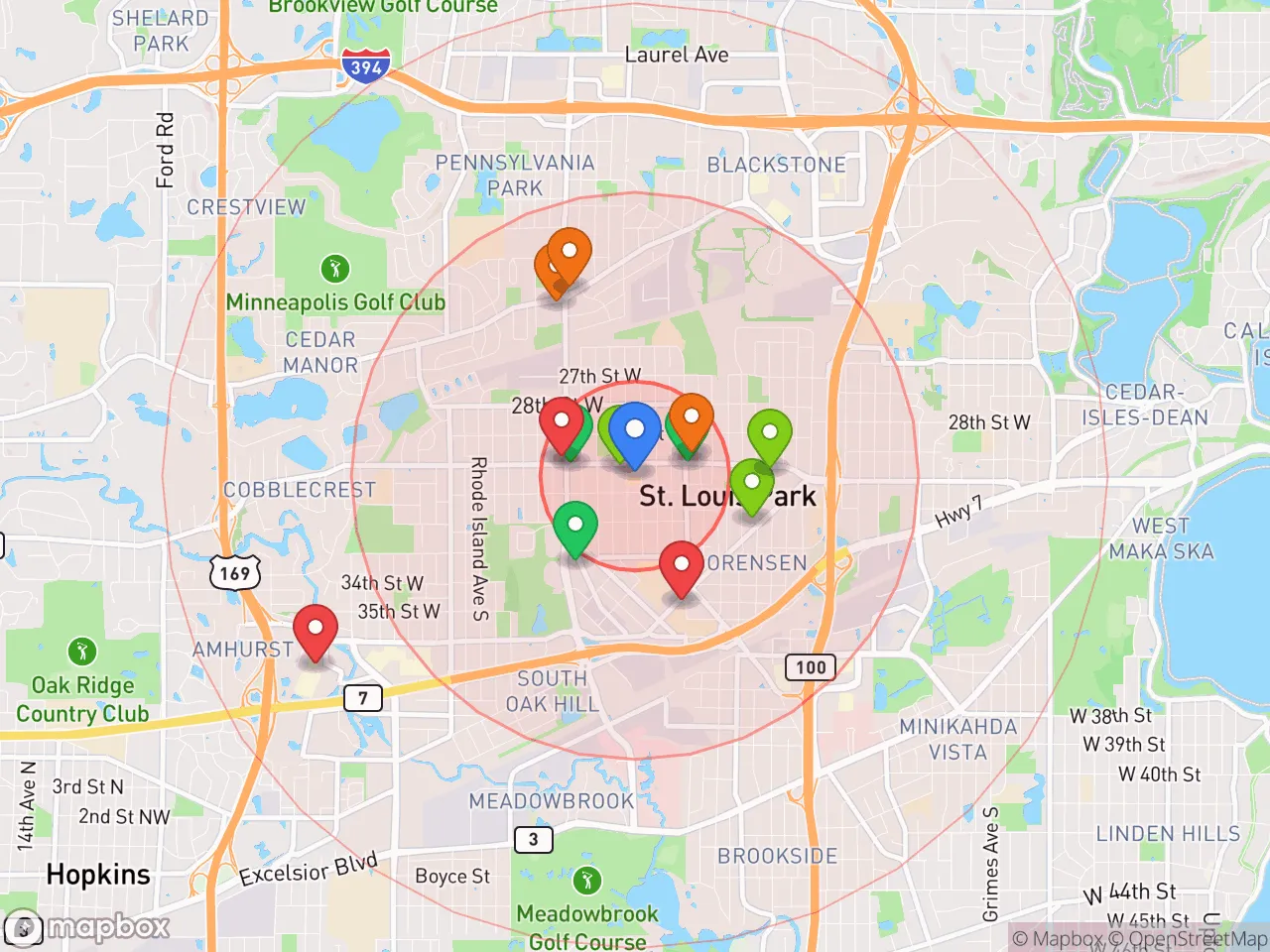
Hobbies
Explore the areaGroceries
5 within 10 miles
Gas
20 within 10 miles
Hospital
20 within 20 miles
Airport
JFK — John F. Kennedy Memorial
Post Office
USPS — Saint Louis Park, MN
Critical Amenities
Quality-of-Life Analysis
St. Louis Park is an affluent, inner-ring suburb of Minneapolis that attracts a mix of young professionals, growing families, and empty-nesters seeking a walkable, amenity-rich community without the high price tag of the city’s most exclusive neighborhoods. With a cost of living index of 135 (35% above the U.S. average), the area is notably more expensive than the national norm but remains a relative value compared to adjacent Edina and Wayzata, where home values routinely exceed $500,000. The population skews educated and upper-middle-class, with a median household income well above the state average, and the city’s compact geography—just over 10 square miles—fosters a dense, connected feel that blends suburban convenience with urban energy.
Cost of living, housing affordability, and how St. Louis Park compares to nearby suburbs
St. Louis Park’s cost of living index of 135 is driven primarily by housing, though it remains a more affordable entry point than its western neighbors. The median home value of $371,600 is roughly $100,000 less than in Edina and $200,000 less than in Wayzata, making it a popular compromise for buyers who want proximity to downtown Minneapolis (just 15 minutes east) without the premium of those elite suburbs. Median rent sits at $1,589, which is competitive for the region—comparable to Golden Valley but about $200 less per month than in uptown Minneapolis. The average commute of 20.5 minutes is a standout advantage: it’s shorter than the metro average of 26 minutes, thanks to the city’s location along Interstate 394 and the Southwest Light Rail Transit line (opening 2027), which will connect riders directly to downtown Minneapolis and Eden Prairie. Property taxes in St. Louis Park are moderate for Hennepin County, with an effective rate around 1.1%, though buyers should note that many homes in the city’s older housing stock (built largely in the 1950s and 1960s) may require updates that add to total cost.
What daily life is like: schools, parks, dining, and the local rhythm
Daily life in St. Louis Park revolves around its strong public school system (St. Louis Park Public Schools, rated above average by Niche, with a 14:1 student-teacher ratio) and an unusually dense concentration of parks and trails. The city maintains 42 parks, including the 100-acre Wolfe Park and the 3.5-mile Minnehaha Creek Trail that cuts through the heart of town, connecting residents to Lake Harriet and the Chain of Lakes. The retail and dining scene is anchored by the West End district, a mixed-use development with national chains (Whole Foods, REI) and local staples like Park Tavern, a historic bowling alley and restaurant that has operated since 1938. The city’s zoning is notably progressive: St. Louis Park was one of the first Minnesota suburbs to legalize accessory dwelling units (ADUs) and has actively redeveloped former industrial sites into mixed-income housing, including the 22-acre Excelsior & Grand area. For families, the rhythm is defined by strong youth sports leagues (hockey, soccer, and lacrosse are popular) and the proximity to the Minnesota Zoo and the Mall of America, both within a 20-minute drive. Commuters benefit from the city’s bus rapid transit (BRT) lines and the upcoming light rail, which will reduce car dependency for workers heading to downtown Minneapolis or the University of Minnesota.
St. Louis Park is best suited for professionals and families who want a walkable, amenity-dense suburb with a shorter commute and a lower price barrier than Edina or Wayzata, but who are willing to accept older housing stock and a less sprawling, more urban feel. Empty-nesters and downsizers are drawn to the city’s newer condos and townhomes near the West End, while young families appreciate the school system and the 20-minute access to downtown jobs. Those seeking large lots, quiet cul-de-sacs, or a truly rural atmosphere should look farther west to Medina or Orono; St. Louis Park’s strength is its density, convenience, and the sense of being part of a connected, active community rather than a detached suburb.

Crime in St Louis Park, MN
Generally safer than 62% of comparable U.S. locations.
Violent CrimeViolent Crime Analysis
Property CrimeProperty Crime Analysis
Crime Analysis
St. Louis Park, a first-ring suburb of Minneapolis, presents a mixed safety profile that warrants careful consideration. The city's violent crime rate of 222.8 incidents per 100,000 residents is notably lower than the national average, but its property crime rate of 1,417.9 per 100,000 exceeds both state and national benchmarks. Prospective residents should weigh these figures against the broader context of the Twin Cities metro area, where progressive criminal justice policies have drawn scrutiny for their impact on public safety.
Crime in context
St. Louis Park's violent crime rate sits well below the U.S. average of approximately 380 per 100,000, placing it in a safer tier for personal safety. However, the property crime rate is roughly 30% higher than the national average of about 1,100 per 100,000. This disparity reflects a regional pattern: the Minneapolis-St. Paul metro area, including its inner suburbs, has seen property crime rates climb since 2020, driven in part by policies that critics argue prioritize offender rehabilitation over deterrence. The Hennepin County Attorney's office, which prosecutes crimes in St. Louis Park, has implemented progressive charging guidelines, including reduced prosecution for certain theft and drug offenses. While these policies aim to reduce incarceration, they have been linked to higher recidivism and a perception that property crimes carry minimal consequences.
What residents experience
Daily life in St. Louis Park involves navigating a low risk of violent confrontation but a tangible threat to personal property. Car break-ins, package thefts, and bicycle thefts are common complaints, particularly near commercial corridors like Excelsior Boulevard and the West End shopping district. Residents report that police response times have lengthened in recent years, with the department prioritizing violent crimes over property offenses. The city's proximity to Minneapolis means that crime spillover is a real concern: auto theft rings and organized retail theft groups operating in the central city frequently target suburban parking lots. St. Louis Park's own police department has been understaffed since 2022, with officer numbers dropping 15% below authorized levels, which limits proactive patrols.
Neighborhood-level variation
Safety conditions vary significantly within St. Louis Park. The southwestern quadrant, near the Minnetonka border and around the Birch Island Lake area, sees the lowest crime rates, with violent crime nearly absent and property crime roughly half the city average. In contrast, the northeastern neighborhoods abutting Minneapolis—particularly around Highway 7 and Louisiana Avenue—experience higher rates of theft and vandalism. The area around the West End, a dense mixed-use development, accounts for a disproportionate share of property crime reports, including vehicle break-ins and shoplifting. Apartment complexes along Cedar Lake Road and the Beltline Boulevard corridor also report elevated incident rates. For families, the safest housing choices are in the southwestern single-family-home districts, while renters should scrutinize building security measures in the central and eastern zones. Overall, St. Louis Park requires a vigilant approach to property protection, even as violent crime remains relatively uncommon.
* Values derived from national, state, county, city and local statistics and may differ in a specific area. Last updated: 2026-04-24T08:04:19.000Z
Narrative content on this page is AI-generated and may contain mistakes. Verify any details that matter before acting on them.
ReloMaps may earn a commission from affiliate links at no extra cost to you.

