Political ClimatePolitical Climate in St Peters, MO
District shown is the primary district for this city’s centroid. Cities may span multiple districts.
Local Political AnalysisPolitical Analysis of St Peters, MO
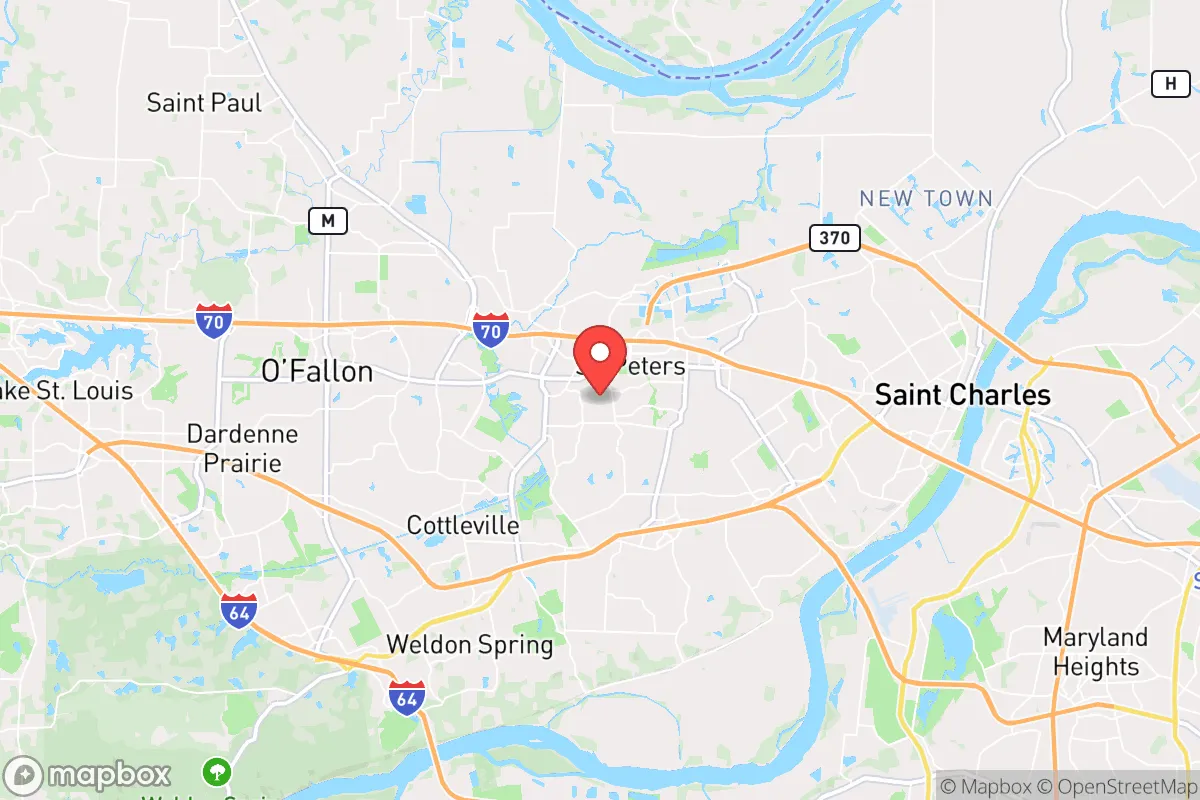
St. Peters, Missouri, sits solidly in conservative territory, with a Cook PVI of R+13 that reflects a community where traditional values and limited government have long been the norm. This isn't a place that swings wildly with national trends; it's a reliably red anchor in St. Charles County, and folks here have voted that way for decades. The political lean is deeply rooted in a preference for local control, lower taxes, and a general skepticism of federal overreach—a mindset that's held steady even as nearby St. Louis City has drifted further left.
How it compares
Drive 20 minutes east into St. Louis City, and you're in a completely different world—politically, culturally, and economically. St. Louis City leans heavily Democratic (Cook PVI of D+27), with policies on crime, taxes, and education that often feel like a cautionary tale to St. Peters residents. To the south, places like Chesterfield and Town and Country are more moderate, but St. Peters and its neighbors—O'Fallon, Lake St. Louis, and Wentzville—form a conservative corridor where Republican candidates routinely win by double digits. Even within St. Charles County, St. Peters is seen as a steady, no-nonsense community, less flashy than some of the newer developments but more grounded in its values. The contrast with St. Louis City is stark: while the city has embraced progressive criminal justice reforms and higher property taxes, St. Peters has kept its focus on public safety and fiscal restraint, which is why you see fewer "for sale" signs here.
What this means for residents
For someone living here, the political climate translates into a daily life that feels less bureaucratic and more free. You're not dealing with the kind of government overreach that's become common in blue areas—no mask mandates that drag on for years, no heavy-handed business closures during health scares, and no property tax hikes that price out longtime homeowners. The local school board and city council tend to prioritize parental rights and local decision-making, which means you have a real say in how your kids are educated and how your tax dollars are spent. That said, there's a growing concern among long-time residents about the slow creep of progressive ideas, especially through social media and national narratives that try to paint conservative values as outdated. The worry is that if we're not vigilant, we could see the same kind of ideological shift that's transformed places like Columbia or even parts of St. Louis County—where personal freedoms get traded for government programs that sound good on paper but rarely deliver.
Culturally, St. Peters still feels like a place where neighbors know each other and community events—like the annual Fall Festival or the farmers market—are about connection, not politics. There's a strong sense of self-reliance here, and that's reflected in the local policy: zoning laws that respect property rights, a police department that focuses on keeping the peace without over-policing, and a tax structure that doesn't punish success. The biggest distinction from nearby liberal areas is the trust in individuals over institutions. People here don't look to the government to solve every problem, and they're wary of any policy that sounds like it's coming from a think tank in D.C. or Jefferson City. If you're looking for a place where your vote actually counts and your voice isn't drowned out by a noisy minority, St. Peters is still that kind of town—but it's worth keeping an eye on the horizon, because the political winds are always shifting, and complacency is the first step toward losing what makes this community work.

State Political ClimatePolitical Climate in Missouri
State Political AnalysisPolitical Environment in the State
Missouri has long been considered a bellwether state, but over the past 15 years it has shifted decisively from a classic swing state to a solidly Republican stronghold. The Show-Me State voted for the GOP presidential candidate by double digits in 2020 and 2024, a stark contrast to the razor-thin margins of the 2000s. This transformation is driven by a powerful rural and exurban coalition that has overwhelmed the Democratic strongholds of St. Louis and Kansas City, with the state’s political center of gravity moving steadily southwest and into the Ozarks. For a conservative considering relocation, Missouri offers a policy environment that has become increasingly aligned with limited government principles, though the battle over local control and cultural issues remains very much alive.
Urban vs. rural divide
The political map of Missouri is a study in stark contrasts. The two major metropolitan areas—St. Louis and Kansas City—are deep blue islands, consistently delivering 70% or more of their votes to Democratic candidates. St. Louis County, with its inner-ring suburbs like Clayton and University City, is the epicenter of progressive activism in the state, while Kansas City’s Jackson County has become reliably Democratic as well. In contrast, the rest of the state is overwhelmingly red. The I-44 corridor running southwest from St. Louis through Springfield and into Joplin is some of the most reliably Republican territory in the nation. The key battlegrounds are the fast-growing exurbs like St. Charles County (just west of St. Louis) and Cass County (south of Kansas City), which have flipped from purple to deep red over the last two decades. These areas are where conservative families and businesses have fled from the urban cores, and they now drive the state’s overall rightward tilt. The rural counties along the Mississippi River, like Cape Girardeau and Perry County, are also rock-ribbed Republican, with margins often exceeding 70%.
Policy environment
Missouri’s policy environment is a mixed bag for conservatives, but the trend is clearly in the right direction. The state has a flat income tax rate of 4.8% (down from 5.4% in 2022) and a low corporate tax rate, making it competitive for business. Property taxes are among the lowest in the nation, a major draw for homeowners. On education, Missouri has a robust charter school law in St. Louis and Kansas City, and the Missouri Empowerment Scholarship Accounts program provides tax-credit scholarships for low-income students to attend private schools—a win for school choice. However, the state’s education establishment remains powerful, and battles over curriculum transparency and parental rights are ongoing. On healthcare, Missouri did not expand Medicaid until 2021, and only after a voter-led ballot initiative forced the issue—a reminder that the legislature is generally skeptical of government-run healthcare. Election laws have been tightened: voter ID is required, and the state has purged non-citizens from voter rolls. The Second Amendment Preservation Act (SAPA), passed in 2021, is a landmark law that declares federal gun control measures unenforceable in Missouri, a bold assertion of state sovereignty that has drawn legal challenges but remains popular.
Trajectory & freedom
Missouri is becoming more free in several key areas, but the trajectory is not without friction. The passage of SAPA in 2021 was a clear signal that the state intends to push back against federal overreach on gun rights. In 2023, the legislature passed a law banning transgender medical procedures for minors, a major win for parental rights and medical autonomy. The state has also enacted a “Right to Farm” constitutional amendment, protecting agricultural property rights from activist lawsuits. On taxation, the legislature has been steadily cutting income tax rates, with a goal of eventually eliminating the income tax entirely. However, the state’s freedom is constrained by its reliance on federal funding and by the power of local governments in St. Louis and Kansas City, which have enacted their own progressive policies on housing, policing, and COVID mandates. The tension between state preemption and local control is a recurring theme—St. Louis’s attempt to impose a minimum wage hike was struck down by the state, and Kansas City’s mask mandates were similarly overruled. For a conservative, the state-level trajectory is encouraging, but you’ll want to avoid the urban islands if you want to live under the most freedom-friendly policies.
Civil unrest & political movements
Missouri has been a flashpoint for civil unrest, particularly in the St. Louis area. The 2014 Ferguson protests, sparked by the shooting of Michael Brown, were a national turning point for the Black Lives Matter movement and left deep scars. The city of Ferguson itself has never fully recovered economically, and the broader St. Louis region continues to grapple with high crime rates and racial tensions. More recently, the 2020 protests in Kansas City and St. Louis saw property destruction and clashes with police, leading to a strong backlash that helped fuel the GOP’s gains in the suburbs. On the right, the Missouri Freedom Caucus has become a powerful force in the state legislature, pushing for even stronger Second Amendment protections, school choice, and anti-abortion laws. Immigration politics are less heated than in border states, but there is a growing concern about illegal immigration in agricultural areas, and the state has passed laws banning sanctuary cities. Election integrity remains a hot-button issue: the 2020 election saw no major scandals in Missouri, but the legislature has nonetheless tightened voting laws, and some activists continue to push for a full audit of the 2020 results. The overall atmosphere is one of political polarization, but the conservative movement is clearly ascendant.
Projection
Over the next 5-10 years, Missouri is likely to become even more Republican and more conservative. In-migration from blue states like California and Illinois is accelerating, particularly to the fast-growing exurbs of St. Louis and Kansas City, as well as to the Ozarks region around Branson and Lake of the Ozarks. These newcomers are often fleeing high taxes and progressive policies, and they tend to vote Republican. The urban cores of St. Louis and Kansas City will continue to shrink and become more Democratic, but their political influence will wane as the state legislature continues to preempt their local ordinances. The biggest wildcard is the state’s abortion policy: Missouri has one of the strictest abortion bans in the nation, and a ballot initiative to restore abortion access is likely in 2024 or 2026. If it passes, it could reshape the political landscape, but for now, the legislature is solidly pro-life. Expect continued battles over school choice, tax cuts, and Second Amendment rights, with the conservative majority likely to push further. A new resident moving in now should expect a state that is increasingly friendly to traditional values, low taxes, and personal liberty, but with the understanding that the urban islands will remain culturally and politically distinct.
Bottom line for a new resident: Missouri is a solid bet for conservatives who want a low-cost, low-tax environment with strong protections for gun rights and parental authority. Avoid the urban cores of St. Louis and Kansas City if you want to live under the most freedom-friendly policies, and instead look to the exurbs like St. Charles County, the Ozarks, or the I-44 corridor. The state is trending in the right direction, but you’ll need to be engaged locally to keep it that way—especially on education and election integrity. It’s a place where your vote counts, and where the culture war is being won by the right, but the fight is far from over.
* Values derived from national, state, county, city and local statistics and may differ in a specific area. Last updated: 2026-04-30T06:56:59.000Z
Narrative content on this page is AI-generated and may contain mistakes. Verify any details that matter before acting on them.
ReloMaps may earn a commission from affiliate links at no extra cost to you.

