Photo: Wikipedia
Demographics of Stanley, ND
Affluence Level in Stanley, ND
A middle-class area roughly in line with national averages across income, home values, education, and employment.
People of Stanley, ND
The people of Stanley, North Dakota today form a compact, predominantly white community of 2,089 residents, with a notable and growing Hispanic minority now comprising 13.0% of the population. The city retains a strong working-class character rooted in energy and agriculture, with only 23.3% of adults holding a college degree, a figure well below the national average. Distinctive identity markers include a palpable sense of self-reliance, a deep connection to the surrounding oil fields and wheat farms, and a social fabric that remains largely homogeneous despite recent demographic shifts.
How the city was settled and grew
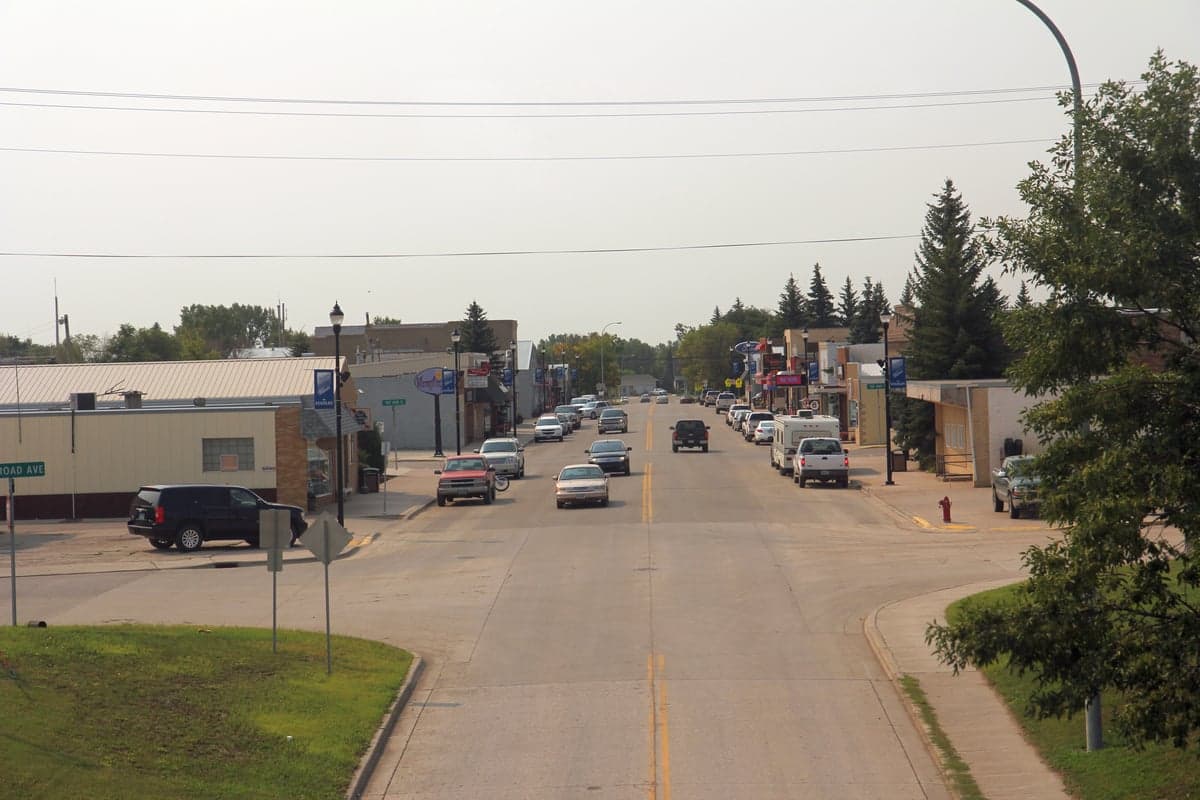
Stanley was founded in 1888 as a railroad town on the Great Northern Railway line, named after a railroad official. The original population was almost entirely of Northern European stock—Norwegian, German, and Swedish immigrants—drawn by the promise of homesteading land under the Homestead Act and later the Enlarged Homestead Act of 1909. These early settlers built the core of what is now Downtown Stanley along Main Street, erecting wood-frame houses and commercial buildings that still stand today. A second wave arrived during the 1950s and 1960s, driven by the expansion of mechanized wheat farming and the construction of the Garrison Dam project on the Missouri River, which brought temporary construction workers and their families. Many of these workers settled in the West Side Addition, a neighborhood of modest ranch-style homes built on the city’s western edge. The population peaked at roughly 1,500 in 1960 before entering a long decline as agricultural consolidation reduced the need for farm labor.
Modern era (post-1965)
The modern era for Stanley began abruptly with the Bakken oil boom in the late 2000s. The city’s population nearly doubled between 2000 and 2010, from 1,279 to 2,089, as workers flooded in from across the country. This influx was overwhelmingly domestic—white, male, and transient—with many living in man camps and temporary housing on the outskirts. A smaller but more permanent wave of Hispanic workers, primarily from Texas and the Southwest, arrived to work in oilfield support services, construction, and hospitality. These families concentrated in the Southside Trailer Park and along Highway 2 East, where affordable rental housing and mobile homes were available. The foreign-born population remains very low at 1.3%, and the Black (1.1%) and Indian-subcontinent (1.1%) populations are tiny, reflecting the city’s limited appeal to international immigrants. The East/Southeast Asian share is effectively zero. The oil boom also spurred the development of North Ridge Estates, a subdivision of newer, larger homes built for higher-income oil professionals and managers, creating a visible economic divide between the older, settled neighborhoods and the boom-era enclaves.
The future
Stanley’s population is likely to plateau or decline slightly in the next 10-20 years as the Bakken boom matures and oil production stabilizes at lower levels. The city is not homogenizing so much as stratifying: the transient oil workforce will continue to cycle through, while the Hispanic community, now 13.0% of the population, appears to be putting down roots, with families enrolling children in local schools and forming a small but stable enclave in the Southside area. The white majority, concentrated in the older neighborhoods like Downtown Stanley and the West Side Addition, is aging and not being fully replaced by younger families. The Indian-subcontinent and Black populations are too small to form distinct communities and are likely to remain negligible. The city is not tribalizing into ethnic enclaves in the way larger cities do, but the economic divide between the oil-boom haves in North Ridge Estates and the working-class renters in the trailer parks is becoming the primary social fault line.
For someone moving in now, Stanley is becoming a quieter, more settled version of its boom-era self—still overwhelmingly white and conservative, but with a small, permanent Hispanic minority that is slowly integrating into the local economy and schools. The city offers a low-cost, low-crime environment for those who value self-reliance and a close-knit community, but the economic base remains tied to the volatile energy sector, and the social scene is limited. New arrivals should expect a place where the old agricultural roots and the recent oil wealth coexist uneasily, and where the population is likely to shrink modestly over the coming decade.

* Values derived from national, state, county, city and local statistics and may differ in a specific area. Last updated: 2026-10-10T16:29:05.000Z
Narrative content on this page is AI-generated and may contain mistakes. Verify any details that matter before acting on them.
ReloMaps may earn a commission from affiliate links at no extra cost to you.

