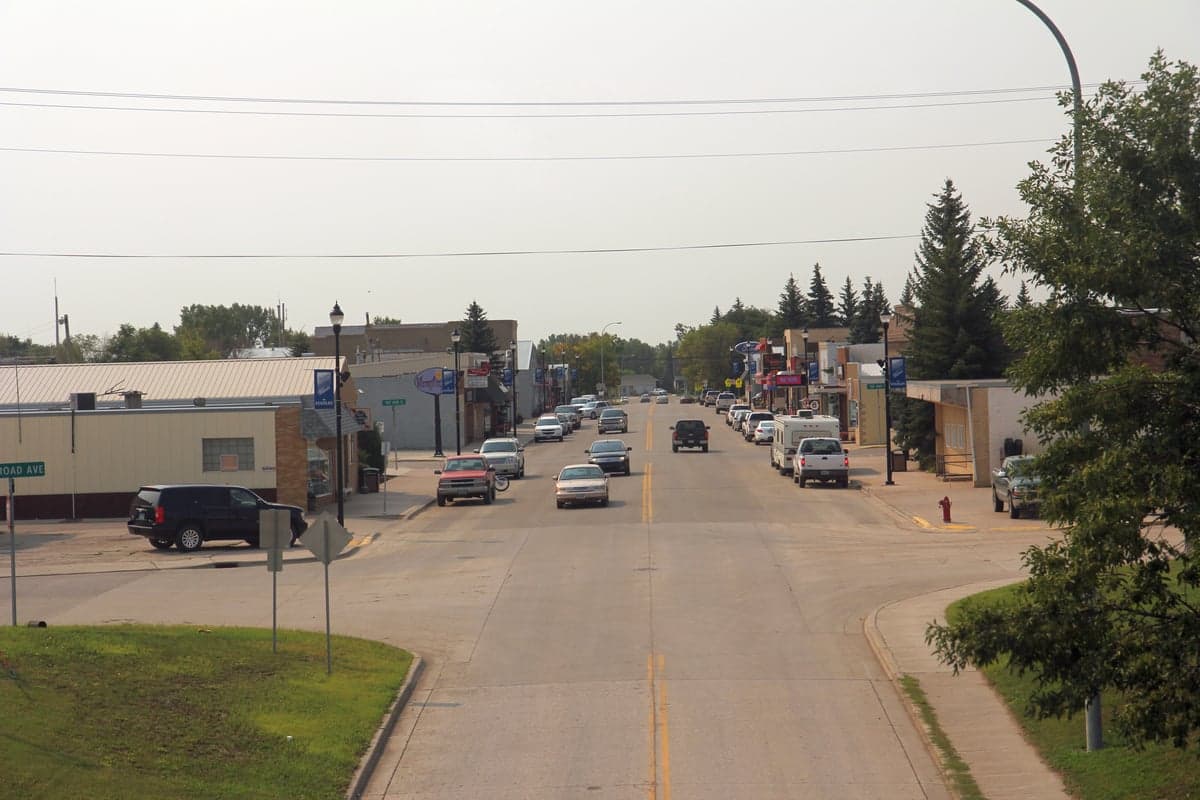
Photo: Wikipedia
Personal Sovereignty in Stanley, ND
Viable for self-reliance. Generally workable, though some barriers may limit total independence.
What does Personal Sovereignty tell us?
Personal Sovereignty measures your capacity for self-reliance and independence with minimal government friction. Higher scores mean fewer barriers between you and the way you want to live... but it assumes you have the space you need and good neighbors.
What does this tell us?
Personal Sovereignty measures your capacity for self-reliance and independence with minimal government friction. Higher scores mean fewer barriers between you and the way you want to live... but it assumes you have the space you need and good neighbors.
State Policy
Energy independence: Net exporter (500% of energy produced in-state)
Personal Liberty
Homesteading

Personal Liberty Analysis
Stanley, North Dakota, offers one of the strongest personal sovereignty environments in the Upper Midwest, largely because the state government has deliberately minimized its footprint in daily life. For a survivalist or prepper, this means fewer layers of bureaucratic friction between you and your ability to live on your own terms. The town sits in Mountrail County, a sparsely populated region where local ordinances are minimal, and the prevailing culture assumes you can handle your own affairs—whether that means keeping a firearm, building a root cellar, or telling a school board what you think. The trade-off is that you’re also expected to handle the consequences of that freedom, from winter survival to self-defense, without expecting the state to bail you out. That’s the deal, and for the right mindset, it’s a good one.
Tax burden and regulatory posture: how much the state takes and how much it stays out of your way
North Dakota’s tax structure is among the most favorable in the country for someone who wants to keep what they earn. There is no state income tax, which means every dollar you make stays in your pocket or your prep. Property taxes in Mountrail County run around 1.2% of assessed value, which is moderate for the region, but the state’s oil revenue keeps the overall tax burden low compared to states like Minnesota or California. Sales tax in Stanley is 7%, but that’s a consumption tax you can largely control by buying in bulk or bartering. More important than the raw numbers is the regulatory posture: North Dakota has a right-to-work law, no state-level red flag law, and no universal background check requirement for private firearm sales. The state legislature has consistently pushed back against federal overreach, including passing resolutions asserting state sovereignty under the Tenth Amendment. For a prepper, this means you’re not fighting a hostile state apparatus every time you want to stockpile supplies, modify your property, or conduct a private transaction. The regulatory climate is permissive, not punitive.
Self-defense and gun law specifics: what you can carry, where, and how the law backs you up
North Dakota is a constitutional carry state, meaning you can carry a concealed firearm without a permit if you’re legally allowed to possess one. Stanley’s local law enforcement is generally supportive of gun rights, and you won’t find the kind of municipal restrictions that plague cities like Fargo or Bismarck. The state also has a strong Castle Doctrine law, with no duty to retreat in your home, vehicle, or workplace. Stand Your Ground protections extend to any place you have a legal right to be. For a survivalist, the practical effect is that you can keep a rifle in your truck, a pistol on your hip, and a shotgun by the door without worrying about arbitrary “sensitive places” designations. The state preempts local gun ordinances, so Mountrail County can’t pass its own restrictions. Magazine capacity is not limited, and there is no state-level firearm registry. If you’re coming from a state with magazine bans or permit requirements, the difference is night and day. The legal framework assumes you are the first line of defense, and it backs that assumption with clear statutes.
Self-reliance and homesteading viability: lot sizes, zoning, and off-grid feasibility
Stanley’s rural character makes it a strong candidate for a self-reliant lifestyle. Within the city limits, residential lots typically range from a quarter-acre to half-acre, which is enough for a substantial garden, a chicken coop, and a small workshop. Outside town, you can buy raw land in five- to forty-acre parcels for $1,000 to $3,000 per acre, depending on proximity to oil fields and water access. Zoning is minimal: Mountrail County has no county-wide building code, and the city’s zoning is limited to basic use classifications. You can build a pole barn, install a rainwater catchment system, or set up solar panels without a lengthy permitting process. Off-grid feasibility is high, provided you plan for the climate. The growing season is short—about 110 days—so you’ll need cold frames or a greenhouse for year-round production. Water access is generally good via well drilling, and the area’s low population density means you can run a generator or burn firewood without neighbor complaints. The main constraint is winter: you need a reliable heat source and enough stored supplies to get through a blizzard that might cut roads for days. But that’s a logistical problem, not a legal one. The state won’t stop you from building a root cellar, keeping livestock, or storing a year’s worth of food.
Personal liberties: parental rights, medical autonomy, speech, and property protections
North Dakota has some of the strongest parental rights protections in the nation. State law explicitly affirms that parents have the fundamental right to direct the upbringing, education, and health care of their children. This means you can opt your kids out of curriculum you object to, and the state has resisted federal mandates on vaccine requirements for school attendance. Medical autonomy is less explicit than in, say, Idaho, but the state has not imposed broad vaccine mandates or restrictive health orders that would limit your ability to choose your own treatments. Free speech is robust: there are no hate speech laws that criminalize political or religious expression, and the state has not adopted the kind of “misinformation” enforcement seen in blue states. Property rights are protected by a strong eminent domain statute that requires just compensation and a public use finding, and the state has pushed back against federal land grabs. For a conservative concerned with government overreach, the key takeaway is that North Dakota’s political culture is one of restraint. The state government is not actively looking for ways to regulate your personal choices, and local officials in Stanley are likely to side with individual liberty over bureaucratic convenience.
Compared to other rural relocation destinations, Stanley offers a rare combination of low taxes, strong gun rights, minimal zoning, and robust parental authority. It’s not a libertarian utopia—you still have to follow federal laws, and the oil industry brings some transient population and associated crime—but the baseline level of personal sovereignty is higher than in most of the country. If your priority is to live with minimal interference from the state, while retaining the ability to defend yourself, raise your family as you see fit, and build a self-sufficient homestead, Stanley deserves a serious look. The winters are harsh, the amenities are limited, and you’ll need to be self-reliant. But that’s the point.

* Values derived from national, state, county, city and local statistics and may differ in a specific area. Last updated: 2026-10-10T16:29:05.000Z
Narrative content on this page is AI-generated and may contain mistakes. Verify any details that matter before acting on them.
ReloMaps may earn a commission from affiliate links at no extra cost to you.

