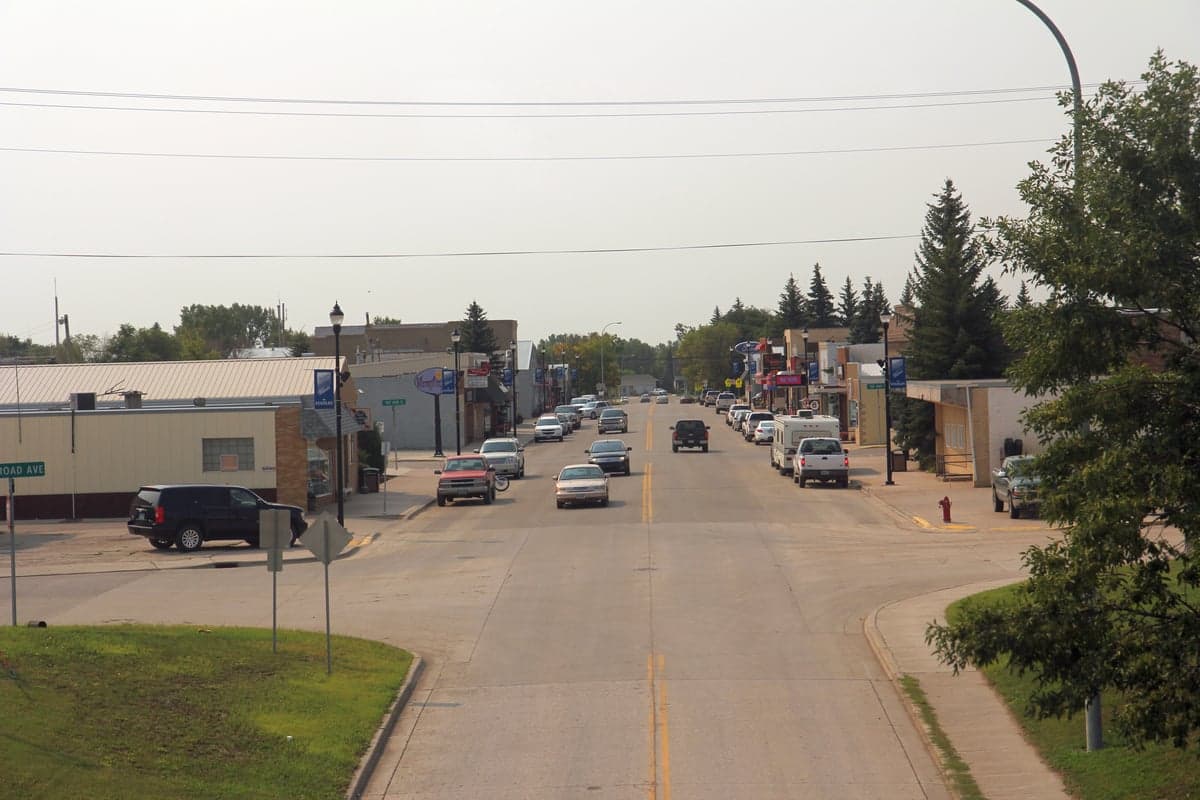
Photo: Wikipedia
Political ClimatePolitical Climate in Stanley, ND
District shown is the primary district for this city’s centroid. Cities may span multiple districts.
Inherited from parent state — no local data available.
Local Political AnalysisPolitical Analysis of Stanley, ND
Stanley, North Dakota, is about as solidly conservative as it gets, and that's not changing anytime soon. The Cook PVI of R+18 tells the story, but living here, you feel it in the way folks run their businesses, raise their kids, and expect the government to stay out of their lives. This isn't a place that's drifted left; it's a place that's held the line, and frankly, most of us are proud of that. You see it in the local elections, the school board meetings, and just about every conversation at the coffee shop.
How it compares
Drive an hour south to Bismarck or Mandan, and you'll find a more moderate, even slightly purple, political scene, especially around the state capitol. Those cities have a mix of state workers and a growing service industry that brings in more varied viewpoints. But here in Stanley, the oil and agriculture economy keeps things grounded. We're closer to Williston, which is also deeply red, but Stanley feels more like the quiet, steady anchor of the county. The surrounding towns—like Tioga and Powers Lake—are cut from the same cloth. There's no real progressive foothold out here, and when you see those big-city ideas about government overreach or new regulations trickling up from the coast, it's met with a lot of skepticism. We remember when things were simpler, before the boom brought in a lot of outside attention, and most of us prefer the old way of doing things.
What this means for residents
For someone living here, the political climate translates directly into daily life. You don't have to worry about the county telling you what you can and can't do with your own land, whether it's building a shop, running a small business out of your garage, or hunting on your property. The local government's main job is seen as keeping the roads plowed and the schools funded, not micromanaging personal choices. Taxes are low, and the regulatory burden is light, which is why so many small oilfield service companies and farms can actually turn a profit. There's a strong sense that your vote actually means something here—it's not just a drop in a blue bucket. The downside? If you lean left, you'll feel pretty isolated. But for the vast majority, that's a feature, not a bug. We like knowing our neighbors share the same basic values about self-reliance and limited government.
One thing that's shifted a bit in the last few years is the cultural tone. The oil boom brought in workers from all over, and while most of them fit right in, there's been a subtle push from some newer residents to bring in more "progressive" ideas about energy policy and land use. That's a red flag for a lot of us. We see what happens when states like Colorado or California start dictating energy standards from the top down, and we're not interested in repeating that mistake. The local school board has stayed focused on core academics and hasn't bought into the divisive social curriculum you hear about elsewhere. Looking ahead, the long-term concern is that as the state's population grows, the influence of places like Fargo and Grand Forks could start to chip away at our way of life. But for now, Stanley remains a place where personal freedom isn't just a talking point—it's how we live every day.

State Political ClimatePolitical Climate in North Dakota
State Political AnalysisPolitical Environment in the State
North Dakota is a deeply conservative state, with a Republican trifecta that has held the governorship and both legislative chambers for over a decade, and a partisan lean of roughly +20 points in federal elections. The dominant coalition is a blend of rural agricultural interests, energy-sector workers from the Bakken oil patch, and a growing population of conservative-leaning transplants from blue states seeking lower taxes and fewer regulations. Over the past 20 years, the state has shifted rightward, driven by the oil boom and an influx of voters who prioritize energy independence and gun rights, though a small but vocal progressive movement has emerged in the state’s two largest cities.
Urban vs. rural divide
The political map is starkly divided between the rural, deeply red countryside and the two blue-leaning urban islands of Fargo and Grand Forks. Fargo, the largest city, has trended slightly left in recent cycles, with Cass County voting for Joe Biden in 2020 by a narrow margin, driven by a growing population of younger professionals and university faculty at North Dakota State University. Grand Forks, home to the University of North Dakota, is a similar story—Grand Forks County went for Biden in 2020, though by a smaller margin. In contrast, the rest of the state is overwhelmingly Republican. Williston and Watford City in the oil-rich Bakken region are among the most conservative areas, routinely voting 80%+ Republican, fueled by a transient workforce that values low taxes and minimal government interference. Bismarck, the state capital, is reliably red but more moderate than the oil patch, with Burleigh County voting +18 for Trump in 2020. The rural counties along the Missouri River and the Red River Valley are solidly Republican, with many precincts seeing 90%+ GOP votes. The divide is less about culture war and more about economic dependence: urban areas rely on education and healthcare, while rural areas depend on agriculture and energy, creating a natural tension over state funding priorities.
Policy environment
North Dakota’s policy environment is a model of conservative governance. The state has no state income tax—a major draw for relocators—and a low property tax rate, though local levies vary. The regulatory posture is business-friendly, with minimal zoning restrictions outside of cities and a right-to-work law that limits union power. Education policy is decentralized, with strong local control over school boards and a robust school choice movement; the state recently expanded charter school options and passed a tax credit for private school donations. Healthcare is a mixed bag: the state expanded Medicaid under the Affordable Care Act in 2013, a move that was controversial among conservatives but has since been accepted, though there is ongoing debate about work requirements. Election laws are strict: voter ID is required, and the state has a voter ID law that was tightened in 2021 to require a residential address, which critics say disenfranchises Native American voters on reservations like Turtle Mountain and Fort Berthold. The state also has a strong pro-life stance, with a near-total abortion ban passed in 2023 after the Dobbs decision, though it is currently tied up in court challenges. Overall, the policy environment is designed to maximize individual freedom and economic growth, with a heavy emphasis on energy development and agricultural subsidies.
Trajectory & freedom
North Dakota is becoming more free in many respects, but there are warning signs. On the positive side, the state passed a constitutional carry law in 2021, allowing residents to carry concealed firearms without a permit, and has no red flag law. Parental rights were strengthened with a 2023 law requiring schools to notify parents of any curriculum changes related to sexuality or gender identity. Property rights are robust, with strong protections against eminent domain, particularly in the oil patch. However, there are concerning trends. The state’s Medicaid expansion has created a dependency that some conservatives worry will grow, and the state government has been slow to roll back occupational licensing requirements, which burden entrepreneurs. The most significant flashpoint is the Stand Your Ground law, which was expanded in 2023 to remove the duty to retreat in public spaces, a move that was celebrated by gun rights advocates but criticized by law enforcement. On the negative side, the state’s COVID-19 response was relatively light compared to blue states, but Governor Doug Burgum did impose some restrictions in 2020 that angered libertarians, including a temporary mask mandate and business closures. The trajectory is toward more personal liberty, but the state’s reliance on federal subsidies for agriculture and energy creates a tension between independence and dependency.
Civil unrest & political movements
North Dakota has seen its share of political flashpoints, most notably the Dakota Access Pipeline protests at the Standing Rock Reservation in 2016-2017, which drew thousands of activists from across the country. The protests were a major clash between law enforcement and Native American activists, with the state government taking a hard line against the protesters, including the use of tear gas and mass arrests. This event galvanized a small but active progressive movement in the state, particularly among younger voters in Fargo and Grand Forks. On the right, the Bakken oil boom has fueled a libertarian-leaning movement that opposes any federal interference in energy development, and there is a strong strain of nullification rhetoric, with some legislators pushing for state control over federal lands. Immigration politics are relatively quiet, as the state has a small immigrant population, but there have been debates over refugee resettlement, with some rural communities opposing it. Election integrity is a hot topic: the state’s voter ID law has been challenged in court, and there is ongoing concern among conservatives about the integrity of mail-in voting, though the state has not seen major fraud scandals. The most visible flashpoint for a new resident would be the oil vs. environment debate, which is a constant source of tension in the western part of the state.
Projection
Over the next 5-10 years, North Dakota is likely to remain deeply conservative, but with a growing urban-rural divide. The state’s population is aging and declining in rural areas, while Fargo and Grand Forks are growing, which could slowly shift the political center of gravity. The Bakken oil patch is expected to continue producing, but the transition to renewable energy could create economic pressure, particularly if federal policies shift. In-migration from blue states is increasing, particularly to Fargo and the oil patch, and these newcomers tend to be conservative-leaning but may bring more moderate views on social issues. The state’s Republican supermajority is likely to hold, but internal divisions between the libertarian wing and the more establishment wing could grow, particularly over issues like Medicaid expansion and education funding. A new resident moving in now should expect a state that is stable, safe, and free, but with a growing tension between the rural, traditionalist base and the urban, more cosmopolitan population. The biggest risk is economic: if oil prices crash or federal subsidies for agriculture are cut, the state could face a fiscal crisis that would test its commitment to low taxes.
For a conservative relocator, North Dakota offers a high degree of personal freedom, low taxes, and a culture that values self-reliance. The political climate is overwhelmingly friendly to conservative values, but you’ll need to be aware of the urban-rural divide and the ongoing debates over energy and land use. If you’re looking for a place where your rights are respected and the government stays out of your life, North Dakota is one of the best bets in the country—just be prepared for the cold winters and the long drives between towns.
* Values derived from national, state, county, city and local statistics and may differ in a specific area. Last updated: 2026-10-10T16:29:05.000Z
Narrative content on this page is AI-generated and may contain mistakes. Verify any details that matter before acting on them.
ReloMaps may earn a commission from affiliate links at no extra cost to you.

