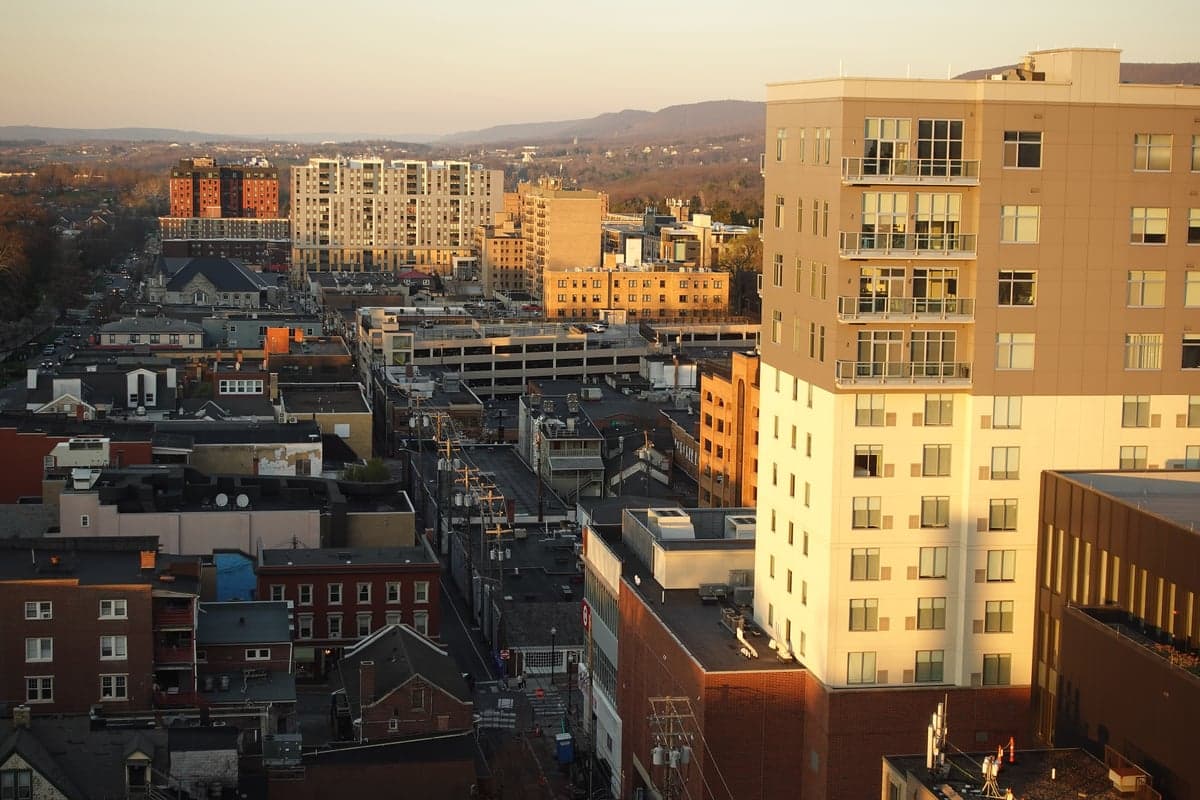
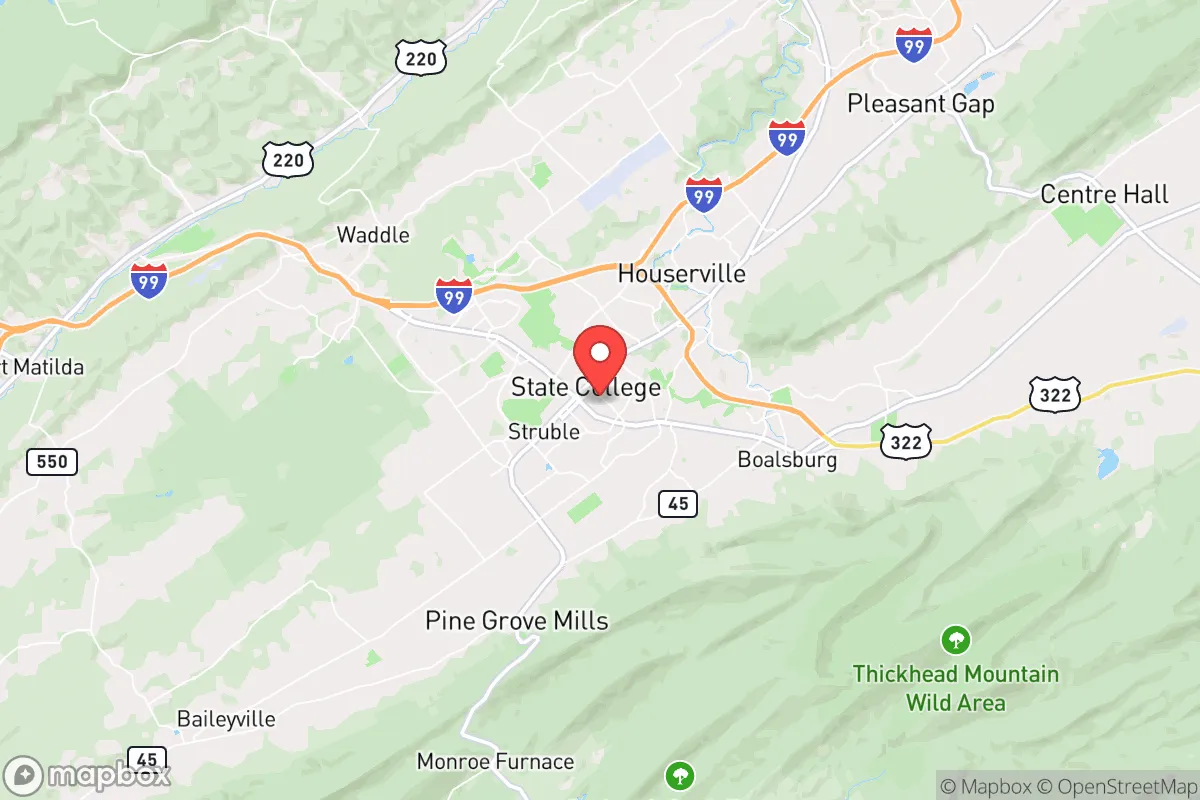
Photo: Wikipedia
Demographics of State College, PA
Affluence Level in State College, PA
A middle-class area roughly in line with national averages across income, home values, education, and employment.
People of State College, PA
State College, Pennsylvania, is a university town of 40,669 residents defined by its transient student population and a stable core of long-term professionals tied to Penn State. The city is overwhelmingly white (77.1%) but has a notable foreign-born population of 9.4%, driven largely by graduate students and faculty. With 70.7% of adults holding a college degree, the population is among the most educated in the state, creating a culture that blends academic rigor with a small-town, family-oriented atmosphere. Distinctive identity markers include a high proportion of renters, a strong cycling and pedestrian culture, and a political environment that leans left relative to surrounding Centre County.
How the city was settled and grew
State College was not a colonial settlement but a planned community that grew around the Pennsylvania State College, founded in 1855 as the Farmers' High School. The original population was overwhelmingly white, Anglo-Saxon, and Protestant—drawn from rural Pennsylvania and neighboring states to staff and attend the agricultural college. The first residential neighborhoods, such as Holmes-Foster and Highland, were built in the late 19th and early 20th centuries to house faculty and administrators. These areas remain among the city's most desirable, with large Victorian and Craftsman homes. The arrival of the railroad in the 1880s and the expansion of the college after the Morrill Act of 1862 brought a second wave of domestic migrants—middle-class families from the Northeast and Midwest seeking educational opportunity. By 1950, the population was nearly 100% white, with a small number of Black families concentrated in the West End neighborhood, many of whom worked as domestic servants or laborers for the university.
Modern era (post-1965)
The Immigration and Nationality Act of 1965 fundamentally reshaped State College's demographics. The university's growing international reputation drew graduate students and faculty from East and Southeast Asia, particularly China, South Korea, and Taiwan. These newcomers settled primarily in the College Heights and Vairo Village areas, where apartment complexes and starter homes offered affordable entry points. By 2020, East and Southeast Asian residents made up 7.7% of the population, concentrated in these neighborhoods and in the graduate-student housing near campus. A separate wave of Indian subcontinent immigrants (2.6% of the population) arrived later, largely after 2000, drawn by STEM and engineering programs. They tend to cluster in the Toftrees area, a suburban-style development west of campus with newer single-family homes and good schools. The Hispanic population (5.0%) grew more slowly, with many families settling in the South Hills neighborhood, where older, more affordable housing stock exists. Domestic in-migration during this period shifted from rural Pennsylvania to suburban professionals from the Philadelphia and Washington, D.C., metro areas, who bought homes in Park Forest Village for its large lots and proximity to the university.
The future
The population of State College is likely to continue its slow growth, driven by university expansion and the attraction of a highly educated workforce. The white share is gradually declining as the foreign-born population increases, but the city is not homogenizing—rather, it is tribalizing into distinct enclaves. East and Southeast Asian communities are consolidating in College Heights and Vairo Village, while Indian families are increasingly visible in Toftrees and newer subdivisions west of town. The Hispanic population is plateauing, with little new immigration from Latin America, and assimilation into the broader white population is occurring among second-generation families. The Black population (3.6%) remains small and stable, concentrated in the West End and South Hills. Over the next 10–20 years, expect the foreign-born share to rise toward 12–14%, with East and Southeast Asian and Indian communities growing fastest. The city will remain a liberal academic bubble within a conservative county, but the demographic shift will likely reinforce its progressive character.
For a conservative-leaning individual or family moving to State College today, the city offers a stable, safe, and highly educated environment, but one where political and cultural values may differ sharply from the surrounding region. The population is becoming more diverse and more international, particularly in the professional and academic sectors, while the native-born white population remains dominant in the older, established neighborhoods. The key trade-off is between the intellectual and economic opportunities of a university town and the social homogeneity that some relocators may prefer.

* Values derived from national, state, county, city and local statistics and may differ in a specific area. Last updated: 2026-05-01T04:11:40.000Z
Narrative content on this page is AI-generated and may contain mistakes. Verify any details that matter before acting on them.
ReloMaps may earn a commission from affiliate links at no extra cost to you.

