Photo: Wikipedia
Demographics of Statesboro, GA
Affluence Level in Statesboro, GA
A below-average socioeconomic profile. Incomes, home values, and educational attainment trail the U.S., with higher poverty and unemployment.
People of Statesboro, GA
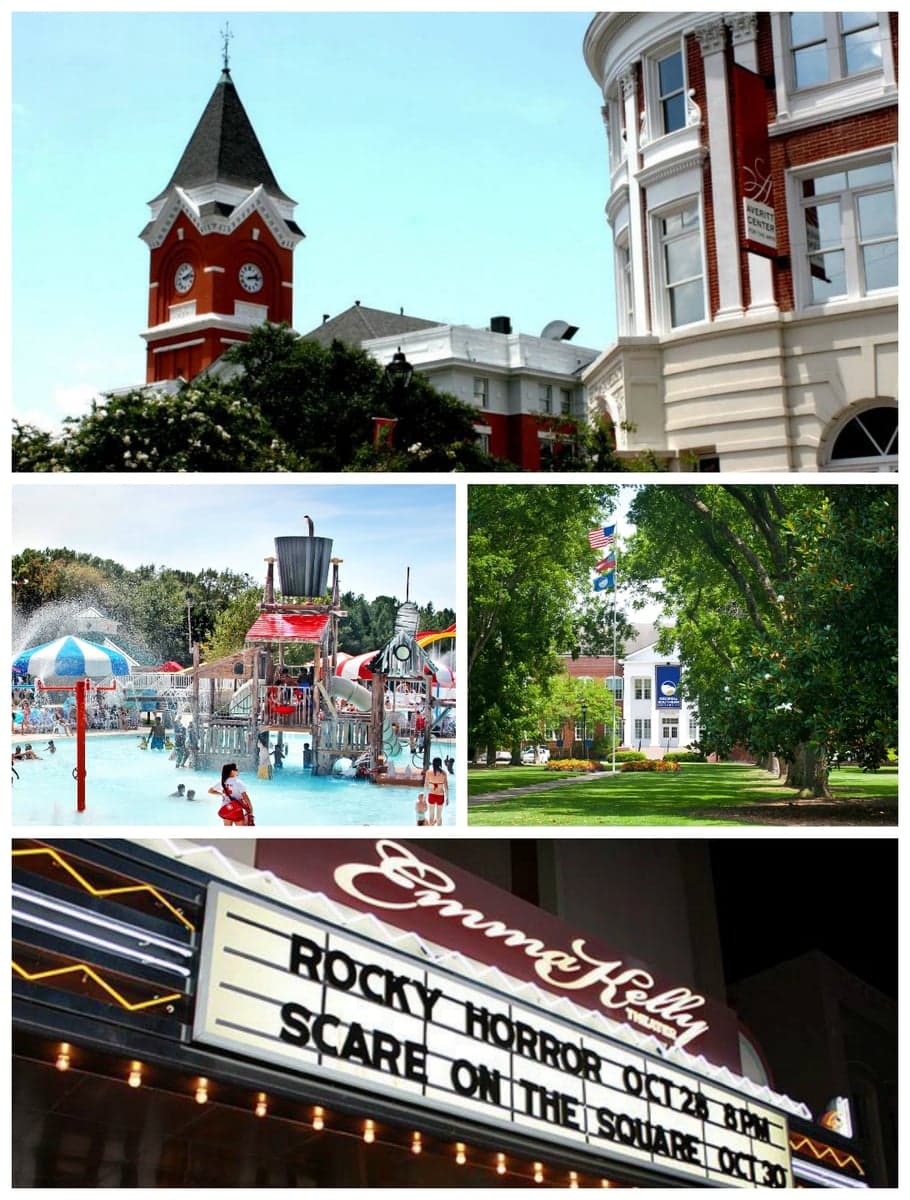
Statesboro, Georgia, is a city of roughly 33,705 residents defined by its dual identity as both a historically Black-majority community and a college town anchored by Georgia Southern University. The population is nearly evenly split between Black (42.6%) and White (47.0%) residents, with a small Hispanic share (5.1%) and minimal foreign-born presence (1.8%), giving the city a distinctly Southern, biracial character that sets it apart from the rapidly diversifying metro Atlanta suburbs. With 30.1% of adults holding a college degree—driven largely by the university—Statesboro leans educated but retains a small-town feel, where family ties and church communities remain central to daily life.
How the city was settled and grew
Statesboro was founded in 1803 as the seat of Bulloch County, carved from pine forests and swampland that attracted early settlers of Scots-Irish and English descent who came for cheap land and timber. The arrival of the Savannah and Statesboro Railway in the 1880s turned the town into a cotton and naval stores hub, drawing a wave of Black laborers from the surrounding Lowcountry who built the West End neighborhood—still a historically Black enclave centered around the old Georgia Avenue corridor. By 1900, the population was roughly 60% White and 40% Black, with White merchants and professionals clustering in Downtown Statesboro around the courthouse square, while Black families settled in Sweetheart Circle area (now part of the Georgia Southern campus) and the Fair Road district. The founding of Georgia Southern University in 1906 as a teacher-training school brought a small influx of faculty and students, but the city remained a sleepy agricultural market town through the 1950s, with segregation enforced by custom and law.
Modern era (post-1965)
The post-1965 period reshaped Statesboro’s human geography in two distinct phases. First, the Civil Rights movement and the end of legal segregation opened neighborhoods like Brooklet Road and East Main Street to Black families who had previously been confined to the West End and Fair Road. By the 1980s, Georgia Southern’s expansion into a regional university drew White students and faculty from across Georgia, creating a new University District around the campus—a largely White, transient population that lives in apartments and student housing near the football stadium. Meanwhile, the city’s Black population grew through natural increase and limited in-migration from rural Bulloch County, solidifying the West End and Northside (north of U.S. 301) as predominantly Black neighborhoods. The Hispanic share, now 5.1%, began rising in the 1990s as Mexican and Central American laborers arrived for construction and poultry processing jobs, settling in small pockets near Veterans Memorial Parkway and the industrial corridor south of downtown. The foreign-born population remains tiny at 1.8%, reflecting Statesboro’s limited appeal to international immigrants compared to Savannah or Atlanta. The Asian share (0.7%) and Indian share (0.5%) are negligible, consisting mostly of university faculty and a handful of convenience store owners.
The future
Statesboro’s population is heading toward a slow homogenization rather than rapid diversification. The White share has declined from roughly 55% in 2000 to 47% today, driven by an aging White population and younger White families leaving for larger metros, while the Black share has held steady around 42-43%. The Hispanic share is growing slowly—projected to reach 7-8% by 2035—but remains concentrated in low-wage sectors and is unlikely to reshape the city’s cultural identity. The university continues to attract a transient student body that is roughly 60% White and 25% Black, but most graduates leave after commencement, limiting long-term demographic change. The city is not tribalizing into distinct enclaves so much as maintaining existing patterns: the West End and Northside remain predominantly Black, the University District is overwhelmingly White and young, and the newer subdivisions along Brannen Street and Langston Chapel Road are mixed but trending White. For a conservative-leaning mover, Statesboro offers a stable, family-oriented environment where church and school networks matter more than ethnic identity, but the lack of economic growth outside the university means the population is likely to plateau near 35,000-38,000 over the next two decades.
For someone moving in now, Statesboro is a biracial Southern college town where the university and its rhythms dominate daily life, and where the small Hispanic and Asian populations add flavor but not demographic weight. The city is not becoming a melting pot—it is staying a place where Black and White families have coexisted for generations, with a conservative social fabric that values tradition, faith, and local loyalty over rapid change.

* Values derived from national, state, county, city and local statistics and may differ in a specific area. Last updated: 2026-04-29T23:26:04.000Z
Narrative content on this page is AI-generated and may contain mistakes. Verify any details that matter before acting on them.
ReloMaps may earn a commission from affiliate links at no extra cost to you.

