
Photo: Wikipedia
Political ClimatePolitical Climate in Statesboro, GA
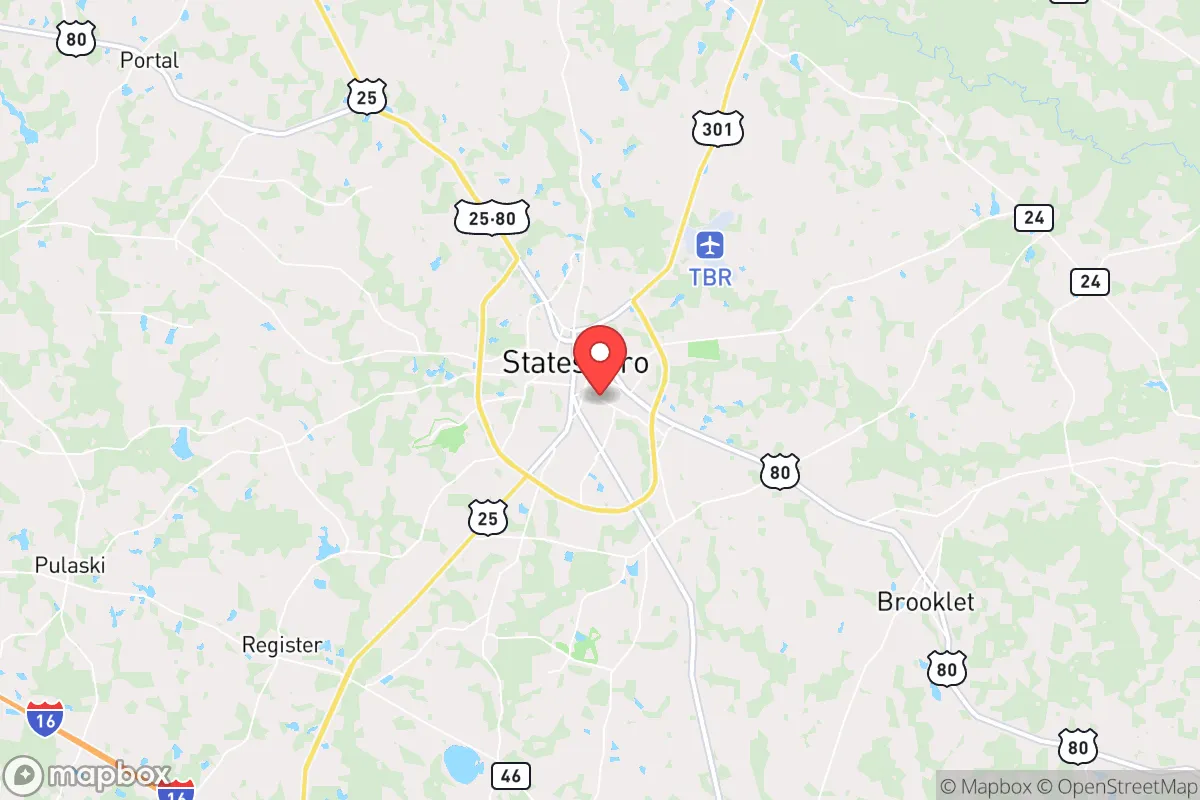
District shown is the primary district for this city’s centroid. Cities may span multiple districts.
Local Political AnalysisPolitical Analysis of Statesboro, GA
Statesboro is a solidly conservative town, and it’s been that way for as long as anyone can remember. The Cook PVI rating of R+7 tells you the math—this area leans Republican by a comfortable margin, and that’s not changing anytime soon. But if you’ve lived here a while, you know the political climate isn’t just about party labels; it’s about a deep-seated belief in personal responsibility and keeping government out of your business. You see it in the local elections, the school board decisions, and the way folks talk at the hardware store. The trajectory is steady—conservative, with a wary eye on any outside influence trying to shift things left.
How it compares
Drive 45 minutes north to Augusta, and you’ll feel a different vibe—more urban, more diverse, and politically a toss-up. Head south to Savannah, and you’re in a blue-leaning city where progressive ideas have a louder voice. Statesboro sits in that sweet spot of rural Georgia conservatism, surrounded by smaller towns like Brooklet and Register that are even more reliably red. The contrast is sharpest during election season: while Savannah’s city council debates zoning for bike lanes and affordable housing mandates, Statesboro’s commissioners are more likely to be talking about property rights and keeping tax rates low. That R+7 rating isn’t just a number—it’s a reflection of a community that values tradition and distrusts big government solutions.
What this means for residents
For the average person living here, the political climate means you’re left alone to live your life. There’s no heavy hand from the county telling you how to run your small business or what you can do with your land. Property taxes are manageable, and the local government tends to stay out of the way—something you don’t get in more progressive areas where every little thing gets regulated. That said, there’s a growing concern among long-time residents about the influence of Georgia Southern University. The student population brings a younger, more liberal energy that sometimes clashes with the town’s conservative roots. You’ll see it in local debates over housing density, noise ordinances, and even mask mandates during flu season. So far, the town’s character has held firm, but folks keep a close watch on any policy shifts that might signal a move toward the kind of government overreach you see in bigger cities.
One thing that sets Statesboro apart is its strong sense of local identity. You won’t find the kind of divisive, hyper-partisan bickering that dominates national news. Instead, the political culture here is more about practical solutions and neighborly trust. The biggest red flag for most residents is any attempt to impose outside values—whether that’s from state-level mandates or federal programs. The local school board, for example, has pushed back on curriculum changes that feel like indoctrination, and the city council has resisted zoning changes that would limit property rights. If you’re looking for a place where you can raise a family without constant government interference, Statesboro delivers. Just keep an eye on those university-driven trends—they’re the main wild card in an otherwise stable, conservative landscape.

State Political ClimatePolitical Climate in Georgia
State Political AnalysisPolitical Environment in the State
Georgia has shifted from a reliably Republican stronghold to a genuine battleground state over the past two decades, driven by explosive growth in the Atlanta metro area and demographic changes that have tightened every statewide race. The state’s overall partisan lean is now roughly R+3 to D+1 depending on the cycle, with Republicans still controlling the governorship and both legislative chambers, but Democrats winning presidential and Senate elections in 2020 and 2024. The trajectory is unmistakable: the coalition that once delivered Georgia easily for George W. Bush (winning by 17 points in 2004) has eroded, replaced by a narrow, high-turnout environment where every election is a knife fight.
Urban vs. rural divide
The political map of Georgia is a textbook case of the urban-rural chasm. Atlanta’s core counties—Fulton, DeKalb, Cobb, Gwinnett—are now solidly Democratic, with Gwinnett County flipping from red to blue between 2016 and 2020, a seismic shift driven by suburban voters repelled by Trump and an influx of Asian and Hispanic residents. These four counties alone deliver roughly 30% of the state’s vote, and they vote 65-75% Democratic. Meanwhile, the rest of the state—from the rural southwest to the north Georgia mountains—remains deeply Republican. Counties like Murray, Gilmer, and Union in the north routinely vote 80%+ Republican, while the Black Belt counties in the southwest (like Randolph and Terrell) are heavily Democratic but shrinking in population. The swing areas that decide elections are the exurban “collar counties” around Atlanta—Cherokee, Forsyth, Paulding, and Hall—where growth is fastest and voters are more moderate, often splitting tickets between Republican state legislators and Democratic statewide candidates. Savannah’s Chatham County and Augusta’s Richmond County are Democratic strongholds in their regions, while Columbus (Muscogee County) and Macon (Bibb County) lean Democratic but with significant Republican pockets. The divide isn’t just geographic—it’s cultural, with Atlanta’s cosmopolitan, college-educated voters increasingly at odds with the rural, evangelical base that still dominates the GOP primary.
Policy environment
Georgia’s policy environment is a mixed bag that reflects its divided politics. On taxes, the state has a flat income tax rate of 5.39% (down from 5.75% in 2024), with a Republican-led push to eventually phase it down to 4.99%. Property taxes are relatively low, with a homestead exemption that caps annual increases at 3% for owner-occupied homes. The regulatory posture is generally business-friendly, with Georgia ranking in the top 10 for ease of doing business, though occupational licensing requirements remain a headache for tradespeople. Education policy is a flashpoint: the state has a robust school choice program (the Georgia Promise Scholarship Act, passed in 2024, provides $6,500 for private school tuition), but the Atlanta-area districts are increasingly progressive, with Cobb County schools adopting controversial CRT-adjacent curriculum materials that sparked parental backlash. Healthcare is a sore spot—Georgia is one of the 10 states that has not expanded Medicaid, leaving a coverage gap of roughly 300,000 low-income adults, though the state’s “Pathways to Coverage” waiver program (with work requirements) has enrolled only about 4,000 people. Election laws are a national battleground: the 2021 Election Integrity Act (SB 202) added voter ID requirements for absentee ballots, limited drop box locations, and banned mobile voting centers, which critics call suppression and supporters call common-sense security. The law withstood court challenges and remains in effect, though litigation continues.
Trajectory & freedom
On personal liberty, Georgia’s trajectory is a study in contrasts. Gun rights have expanded significantly: the 2022 “Constitutional Carry” law (HB 218) allows permitless carry of concealed firearms for anyone 21 or older who can legally possess a gun, making Georgia one of 25 states with such a law. The state also has a strong “Stand Your Ground” statute and preempts local gun ordinances, meaning Atlanta cannot pass its own restrictions. Parental rights saw a win with the 2022 “Parents’ Bill of Rights” (HB 1178), which requires schools to notify parents of any changes to a student’s services or monitoring related to mental, emotional, or physical health—effectively a “don’t hide it from mom and dad” law. However, medical freedom took a hit: the state’s 2019 “heartbeat bill” (HB 481) bans abortion after about six weeks, with no exceptions for rape or incest, which conservatives see as protecting life but libertarians view as government overreach into private medical decisions. Property rights are generally strong, with no statewide rent control and limited eminent domain abuse, though Atlanta’s city council has flirted with rent stabilization measures that were preempted by state law. On speech, Georgia has no “hate speech” law that criminalizes protected expression, but the state’s “campus free speech” act (SB 17, 2023) requires public universities to allow any speaker and prohibits “free speech zones,” a win for open discourse. The overall trend is toward more freedom on guns and education, but less on abortion and healthcare choices.
Civil unrest & political movements
Georgia has seen its share of political turbulence. The 2020 election aftermath was a flashpoint, with Trump’s phone call to Secretary of State Brad Raffensperger (“find 11,780 votes”) leading to a Fulton County grand jury investigation and eventual indictment of Trump and 18 allies under the state’s RICO statute—a case that has polarized the state and is still ongoing. Protests have been a recurring feature: the 2020 Black Lives Matter demonstrations in Atlanta turned destructive, with the Wendy’s shooting of Rayshard Brooks sparking arson and looting along the city’s main corridors. On the right, the “Stop the Steal” movement held large rallies at the state capitol, and groups like the Georgia Republican Assembly have pushed for election audits and hand-counting of ballots. Immigration politics are heated: Georgia has no sanctuary city policies, and the 2011 HB 87 law (modeled on Arizona’s SB 1070) allows police to check immigration status during lawful stops, though it was partially struck down. The border crisis has driven busloads of migrants to Atlanta, straining social services and fueling local resentment. Election integrity remains a live issue: the 2024 election saw record turnout but also allegations of “ballot harvesting” in DeKalb County, with a state investigation ongoing. A new resident would notice the political intensity—yard signs, bumper stickers, and heated local Facebook groups are ubiquitous, especially in the swing suburbs of Forsyth and Cherokee counties.
Projection
Over the next 5-10 years, Georgia will likely become even more competitive, with a slight Democratic lean in presidential years due to Atlanta’s continued growth. The Atlanta metro is adding 100,000+ people annually, mostly in the Democratic-leaning suburbs of Gwinnett, Cobb, and Henry counties, while rural counties continue to depopulate. This demographic shift means Republicans will need to run up the score in exurban and rural areas even more than they do now—a tall order as those areas are also growing, but more slowly. The state legislature is likely to remain Republican through 2030 due to gerrymandering (the current maps are being challenged in court), but the governor’s mansion and Senate seats are toss-ups every cycle. On policy, expect continued battles over election laws (with Republicans pushing for hand-counting of ballots and voter roll purges), education (with school choice expansion and fights over curriculum), and healthcare (with Medicaid expansion still a live issue if a Democrat wins the governorship). The 2026 gubernatorial election will be a bellwether: if a Republican holds the seat, the state’s conservative trajectory continues; if a Democrat wins, expect a push for Medicaid expansion, gun control, and abortion rights restoration. For a new resident, the key takeaway is that Georgia is not a safe red state anymore—it’s a purple state where your vote matters, and where the political culture is increasingly polarized between the Atlanta bubble and the rest of the state.
Bottom line for a new resident: If you’re moving to Georgia for lower taxes, gun rights, and school choice, you’ll find those protected at the state level for now, but you’ll need to pick your county carefully. The Atlanta suburbs are trending blue fast, while exurbs like Forsyth, Cherokee, and Hall counties remain reliably red and offer a more traditional Southern lifestyle. Be prepared for high-stakes elections every two years, a lively political culture, and a state that is genuinely up for grabs—for better or worse, your vote here actually counts.
* Values derived from national, state, county, city and local statistics and may differ in a specific area. Last updated: 2026-04-29T23:26:04.000Z
Narrative content on this page is AI-generated and may contain mistakes. Verify any details that matter before acting on them.
ReloMaps may earn a commission from affiliate links at no extra cost to you.

