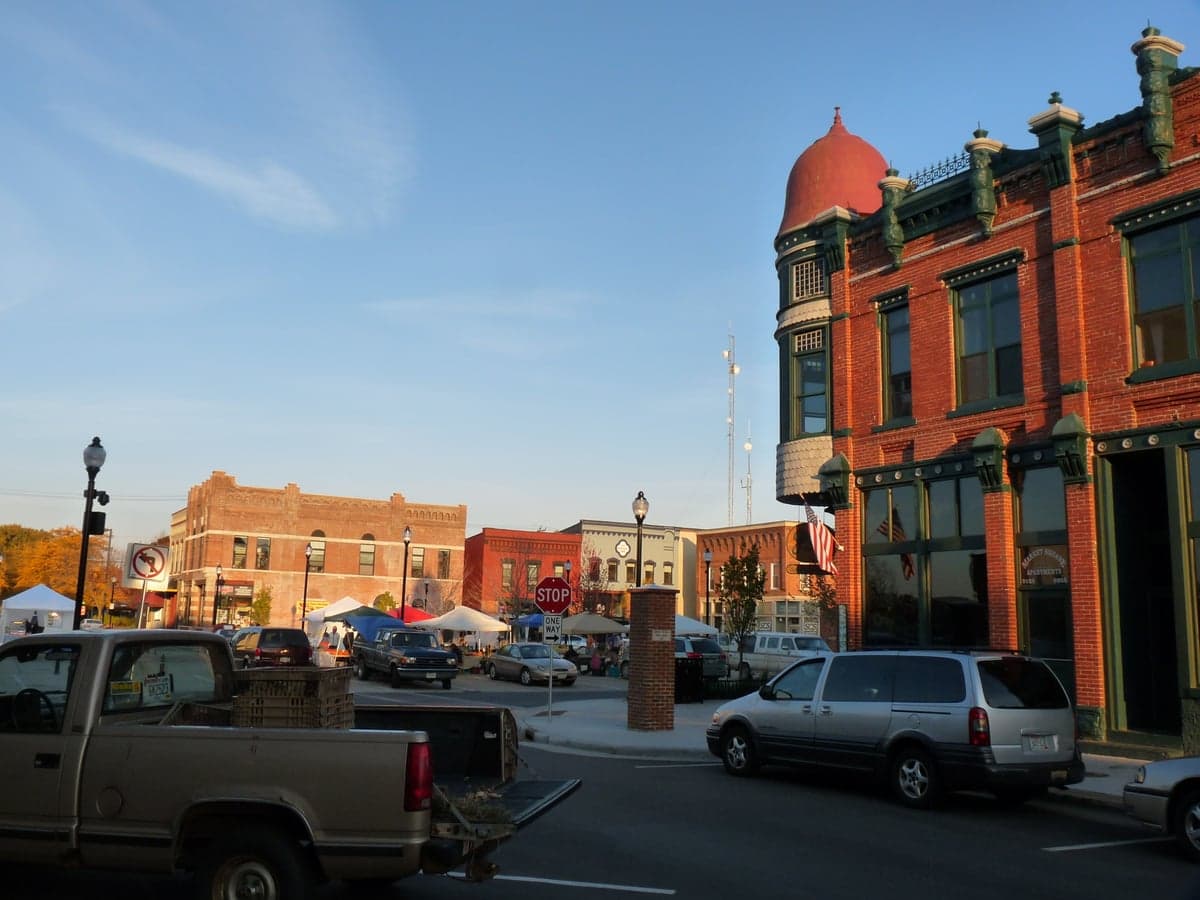
Photo: Wikipedia
Demographics of Stevens Point, WI
Affluence Level in Stevens Point, WI
A middle-class area roughly in line with national averages across income, home values, education, and employment.
People of Stevens Point, WI
The people of Stevens Point, Wisconsin, today form a predominantly white, college-educated community of 25,497 that is notably stable and ethnically homogeneous. With 88.0% of residents identifying as white and only 0.7% foreign-born, the city retains a character shaped by its 19th-century immigrant roots and a modern economy anchored by the University of Wisconsin–Stevens Point. This is a place where family histories often run deep, and the population is slowly aging, with limited new immigration reshaping the demographic landscape.
How the city was settled and grew
Stevens Point was founded in the 1830s as a logging and sawmill hub on the Wisconsin River, drawing its first wave of settlers from New England and New York. By the 1850s, German and Polish immigrants arrived in large numbers, drawn by jobs in the lumber industry and later by the expansion of the Green Bay and Western Railroad. These groups established distinct ethnic neighborhoods that persist in name today. The East Side, particularly around the area near the river and the former mill sites, became a Polish stronghold, with St. Peter's Catholic Church serving as its anchor. German families concentrated in the West Side, near the railroad depot and along what is now Clark Street, building Lutheran churches and breweries. A smaller wave of Irish immigrants settled in the North Side, near the river's bend, working as river drivers and dockhands. By 1900, the city's population had reached roughly 9,000, overwhelmingly white and European-born, with lumber and agriculture driving growth through the mid-20th century.
Modern era (post-1965)
After the 1965 Immigration and Nationality Act, Stevens Point saw minimal demographic change compared to larger Wisconsin cities. The foreign-born share remained below 1% through 2020, and the city's racial composition shifted only slightly. The most notable post-1965 change was the growth of the University of Wisconsin–Stevens Point, which drew domestic in-migration from across the Midwest and a small number of international students. Today, the East/Southeast Asian community (2.2%) is concentrated near the university campus in the College Park neighborhood, where many faculty and graduate students reside. The Hispanic population (4.2%) has grown modestly since 2000, settling primarily in the South Side near the industrial parks and along Highway 10, where affordable housing and service-sector jobs are available. The Black population (1.6%) and Indian subcontinent community (0.3%) are small and dispersed, with no single ethnic enclave. Suburbanization after 1970 drew white families to newer developments in the Plover Road corridor and the Meadow Ridge subdivision, leaving the older East Side and North Side neighborhoods with an aging population and declining household sizes.
The future
The population of Stevens Point is projected to remain stable or decline slightly over the next decade, as the city's birth rate falls below replacement and out-migration of young adults continues. The white share is expected to remain above 85%, with the Hispanic and East/Southeast Asian communities growing slowly through natural increase and limited immigration. The foreign-born share may rise to 1.5-2% by 2040, driven by university-related recruitment and healthcare-sector jobs, but the city is unlikely to see the rapid diversification of larger Wisconsin metros like Milwaukee or Madison. The East Side and North Side are likely to continue aging, while the South Side may see modest infill development and a slight increase in Hispanic and mixed-race families. The College Park neighborhood will remain the most diverse area, with a transient population of students and faculty. No significant tribalization into ethnic enclaves is expected; instead, the city will likely homogenize further as older European-ancestry residents age in place and younger families move to outlying suburbs.
For someone moving to Stevens Point now, the city offers a stable, safe, and culturally cohesive environment with strong schools and a university anchor. The population is not diversifying rapidly, and the social fabric remains rooted in its German and Polish Catholic and Lutheran heritage. New residents, particularly those from outside the Midwest, should expect a community where long-established families dominate civic life and where change comes slowly. This is a place for those seeking predictability and tradition, not rapid demographic transformation.

* Values derived from national, state, county, city and local statistics and may differ in a specific area. Last updated: 2026-04-21T10:30:11.000Z
Narrative content on this page is AI-generated and may contain mistakes. Verify any details that matter before acting on them.
ReloMaps may earn a commission from affiliate links at no extra cost to you.

