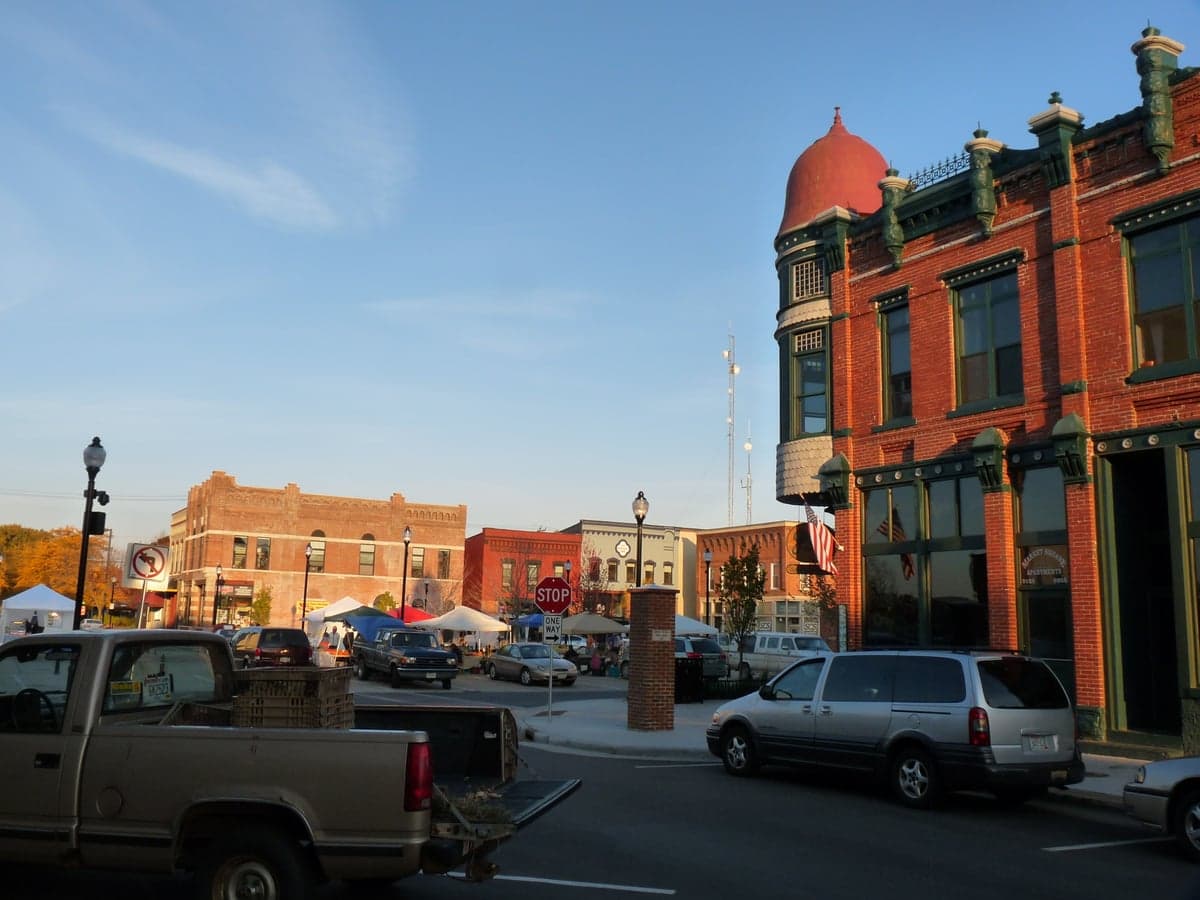
Photo: Wikipedia
Strategic Assessment of Stevens Point, WI
Workable tactical position. Some exposure to population density or targets, but generally defensible in a crisis.
What does the Strategic Assessment tell us?
Our Strategic Assessment grades tactical survivability of an area. Major population centers, military targets, fallout zones, natural disasters, and border exposure all drive risk — lower exposure means a more defensible position in a crisis.
This is heavily inspired by Joel Skousen's Strategic Relocation book. Highly recommended you checkout the book ($)What does this tell us?
Our Strategic Assessment grades tactical survivability of an area. Major population centers, military targets, fallout zones, natural disasters, and border exposure all drive risk — lower exposure means a more defensible position in a crisis.
This is heavily inspired by Joel Skousen's Strategic Relocation book. Highly recommended you checkout the book ($)Strategic Pillars

Key Distances
Regional Safe Places
Below is our recommended "safe zones" in Wisconsin and the surrounding area based on our strategic heuristics. For most people, it's unrealistic to live in a “safe zone” full-time due to work, family or other personal reasons. They tend to be more rural. However, many of these areas are perfect for second homes and retreat properties that double as a vacation home or even a short-term rental.
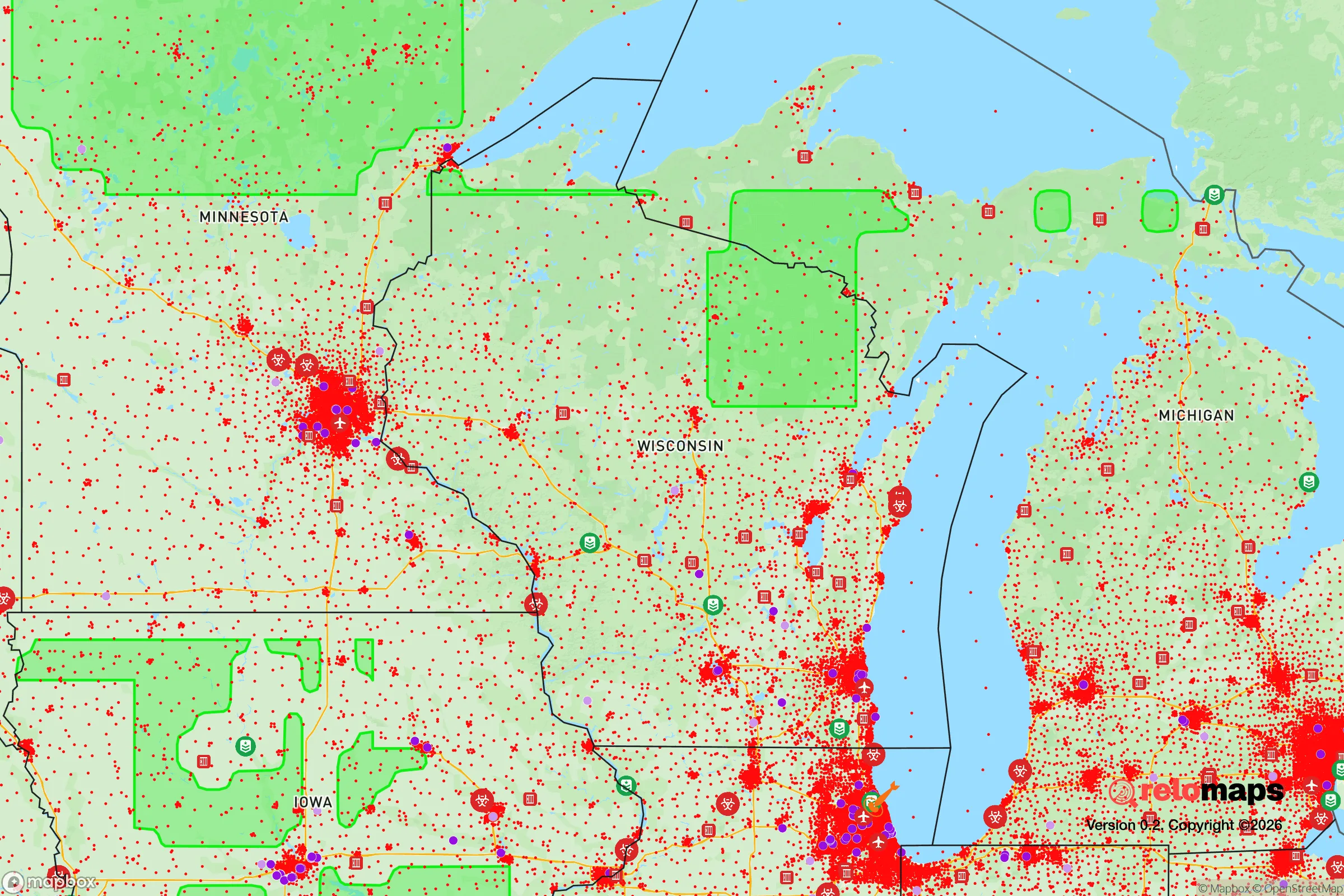
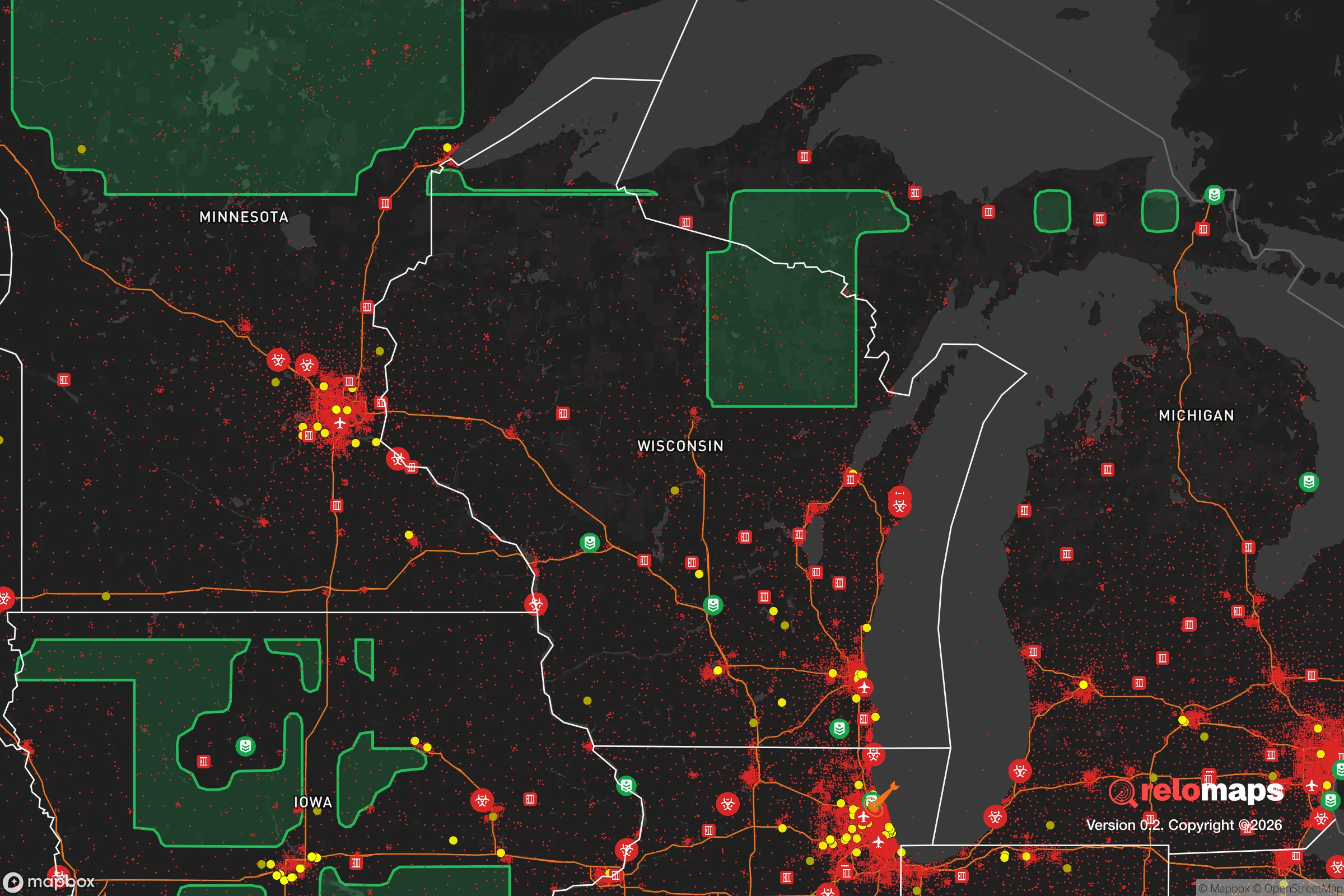


Important Note: For informational purposes only. This does not mean nothing bad ever happens in the green zones. Please use common sense. This is based on public data and modeled with AI. We tried to take a conservative approach but mistakes happen. We update this regularly as new information becomes available.
Solar Generator Recommendations
Backup power matters more here than in safer locations. We've picked three solar generators across budgets and capacity tiers — start with the budget unit if you only need a few essentials, or step up if you want to run a fridge and HVAC for days at a time.

Jackery Portable Power Station Explorer 300
Budget OptionPower on the Go: Weighing only 11 lbs, it's convenient to set up and store with book-sized foldable solar panels

BLUETTI Portable Power Station AC180
Designed for both indoor and outdoor scenarios, AC180 is highly capable as it has a robost capacity and continuous output power.

EF ECOFLOW DELTA Pro Ultra Power Station
Upgraded PickEcoFlow DELTA Pro Ultra is a whole-home energy system designed to grow with your family. Integrated with the Smart Home Panel 2, it scales to meet your evolving energy needs — keeping your home powered, intelligent, and secure through every stage of life.
We earn a commission, at no additional cost to you.
Strategic Assessment Analysis
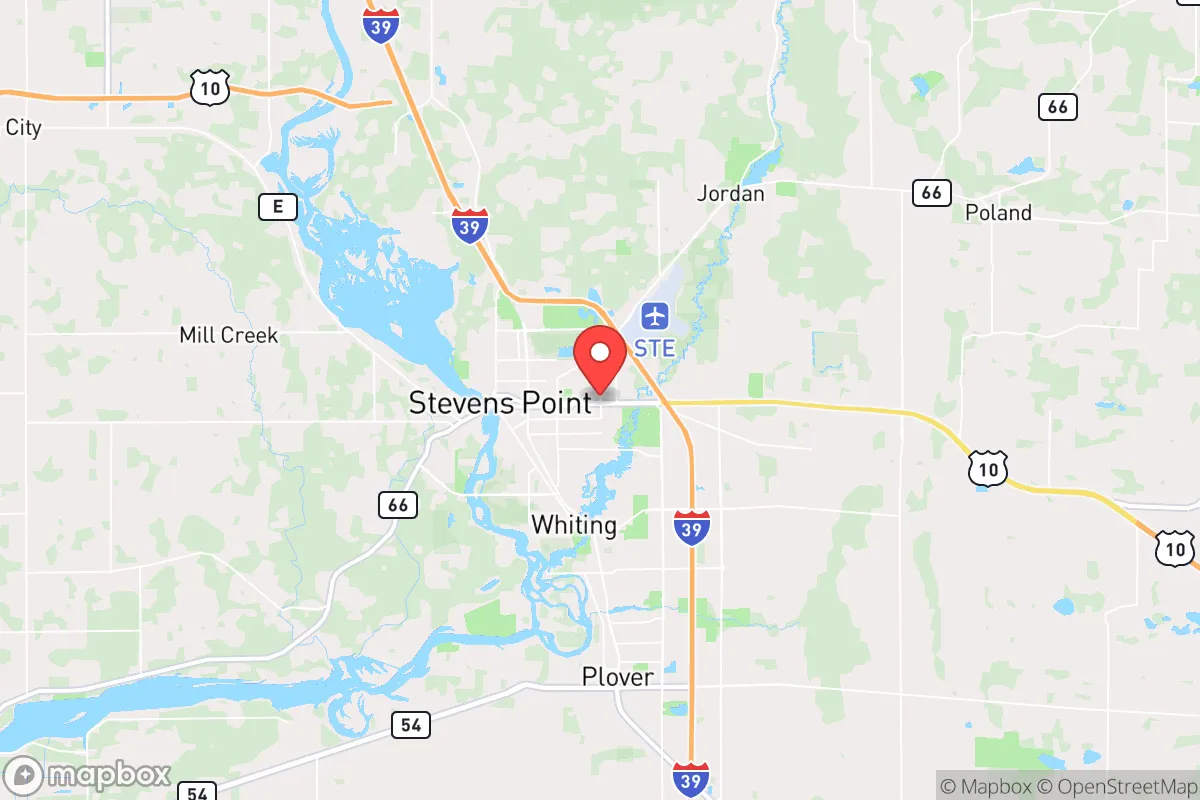
Stevens Point, Wisconsin, offers a compelling mix of strategic depth and practical resilience for those looking to relocate away from the fragility of major metropolitan areas. Situated in the heart of the state, this city of roughly 26,000 people sits at the confluence of the Wisconsin and Plover Rivers, providing a natural buffer against the chaos that often engulfs larger population centers. Its location—roughly 100 miles north of Madison and 70 miles west of Green Bay—places it far enough from the primary fallout zones of major cities while still maintaining access to regional supply chains and medical infrastructure. For the prepper or conservative relocator, Stevens Point represents a middle ground: not so remote that you’re cut off from resources, but not so close to urban centers that you’re in the blast radius of societal collapse.
Geographic position and natural advantages for long-term survival
Stevens Point’s geographic position is its strongest asset. The city is embedded in the Central Sands region, a vast area of sandy, well-drained soils that are ideal for agriculture and groundwater recharge. This isn’t just a nice-to-know fact—it means the local water table is robust, and the land can support food production even in a degraded scenario. The Wisconsin River, which runs along the city’s western edge, is a major, perennial water source that doesn’t dry up in drought years, unlike smaller streams. The surrounding landscape is a mix of hardwood forests, wetlands, and farmland, offering both cover and resources. To the north, the Chequamegon-Nicolet National Forest provides a massive, sparsely populated buffer zone—over 1.5 million acres of public land that could serve as a retreat or foraging area if things go sideways. The city’s elevation is modest (around 1,100 feet), but the terrain is gently rolling, which aids in drainage and reduces flood risk compared to low-lying areas along the Mississippi. For a relocator, this means you’re not sitting in a floodplain, and you have multiple natural corridors for movement or escape if needed.
Risks, exposures, and proximity to fallout-relevant landmarks
No location is without risk, and Stevens Point has its share of vulnerabilities that a strategic relocator must weigh. The most immediate concern is its proximity to the Point Beach Nuclear Plant, located about 30 miles northeast on the Lake Michigan shore near Two Rivers. While the plant is operational and regulated, any major incident—whether from a natural disaster, sabotage, or grid failure—could produce a radioactive plume that, depending on wind patterns, could drift over the Stevens Point area. The prevailing winds in central Wisconsin are from the west and northwest, which means a release from Point Beach would likely push the plume away from the city, but that’s not a guarantee. Additionally, the city sits about 100 miles from the Fort McCoy military installation near Sparta, a major training and logistics hub that could become a target in a conflict scenario. On the plus side, Stevens Point is far from any major interstate highways (I-39 runs just east of town, but it’s a secondary corridor), which reduces the risk of being caught in mass evacuation traffic or refugee flows. The nearest major city, Wausau (population 40,000), is 30 miles north, but that’s a manageable distance. The real danger is the potential for civil unrest spilling over from Madison or Milwaukee—both about a 2-hour drive—but the rural character of the surrounding counties (Portage, Marathon, Wood) means the population is sparse and largely self-reliant, which dampens the spread of urban chaos.
Practical resilience for a relocator: food, water, energy, and defensibility
For the prepper mindset, Stevens Point scores well on the basics. Water is abundant: the Wisconsin River is a reliable surface source, and the Central Sands aquifer is one of the most productive in the Midwest. Many homes in the area have private wells, and the city’s municipal water system draws from deep wells that are less vulnerable to surface contamination. Food security is strong due to the surrounding agricultural land—dairy, corn, soybeans, and vegetables are all grown locally. The city itself has a robust farmers’ market and several grocery co-ops, but in a collapse scenario, you’d want to establish relationships with local farmers or secure land for your own garden. The sandy soil is easy to work and drains quickly, though it requires organic matter to retain nutrients. Energy resilience is a mixed bag. The grid is part of the Midcontinent Independent System Operator (MISO) network, which has seen strain during extreme weather events (e.g., the 2021 polar vortex). However, the area has a growing number of solar installations and backup generators are common among rural residents. Wood heating is viable given the forest cover, and the city’s location away from major power line corridors reduces the risk of grid-triggered blackouts from cascading failures. Defensibility is moderate. Stevens Point is not a fortress—it’s a college town (home to UW-Stevens Point) with a typical suburban layout. But the surrounding rural areas offer numerous chokepoints: the Wisconsin River bridges, the limited number of roads leading into town, and the dense forests to the north and east. A small, organized group could effectively control access to the city’s core. The local population is predominantly conservative and self-sufficient, with a strong hunting and firearms culture—Portage County has a high rate of gun ownership per capita, which in a worst-case scenario means a community that can defend itself. The downside is that the city’s population is not particularly dense, so you’d need to rely on neighbors rather than a large security force.
The overall strategic picture for Stevens Point is one of cautious optimism for the conservative relocator. It’s not a bug-out location in the mountains, but it’s a solid, defensible position in the American heartland with access to water, food, and energy resources. The risks from the nuclear plant and proximity to military infrastructure are real but manageable with proper planning—like having a radiation detection kit and a pre-planned evacuation route north or west. The city’s distance from major urban centers means you’re unlikely to be caught in the initial wave of civil unrest, and the surrounding rural communities provide a buffer of like-minded, self-reliant individuals. If you’re looking for a place to hunker down and ride out the coming instability, Stevens Point offers a balance of isolation and access that few other locations in the Midwest can match. Just don’t expect it to stay quiet forever—no place will. But here, you’ve got a fighting chance.

* Values derived from national, state, county, city and local statistics and may differ in a specific area. Last updated: 2026-04-21T10:30:11.000Z
Narrative content on this page is AI-generated and may contain mistakes. Verify any details that matter before acting on them.
ReloMaps may earn a commission from affiliate links at no extra cost to you.

