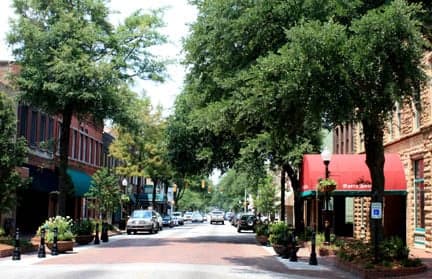
Photo: Wikipedia
Personal Sovereignty in Sumter, SC
Viable for self-reliance. Generally workable, though some barriers may limit total independence.
What does Personal Sovereignty tell us?
Personal Sovereignty measures your capacity for self-reliance and independence with minimal government friction. Higher scores mean fewer barriers between you and the way you want to live... but it assumes you have the space you need and good neighbors.
What does this tell us?
Personal Sovereignty measures your capacity for self-reliance and independence with minimal government friction. Higher scores mean fewer barriers between you and the way you want to live... but it assumes you have the space you need and good neighbors.
State Policy
Energy independence: Importer (25% of energy produced in-state)
Personal Liberty
Homesteading

Personal Liberty Analysis
For the individual or family prioritizing personal sovereignty—the ability to live, defend, and provide for oneself without undue government interference—Sumter, South Carolina, offers a notably permissive legal environment compared to many coastal or Mid-Atlantic states. While no location is a libertarian utopia, Sumter’s combination of low taxes, strong gun rights, minimal zoning in unincorporated areas, and a state-level legal framework that generally respects parental and property rights makes it a serious contender for those seeking to reduce their dependency on systems they distrust. The key is understanding where the state’s authority ends and your personal autonomy begins, and in South Carolina, that line is drawn further in your favor than in roughly half the country.
Tax burden and regulatory posture: How much the state leaves in your pocket
South Carolina’s tax structure is a clear net positive for sovereignty-minded relocators. The state levies a flat income tax rate of 6.2% (as of 2025, with scheduled reductions to 6.0% by 2026), which is moderate but not negligible. However, the real advantage lies in property taxes. Sumter County’s millage rate is roughly 250-280 mills on the fair market value of your home, but the state’s owner-occupied property tax assessment ratio is only 4%—meaning you’re taxed on just 4% of your home’s appraised value. For a $250,000 home, that works out to an annual tax bill of roughly $2,500 to $2,800, far lower than in New York, California, or Illinois. There is no state estate tax or inheritance tax, and the state sales tax is 6% (with local add-ons pushing it to around 8% in Sumter). More importantly for the prepper, South Carolina has no state-level personal property tax on vehicles or household goods, and business licensing requirements are minimal for sole proprietors. The regulatory posture is generally “hands-off” for rural and suburban properties, though the city of Sumter itself enforces building codes and permits. The takeaway: the state takes a modest cut but leaves you with enough capital to invest in land, supplies, and self-reliance infrastructure.
Self-defense and gun law specifics: What you can carry and where
South Carolina is a constitutional carry state as of 2024, meaning any law-abiding adult 18 or older can carry a concealed firearm without a permit. This is a foundational sovereignty right. There is no state-level registration of firearms, no “assault weapon” ban, and no magazine capacity restrictions. The state also has a Stand Your Ground law with no duty to retreat in any place you have a legal right to be. Castle Doctrine applies to your home, vehicle, and workplace. For the survivalist, this means you can legally defend your property and person with a firearm without fear of prosecution for using deadly force against an unlawful intruder. The only notable restriction is that open carry is legal for those with a permit (or under constitutional carry for those 18+), but it is prohibited in certain places like schools, courthouses, and police stations. Sumter County itself has a strong gun culture, with multiple ranges and gun shops, and the local sheriff’s office is generally pro-Second Amendment. If you are coming from a state with magazine bans or red-flag laws, South Carolina’s legal landscape will feel like a breath of fresh air.
Self-reliance and homesteading viability: Lot sizes, zoning, and off-grid feasibility
This is where Sumter truly shines for the homesteader or prepper. Outside the city limits of Sumter, unincorporated Sumter County has very minimal zoning. You can buy a 1- to 5-acre lot for $5,000 to $15,000 per acre, and there are no county-wide bans on keeping chickens, goats, or even a few head of cattle. The county does not enforce building codes on agricultural or rural residential structures under a certain size (typically under 200 square feet for sheds, but check with the planning office for dwellings). Off-grid feasibility is high: the county does not require connection to municipal water or sewer if you have a well and septic system. Solar panels are legal and not restricted by HOAs in unincorporated areas (though city subdivisions may have covenants). The climate is mild enough that a well-insulated cabin with a wood stove is a realistic year-round dwelling. The main regulatory hurdle is the state’s requirement for a septic system permit (DHEC), which costs a few hundred dollars and requires a percolation test. But there are no state-level bans on rainwater collection, composting toilets, or alternative energy. For the family wanting to produce their own food, water, and power, Sumter County offers a low-barrier entry point.
Personal liberties: Parental rights, medical autonomy, speech, and property
South Carolina has a strong track record on parental rights. The state’s Parental Involvement in Education Act requires schools to notify parents of any medical or mental health services provided to minors, and parents have the right to opt their children out of any curriculum they find objectionable. There is no state-level mask or vaccine mandate for children in schools (as of 2025), and the state legislature has repeatedly rejected “critical race theory” mandates. Medical autonomy is more mixed: South Carolina has a constitutional amendment protecting the right to refuse medical treatment, but it also has a strict ban on abortion after six weeks (with no exceptions for rape or incest), which may be a factor for some. Free speech is robustly protected under the state constitution, and there are no state-level “hate speech” laws that criminalize political or religious expression. Property rights are strong: the state has a right-to-farm law that protects agricultural operations from nuisance lawsuits, and eminent domain is limited to public use (not private development). The biggest threat to personal liberty in Sumter is the same as anywhere: federal overreach. But at the state and local level, the government is generally deferential to individual choice, especially in rural areas.
In the broader context of American personal sovereignty, Sumter, South Carolina, ranks as a strong “B+” to “A-” location. It is not as permissive as Alaska or New Hampshire, but it is far freer than the Northeast, West Coast, or any state with income taxes above 8% and restrictive gun laws. The combination of constitutional carry, low property taxes, minimal zoning, and strong parental rights creates an environment where a determined individual or family can build a self-reliant life with minimal government friction. The main trade-offs are the humid summers, the presence of a large military base (Shaw Air Force Base) that brings some federal presence, and the fact that South Carolina is still a “blue law” state in some respects (e.g., no alcohol sales before noon on Sunday in some counties). But for the survivalist or prepper looking to escape the tightening grip of high-tax, high-regulation states, Sumter offers a solid foundation for rebuilding autonomy on your own terms.

* Values derived from national, state, county, city and local statistics and may differ in a specific area. Last updated: 2026-04-30T00:41:48.000Z
Narrative content on this page is AI-generated and may contain mistakes. Verify any details that matter before acting on them.
ReloMaps may earn a commission from affiliate links at no extra cost to you.

