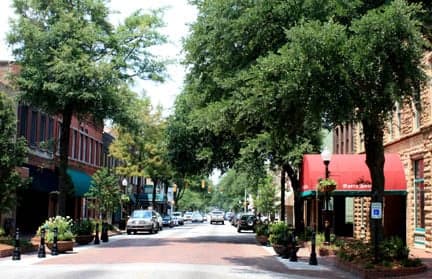
Photo: Wikipedia
Demographics of Sumter, SC
Affluence Level in Sumter, SC
A below-average socioeconomic profile. Incomes, home values, and educational attainment trail the U.S., with higher poverty and unemployment.
People of Sumter, SC
The people of Sumter, South Carolina today form a city of 43,065 residents defined by a Black-majority population (47.4%) alongside a substantial White minority (38.6%), a growing Hispanic community (6.8%), and small but established East/Southeast Asian (2.5%) and Indian (0.3%) populations. The city’s character is shaped by its dual identity as both a historic Southern mill and railroad town and a modern military-adjacent community, anchored by Shaw Air Force Base just west of downtown. With a foreign-born rate of just 1.7%—well below the national average—Sumter remains a predominantly native-born, Southern city where generational roots run deep. The population is notably less college-educated than the national average at 28.6%, reflecting a workforce historically tied to manufacturing, agriculture, and military support roles.
How the city was settled and grew
Sumter was founded in 1845 as a railroad depot town on the Wilmington and Manchester Railroad, drawing its earliest White settlers from the surrounding plantation districts of the South Carolina Lowcountry. These families—largely of English and Scots-Irish descent—established the city as a cotton and timber shipping hub, building their homes in what is now the Historic Downtown Sumter district, centered around Main Street and the Sumter County Courthouse. The post-Civil War era brought a significant Black population to the city as freedmen moved from rural plantations into town for work. They settled primarily in the South Sumter neighborhood, south of the railroad tracks, and in the West End near the Santee River, building churches, schools, and small businesses that became the backbone of the city’s African American community. The early 20th century saw a wave of White mill workers—many from the Appalachian foothills—arrive for jobs at the Sumter Cotton Mill and other textile plants, settling in the Mill Village neighborhoods east of downtown, such as the area around Church Street. By 1950, Sumter’s population was roughly 60% White and 40% Black, with a rigidly segregated housing pattern that persisted for decades.
Modern era (post-1965)
The post-1965 period reshaped Sumter’s demographics through two major forces: the expansion of Shaw Air Force Base and the broader suburbanization of the South. The base, established in 1941, grew dramatically during the Cold War, drawing a steady stream of military families from across the United States. These newcomers—predominantly White but including growing numbers of Black and Hispanic service members—settled in the Shaw Heights neighborhood directly adjacent to the base, as well as in newer subdivisions like Bishopville Highway corridor developments. The 1970s and 1980s saw White flight from the city core to unincorporated areas north and west of Sumter, particularly around Lakewood and the Dalzell area, leaving the central city increasingly Black. By 2000, the city’s Black population had risen to over 50%, while the White share dropped below 40%. The Hispanic population, negligible before 1990, began growing in the 2000s as immigrants from Mexico and Central America arrived for construction, poultry processing, and agricultural work, settling in the South Sumter and Bishopville Highway areas. The East/Southeast Asian community—primarily Filipino and Vietnamese families—grew alongside the military presence, concentrated in Shaw Heights and the Oakland Avenue corridor. The Indian subcontinent population remains tiny (0.3%), mostly professionals connected to the base or regional medical centers.
The future
Sumter’s population is trending toward greater diversity, but the pace is slow. The Hispanic share (6.8%) is the fastest-growing segment, projected to reach 10-12% by 2035 as families expand and new arrivals continue for agricultural and service jobs. The Black majority (47.4%) is stable, with younger Black residents increasingly moving to newer subdivisions in the Dalzell and Bishopville Highway corridors, reducing the historic concentration in South Sumter. The White population (38.6%) is aging and slowly declining in the city limits, though the broader Sumter County remains majority-White. The East/Southeast Asian community (2.5%) is plateauing as military rotations stabilize, while the Indian population (0.3%) is likely to remain negligible. The city is not homogenizing into a single identity; instead, it is tribalizing into distinct enclaves: South Sumter remains predominantly Black and lower-income, Shaw Heights is a military melting pot, and the Lakewood/Dalzell area is increasingly White and middle-class. The foreign-born rate (1.7%) is unlikely to rise sharply, as Sumter lacks the immigrant-heavy industries or refugee resettlement programs seen in larger South Carolina cities like Greenville or Charleston.
For someone moving to Sumter now, the city offers a stable, slow-growing population where racial and ethnic lines are clearly drawn but not openly hostile. The military presence provides a steady influx of outsiders, preventing the city from becoming entirely insular, while the native-born majority ensures a deeply Southern, conservative cultural baseline. New residents should expect a community where neighborhoods still reflect historic settlement patterns, but where the Hispanic and military-connected populations are gradually softening those boundaries. The bottom line: Sumter is a Black-majority Southern city with a military anchor, becoming slightly more diverse but remaining overwhelmingly native-born and working-class—a place where roots matter, but newcomers from the base are readily absorbed.

* Values derived from national, state, county, city and local statistics and may differ in a specific area. Last updated: 2026-04-30T00:41:48.000Z
Narrative content on this page is AI-generated and may contain mistakes. Verify any details that matter before acting on them.
ReloMaps may earn a commission from affiliate links at no extra cost to you.

