Photo: Wikipedia
Demographics of Superior, WI
Affluence Level in Superior, WI
A middle-class area roughly in line with national averages across income, home values, education, and employment.
People of Superior, WI
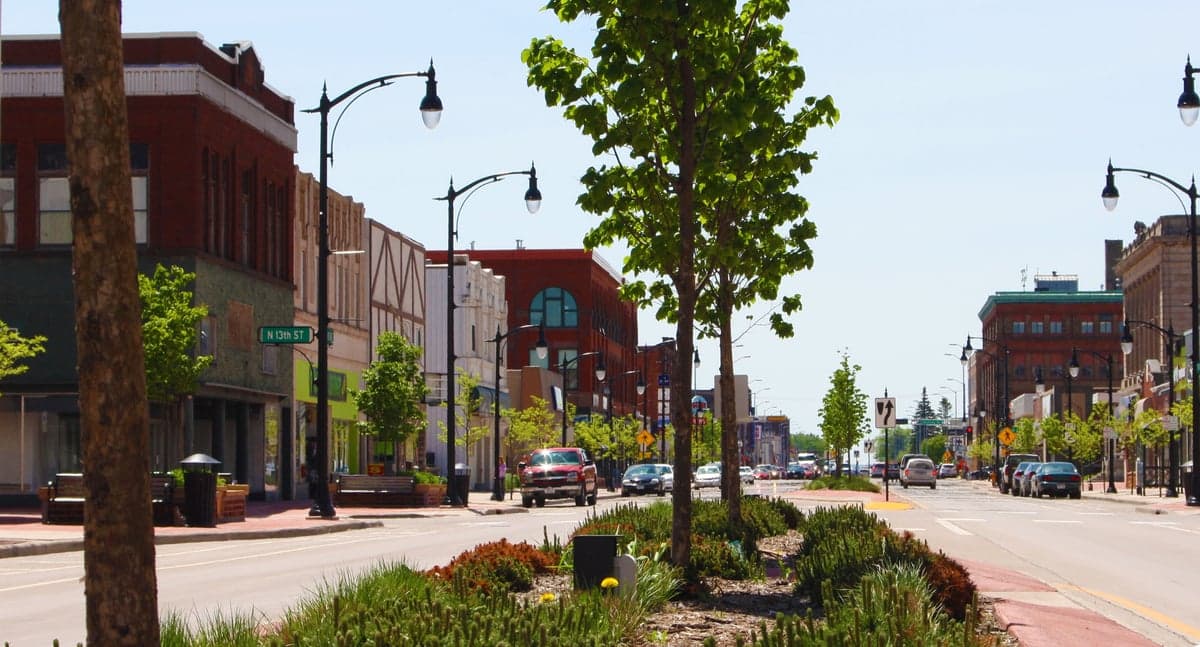
The people of Superior, Wisconsin, today form a predominantly white, working-class community of 26,550 residents, shaped by a century of industrial boom and subsequent economic restructuring. The city is notably less diverse than the national average, with 88.8% of the population identifying as white alone, and a foreign-born share of just 1.1% — a fraction of the U.S. average. Superior’s identity remains tied to its Lake Superior port and rail yards, with a blue-collar character that sets it apart from the more professional-class Twin Ports neighbor, Duluth, just across the bridge. For a conservative-leaning individual or family, Superior offers a slower pace, lower housing costs, and a population that is overwhelmingly native-born and English-speaking.
How the city was settled and grew
Superior’s population history begins with the Ojibwe people, who used the region for fishing and trade long before European arrival. The city itself was platted in 1853, riding a speculative land boom tied to the promise of a transcontinental railroad terminus. The first major wave of white settlers came from New England and New York, drawn by the 1854 land grant that funded the Lake Superior and Mississippi Railroad. These early arrivals built the Barker’s Island and East End neighborhoods, where the first frame houses and commercial blocks appeared. A second, larger wave arrived between 1880 and 1910, fueled by the opening of the Duluth, South Shore and Atlantic Railway and the expansion of the city’s grain elevators and ore docks. This era brought thousands of immigrants from Finland, Sweden, Norway, and Germany, who settled in the North End and Central Superior districts, building the Lutheran churches, cooperative stores, and ethnic halls that still dot the landscape. By 1910, Superior’s population had surged past 40,000, making it one of the fastest-growing cities in the Upper Midwest. The Finnish community was especially large, with Finnish-language newspapers and a strong labor movement presence in the Billings Park and South Superior neighborhoods.
Modern era (post-1965)
After the 1965 Hart-Cellar Act, Superior saw very little of the immigration wave that transformed larger U.S. cities. The foreign-born share today is just 1.1%, and the city’s racial composition has remained overwhelmingly white (88.8%) through the post-1965 period. The most significant demographic shift has been domestic: a slow, steady out-migration of younger adults to the Twin Cities and Duluth, combined with an aging-in-place of the Finnish and Scandinavian-descended population. The East End and North End neighborhoods, once dense with immigrant families, have seen population thinning and a rise in vacant lots and older homeowners. The small Hispanic population (2.1%) is concentrated in the Central Superior area, working in service and warehouse jobs. The Black population (1.7%) and East/Southeast Asian population (1.4%) are scattered, with no single ethnic enclave. The Indian-subcontinent population is negligible at 0.2%. Suburbanization has been minimal; Superior’s city limits are essentially unchanged, and the Billings Park neighborhood remains the most stable, middle-class area, with a mix of longtime residents and a few younger families priced out of Duluth.
The future
Superior’s population is projected to continue a slow decline, from 26,550 today toward the mid-24,000s by 2040, according to state demographers. The city is homogenizing rather than tribalizing: the small non-white populations are not growing into distinct enclaves but are assimilating into the broader white-majority fabric. The Hispanic share may rise modestly as service-sector jobs in warehousing and logistics expand along the U.S. 2 corridor, but no large immigrant wave is expected. The Finnish and Scandinavian cultural identity is fading with the passing of the older generation, though it remains visible in place names and the annual Finnish-American festival. The next 10-20 years will likely see a continued aging of the population, with the median age rising from its current 39.5 toward the mid-40s, and a slow trickle of remote workers and retirees from the Twin Cities seeking cheaper lakefront property in the Barker’s Island area.
For someone moving in now, Superior is becoming a quieter, older, and more homogenous community — a place where stability and low cost of living outweigh demographic dynamism. The city offers a predictable, safe environment for raising a family, but with limited ethnic diversity and a shrinking youth population. The neighborhoods that once defined Superior’s immigrant character — the North End, East End, and Billings Park — are now largely settled by third- and fourth-generation descendants of those same groups, giving the city a continuity rare in modern America.

* Values derived from national, state, county, city and local statistics and may differ in a specific area. Last updated: 2026-04-30T00:21:38.000Z
Narrative content on this page is AI-generated and may contain mistakes. Verify any details that matter before acting on them.
ReloMaps may earn a commission from affiliate links at no extra cost to you.

