
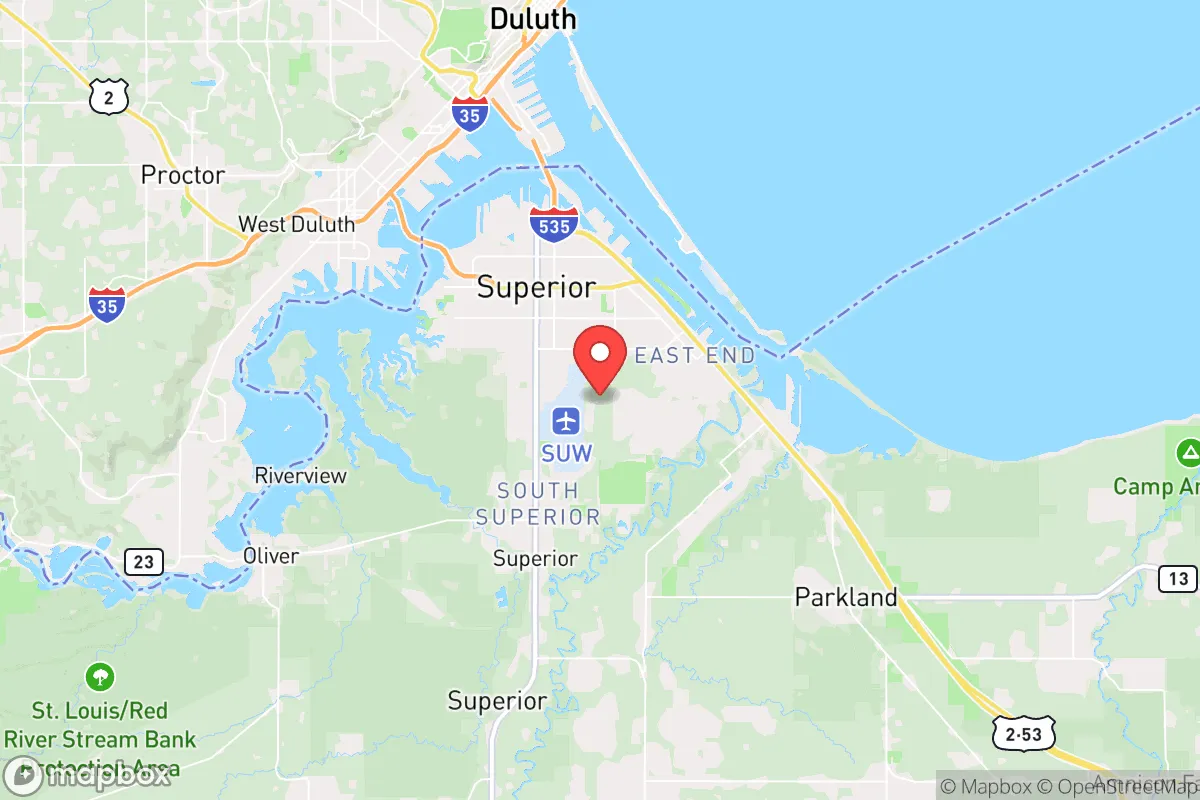
Photo: Wikipedia
Personal Sovereignty in Superior, WI
Moderate friction. Expect trade-offs in some aspect of personal liberty and independence.
What does Personal Sovereignty tell us?
Personal Sovereignty measures your capacity for self-reliance and independence with minimal government friction. Higher scores mean fewer barriers between you and the way you want to live... but it assumes you have the space you need and good neighbors.
What does this tell us?
Personal Sovereignty measures your capacity for self-reliance and independence with minimal government friction. Higher scores mean fewer barriers between you and the way you want to live... but it assumes you have the space you need and good neighbors.
State Policy
Energy independence: Importer (15% of energy produced in-state)
Personal Liberty
Homesteading

Personal Liberty Analysis
Superior, Wisconsin, offers a notably higher degree of personal sovereignty than many comparably sized Midwestern towns, largely due to its position in a state with strong preemption laws and a deeply ingrained culture of self-reliance. For the individual or family operating from a survivalist or prepper mindset, the city provides a meaningful buffer against the most aggressive forms of government overreach, though it is not a libertarian utopia. The key trade-off is between a relatively light regulatory touch at the local level and a state government that, while not as heavy-handed as neighboring Minnesota, still maintains significant control over taxation and certain personal behaviors. This analysis examines the specific levers of autonomy—tax burden, self-defense law, homesteading viability, and personal liberties—to determine if Superior is a viable redoubt for those seeking to maximize their freedom.
Tax burden and regulatory posture: How much of your income and property stays yours
Wisconsin’s tax posture is a mixed bag for the sovereignty-minded. The state imposes a progressive income tax with rates ranging from 3.54% to 7.65% in 2026, which is moderate compared to high-tax states like California or New York but still a significant bite. Property taxes in Superior are a more pressing concern: Douglas County’s effective rate hovers around 1.8% of assessed value, which is above the national average. This is a direct cost of living in a state that funds local services heavily through property levies. However, the regulatory environment at the city level is comparatively lean. Superior has no local income tax, and its zoning code, while present, is less restrictive than in neighboring Duluth, Minnesota. For a prepper, this means fewer bureaucratic hurdles for basic property modifications—like building a detached garage or installing a backup generator—though any major construction still requires permits. The state’s business climate is ranked in the middle of the pack nationally, but for a self-employed individual or small homesteader, the primary burden is the income tax, not a web of local fees or licensing requirements. The key takeaway: you will pay a noticeable share of your earnings to the state, but you face less local regulatory friction than in many other regions.
Self-defense and gun law specifics: What you can carry, own, and where
Wisconsin is a shall-issue state for concealed carry, meaning that if you meet the basic requirements—age 21, no felony record, completion of a training course—the state must issue you a permit. This is a critical distinction from may-issue states where local sheriffs can deny permits arbitrarily. Open carry is legal without a permit for anyone legally allowed to possess a firearm, though local ordinances in Superior do not restrict it. The state also has strong preemption laws: no city or county can enact its own gun control measures that are stricter than state law. This means Superior cannot ban certain firearms, limit magazine capacities, or impose waiting periods beyond what the state mandates. For the survivalist, this is a solid foundation. The state does require a background check for all firearm purchases from licensed dealers, but private sales between individuals are not subject to a state-level check. There is no registry of firearms or ammunition. Stand-your-ground laws are in effect, with no duty to retreat in any place where you are lawfully present. Castle doctrine protections apply to your home, vehicle, and place of business. In practical terms, you can own, carry, and use firearms for self-defense with minimal government interference, and the local government cannot erode those rights. This places Superior in a strong position relative to states like Illinois or Minnesota, where local control can create a patchwork of restrictions.
Self-reliance and homesteading viability: Lot sizes, zoning, and off-grid feasibility
For those looking to reduce dependency on centralized systems, Superior offers moderate but real opportunities. Within the city limits, standard residential lots range from 5,000 to 10,000 square feet, which is enough for a substantial vegetable garden, a small chicken coop, and a workshop. Zoning in most residential areas allows for accessory structures like sheds and greenhouses without special permits, as long as they meet setback requirements. However, keeping livestock beyond chickens—such as goats or pigs—is generally prohibited within city limits. For a more serious homesteading operation, you need to look at the unincorporated areas of Douglas County, where lot sizes of one to five acres are common and zoning is far more permissive. Off-grid feasibility is a mixed picture. Wisconsin has no state law explicitly banning rainwater collection, but the Department of Natural Resources (DNR) has historically taken a restrictive stance on water rights, requiring permits for large-scale collection systems. Solar panels are legal and net metering is available, but the state’s utility companies have lobbied to reduce the financial incentives. A fully off-grid home—with no connection to the electrical grid or municipal water—is legally possible in rural areas, but you will face significant regulatory hurdles from the DNR regarding well drilling and wastewater treatment. The practical advice: Superior itself is good for a semi-self-reliant lifestyle, but true off-grid independence requires moving into the county and navigating state-level environmental regulations that can be cumbersome.
Personal liberties: Parental rights, medical autonomy, speech, and property
Wisconsin’s legal framework generally respects parental rights, though it is not as strong as some states that have passed explicit “parental bill of rights” laws. Parents have the right to direct their child’s education, including homeschooling, which is relatively straightforward to establish with minimal state oversight. Medical autonomy is a more contested area. Wisconsin does not have a broad religious exemption for vaccine mandates, but it also does not have a state-level vaccine passport requirement. During the COVID-19 pandemic, the state saw significant pushback against public health orders, and the current political climate leans toward individual choice in medical decisions. For the prepper, this means you are unlikely to face forced medical interventions, but you should be aware that the state health department retains significant emergency powers. Free speech protections are robust, as Wisconsin is not a state that has enacted broad hate speech laws or restrictions on political expression. Property rights are generally strong, with the state having a relatively low rate of eminent domain abuse. However, the DNR’s authority over wetlands and waterways can be a point of friction for landowners who want to modify their property. The overall assessment: personal liberties in Superior are above average for the Midwest, with the main threats coming from state-level agencies rather than local government. The city council is not activist in nature, and the local culture is one of live-and-let-live.
In the broader context of the United States, Superior, Wisconsin, ranks as a moderately strong location for personal sovereignty. It is not a free-zone like parts of rural Idaho or Alaska, but it offers a solid foundation for those who want to live with minimal government interference in their daily lives. The primary drawbacks are the state income tax and property tax burden, which are real and ongoing costs. The primary strengths are the gun laws, the lack of local overreach, and the cultural acceptance of self-reliance. For a conservative-leaning individual or family looking to relocate to a place where you can defend yourself, raise your children with minimal state interference, and pursue a semi-self-sufficient lifestyle, Superior is a viable option—provided you are willing to pay the tax price for the privilege. The city’s location on the border with Minnesota also offers a strategic advantage: you can access the amenities of a larger metro area while living under a more freedom-respecting legal regime. It is not a perfect sanctuary, but it is a defensible position.

* Values derived from national, state, county, city and local statistics and may differ in a specific area. Last updated: 2026-04-30T00:21:38.000Z
Narrative content on this page is AI-generated and may contain mistakes. Verify any details that matter before acting on them.
ReloMaps may earn a commission from affiliate links at no extra cost to you.

