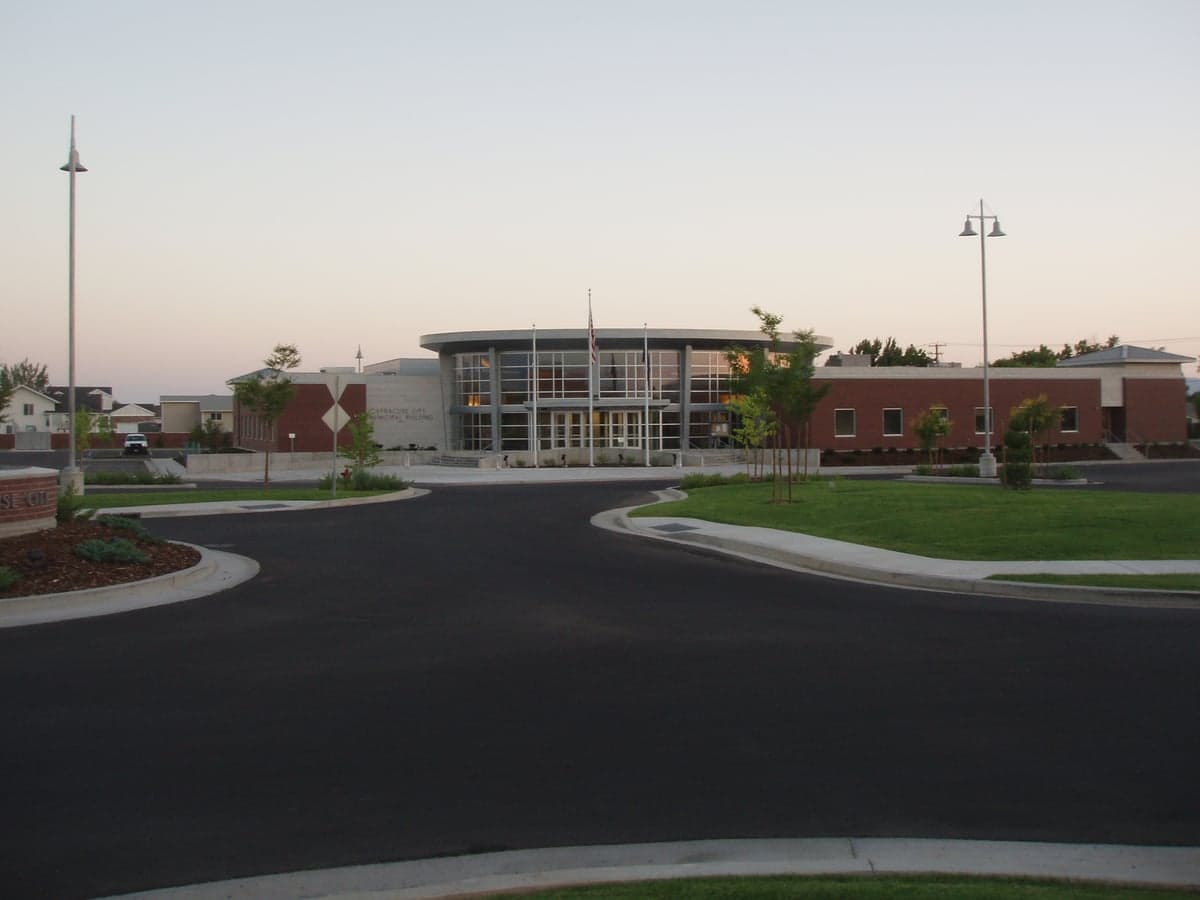
Photo: Wikipedia
Demographics of Syracuse, UT
Historical data isn't available for Syracuse, UT. Trends shown are for Davis County, UT.
Affluence Level in Syracuse, UT
An upper-middle-class area. Household wealth, education levels, and homeownership run ahead of national benchmarks.
People of Syracuse, UT
The people of Syracuse, Utah, today form a predominantly white, family-oriented community of 34,009 residents, characterized by a notably low foreign-born population of just 1.3% and a strong Latter-day Saint (Mormon) cultural influence. The city’s identity is rooted in its agricultural past and rapid suburban expansion, with a population that is 85.5% white, 8.5% Hispanic, and 1.6% East/Southeast Asian. Residents value safety, space, and community cohesion, with 38.2% holding a college degree, reflecting a solidly middle-to-upper-middle-class demographic that is both stable and slowly diversifying.
How the city was settled and grew
Syracuse was settled in the 1850s by Mormon pioneers dispatched by Brigham Young to farm the fertile benchlands along the Great Salt Lake. The original settlers were predominantly of Northern European descent—English, Danish, and Swedish converts to the LDS Church—who established small farms and orchards. The historic Syracuse Town Center, centered around 1700 West and 7500 South, was the original village core where these families built homes, a meetinghouse, and a school. The city remained a tiny agricultural hamlet for over a century, with the population barely reaching 1,000 by 1950. The primary draw was land: the federal Homestead Act and later the LDS Church’s land distribution system allowed families to claim acreage for dryland farming and livestock. The Bluff Ridge area, along the eastern bench, was settled later by second-generation farmers who subdivided larger plots into smaller family farms.
Modern era (post-1965)
The modern transformation of Syracuse began in earnest after 1990, driven by the suburbanization of Davis County and the expansion of Hill Air Force Base. The 1965 Hart-Cellar Act had minimal direct impact on Syracuse—the city’s foreign-born population remains negligible at 1.3%—but the broader Wasatch Front’s growth drew domestic migrants from other Western states. The major wave was white, middle-class families from California, Idaho, and other Utah counties seeking affordable new construction and low crime. The West Point Station subdivision, built in the late 1990s, absorbed many of these newcomers, offering large single-family homes on quarter-acre lots. The Jensen Farms neighborhood, developed in the 2000s, became a hub for families with ties to Hill Air Force Base, adding a small but visible East/Southeast Asian population (1.6%)—primarily military and civilian defense contractor families of Filipino, Korean, and Vietnamese heritage. The Hispanic population (8.5%) grew more gradually, concentrated in older rental stock near the Syracuse Crossing commercial corridor, where many work in construction, landscaping, and service jobs. The Indian-subcontinent population (0.3%) and Black population (0.8%) remain very small, with no distinct ethnic enclave.
The future
Syracuse’s population is projected to continue growing, but at a slowing pace as buildable land diminishes. The city is not tribalizing into distinct enclaves; rather, it is homogenizing around a white, LDS-majority core, with Hispanic and East/Southeast Asian residents slowly assimilating into the broader community through intermarriage and shared school and church activities. The Antelope Crossing master-planned community, currently under development near the lake, will add roughly 2,000 homes, likely attracting more out-of-state white families and a small number of Asian and Hispanic professionals. The foreign-born share is unlikely to rise above 3% in the next decade, as Syracuse lacks the rental housing stock and industrial job base that attract larger immigrant populations. The city’s college attainment rate (38.2%) is likely to edge upward as new residents are disproportionately white-collar workers commuting to Salt Lake City or Ogden.
For someone moving in now, Syracuse is becoming a stable, culturally conservative suburb where demographic change is gradual and largely driven by domestic migration. The population is not diversifying rapidly, but the small Hispanic and East/Southeast Asian communities are integrating into the social fabric rather than forming separate enclaves. The city offers a predictable, family-oriented environment with strong schools and low crime—a place where the population’s future looks much like its present, only slightly larger and marginally more diverse.

* Values derived from national, state, county, city and local statistics and may differ in a specific area. Last updated: 2026-04-21T12:57:51.000Z
Narrative content on this page is AI-generated and may contain mistakes. Verify any details that matter before acting on them.
ReloMaps may earn a commission from affiliate links at no extra cost to you.

