Photo: Wikipedia
Demographics of Takoma Park, MD
Affluence Level in Takoma Park, MD
An upper-middle-class area. Household wealth, education levels, and homeownership run ahead of national benchmarks.
People of Takoma Park, MD
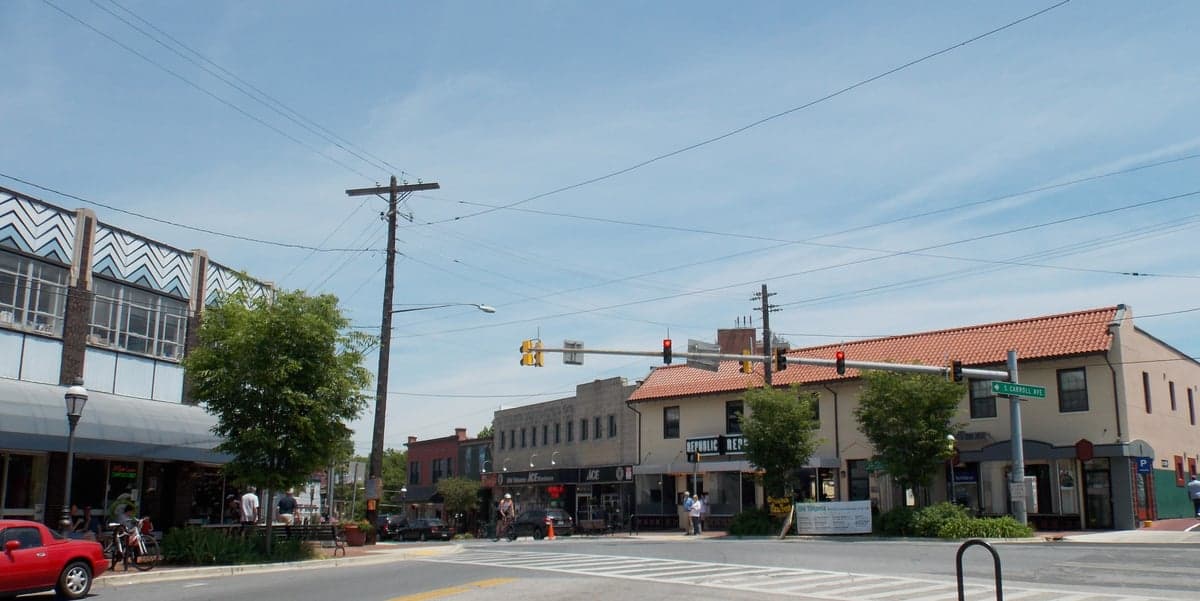
Takoma Park, Maryland, is a densely settled, highly educated city of 17,522 residents where no single racial or ethnic group holds a majority. Its population is defined by a distinctive blend of progressive activism, historic Black communities, and a growing Hispanic presence, all set within a small-town, walkable environment just over the District of Columbia line. With 60.3% of adults holding a college degree and a foreign-born share of 13.2%, the city attracts professionals, artists, and immigrant families who value its leafy streets, strong public schools, and deep civic engagement.
How the city was settled and grew
Takoma Park was founded in 1883 as a railroad suburb of Washington, D.C., named after the Indigenous word for Mount Rainier. The original population was overwhelmingly white, middle-class, and drawn by the promise of a rural retreat with easy commuter rail access to the capital. The earliest neighborhoods—North Takoma and Takoma Junction—were platted around the B&O Railroad station, with large Victorian homes built for government clerks and business owners. By the early 1900s, a small but significant African American community had formed in the Lincoln Avenue area, drawn by jobs in domestic service and construction in the expanding capital. This Black enclave grew steadily through the Great Migration, with families purchasing homes in the Carroll Avenue corridor and around Piney Branch Road, establishing churches, schools, and social institutions that remain anchors today. The city’s population peaked at roughly 18,000 in the 1950s, then declined slightly as post-war suburbanization pulled white families to newer developments farther out in Montgomery County.
Modern era (post-1965)
The 1965 Hart-Cellar Immigration Act and the broader civil rights movement reshaped Takoma Park’s population dramatically. White flight from D.C. accelerated in the 1970s, but Takoma Park absorbed it differently than many suburbs: the city’s existing Black community grew, and new waves of immigrants began arriving. By the 1980s, Long Branch—a neighborhood straddling the city’s eastern edge—became a primary landing zone for Central American immigrants, particularly from El Salvador and Guatemala, drawn by affordable housing and proximity to D.C.’s service economy. This Hispanic population has grown steadily, reaching 13.9% of the city today. Meanwhile, the city’s white population, which had been in decline, rebounded in the 1990s and 2000s as young professionals and families—many affiliated with nearby universities or federal agencies—were attracted by Takoma Park’s historic housing stock, walkability, and reputation as a progressive enclave. East and Southeast Asian residents (2.8%) and Indian-subcontinent residents (1.7%) arrived in smaller numbers, often settling in the New Hampshire Avenue corridor and the Flower Avenue area, drawn by the same factors. The result is a city that is 42.5% white, 32.5% Black, 13.9% Hispanic, and 4.5% Asian/Indian combined—a multiethnic mosaic that remains notably stable, with little of the rapid racial turnover seen in some neighboring jurisdictions.
The future
Takoma Park’s population is likely to remain stable in size but continue diversifying slowly. The Hispanic share is the fastest-growing segment, driven by both new immigration and higher birth rates, and is expected to approach 18-20% within a decade. The Black population, while still substantial, is aging and may decline slightly as younger Black families are priced out by rising home values. The white population, buoyed by continued in-migration of college-educated professionals, will likely hold steady or grow modestly. East/Southeast Asian and Indian communities are small but growing, particularly in the Takoma-Langley Crossroads area, where new apartment construction is attracting younger, more diverse households. The city is not homogenizing; rather, it is becoming more layered, with distinct enclaves—North Takoma remains predominantly white and affluent, Lincoln Avenue retains its historic Black character, and Long Branch is increasingly Hispanic—while the city as a whole maintains a shared identity around progressive politics and civic engagement.
For someone moving in now, Takoma Park offers a stable, highly educated, and politically engaged community where diversity is a lived reality, not just a statistic. The population is not trending toward a single majority group but toward a complex, multiethnic balance that rewards residents who value neighborhood-level distinctiveness and active participation in local governance. It is a place where the past—from railroad suburb to civil rights battleground to immigrant gateway—remains visible in the streets and faces of its people.

* Values derived from national, state, county, city and local statistics and may differ in a specific area. Last updated: 2026-04-22T08:42:01.000Z
Narrative content on this page is AI-generated and may contain mistakes. Verify any details that matter before acting on them.
ReloMaps may earn a commission from affiliate links at no extra cost to you.

