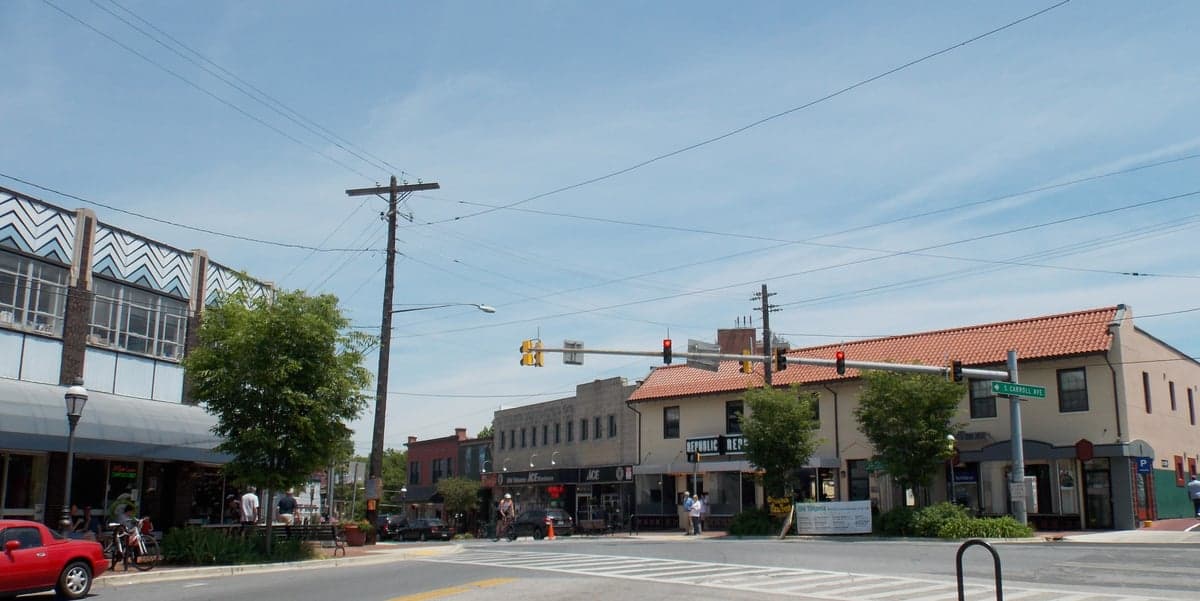
Photo: Wikipedia
Political ClimatePolitical Climate in Takoma Park, MD
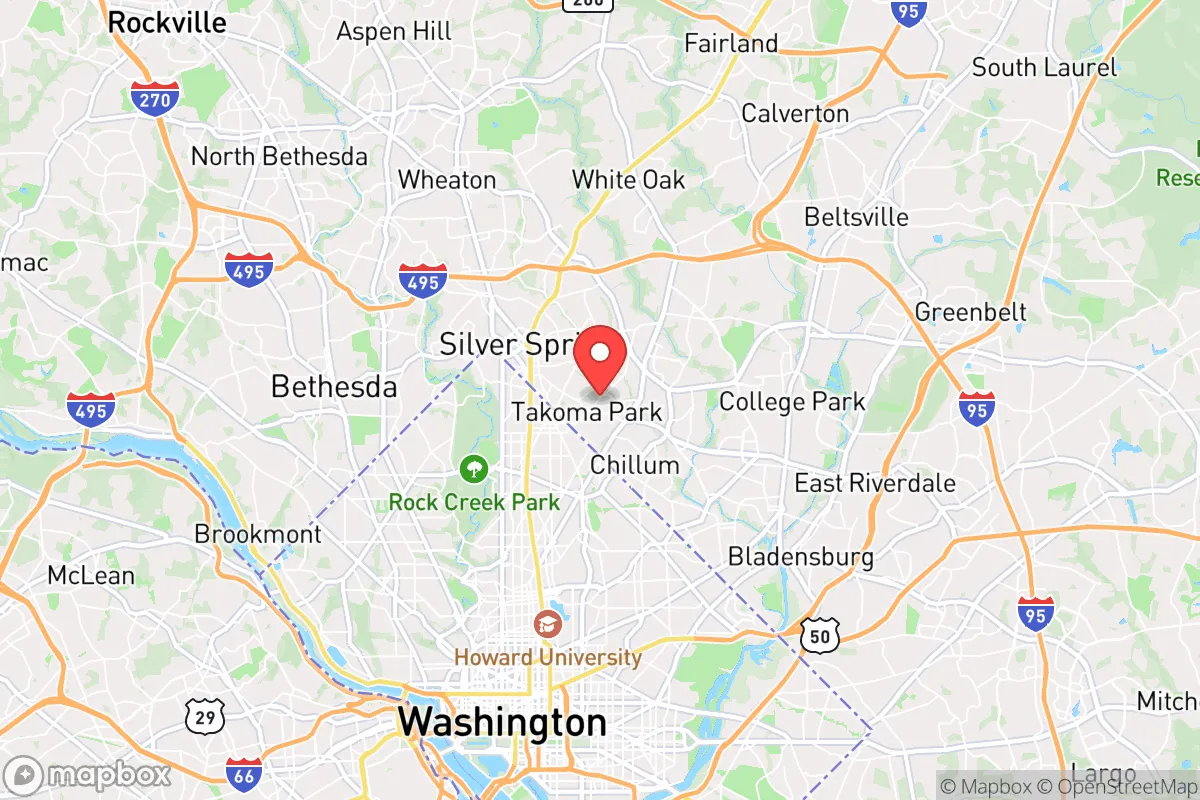
District shown is the primary district for this city’s centroid. Cities may span multiple districts.
Local Political AnalysisPolitical Analysis of Takoma Park, MD
Look, I’ve lived in Takoma Park long enough to remember when it was just a quirky little suburb with a strong sense of community, not a political laboratory. Today, it’s one of the most reliably progressive enclaves in the entire country, with a Cook PVI of D+30—meaning it votes about 30 points more Democratic than the national average. That’s not just a lean; it’s a near-total lock for left-of-center candidates at every level. The trajectory has been steadily leftward for decades, but the pace has accelerated since 2020, with local elections often turning on how aggressively to pursue policies like rent control, sanctuary city status, and police reform. If you value personal freedoms and limited government, this shift is something to watch closely.
How it compares
To understand just how deep the blue runs here, you have to look at the neighbors. Drive five minutes east into Silver Spring, and you’ll find a similar progressive vibe, though it’s a bit more mixed with moderate Democrats and a growing immigrant population. Head west into Kensington or north into Wheaton, and you’ll see slightly more balanced electorates—still heavily Democratic, but with pockets of fiscal conservatism and a stronger small-business voice. The real contrast is Olney, about 15 minutes north, where you’ll find more families who lean center-right on taxes and school policy, and even a few Republican precincts. Takoma Park, though, is in a league of its own: it’s the only city in Montgomery County that declared itself a “nuclear-free zone” in the 1980s and has never looked back. The local government here doesn’t just lean left—it actively competes to be the most progressive jurisdiction in the state, often passing symbolic resolutions that have no practical effect but send a clear message about who’s welcome and who isn’t.
What this means for residents
For a resident who values personal freedom, the practical effects are real and growing. The city council has steadily expanded its reach into areas like rent control (capping annual increases at 2.5% plus inflation), mandatory paid sick leave for all workers, and a sanctuary city ordinance that limits cooperation with federal immigration enforcement. Property taxes are among the highest in the county, and the city has its own police force that’s been under constant pressure to defund or restructure. If you own a small business or a single-family home, you’ll feel the squeeze: permits take longer, zoning is restrictive, and any new development is fought tooth and nail by activist groups. The upside is a very safe, walkable community with excellent schools and a vibrant arts scene—but the trade-off is a government that doesn’t hesitate to tell you how to run your property, your business, or even your lawn (yes, there are strict rules about pesticide use and native plants).
One thing that sets Takoma Park apart is its culture of hyper-local activism. The city has a “Democracy Fund” that provides public matching funds for local candidates, which sounds good until you realize it’s fueled a cottage industry of single-issue activists who run for office on platforms like banning gas-powered leaf blowers or mandating all-electric new construction. The city also has a Youth Council that advises the mayor on policy, and a Police Community Advisory Board that reviews use-of-force incidents. These aren’t bad ideas on their own, but they create a dense layer of bureaucracy that can feel suffocating if you just want to live your life without a dozen committees weighing in on your choices. If you’re considering a move here, know that you’re not just buying a house—you’re joining a political project. For some, that’s a feature. For others, it’s a red flag worth heeding.

State Political ClimatePolitical Climate in Maryland
State Political AnalysisPolitical Environment in the State
Maryland has long been a solidly blue state in federal elections, but its political climate is far more nuanced than the statewide numbers suggest. The state hasn't voted for a Republican presidential candidate since George H.W. Bush in 1988, and Democrats hold supermajorities in both chambers of the General Assembly. However, this dominance masks a deep and growing urban-rural divide, with the liberal Baltimore-Washington corridor increasingly dictating policy for the rest of the state. Over the past 10-20 years, the state has shifted leftward on cultural and economic issues, driven by explosive population growth in the D.C. suburbs and a steady exodus of conservative-leaning voters from rural counties.
Urban vs. rural divide
The political map of Maryland is essentially a tale of two states. The heavily populated "I-95 corridor" — anchored by Baltimore City, Montgomery County, and Prince George's County — delivers overwhelming Democratic majorities. In 2024, Montgomery County alone gave Kamala Harris a margin of over 300,000 votes, effectively deciding the statewide outcome before rural votes were even counted. Meanwhile, the Eastern Shore and Western Maryland are reliably Republican. Garrett County, the state's westernmost county, voted +45 points for Donald Trump in 2024, while Carroll County (northwest of Baltimore) has become a conservative stronghold, voting +30 R. The divide is starkest in the central part of the state: Howard County and Anne Arundel County have trended blue as D.C. commuters move in, while Harford County remains a red island. The city of Frederick has gentrified rapidly, flipping from purple to solid blue, while the surrounding Frederick County remains competitive. If you're looking for a conservative community, you'll find it in places like Hagerstown, Cumberland, or the rural parts of the Eastern Shore — but you'll be increasingly outnumbered at the ballot box.
Policy environment
Maryland's policy environment is a textbook example of progressive governance with a heavy hand. The state has a graduated income tax with a top rate of 5.75%, but when you add county-level "piggyback" taxes, effective rates can exceed 9% in Baltimore City and Montgomery County. Property taxes are high, and the state's estate tax kicks in at just $5 million, hitting family farms and small businesses hard. On the regulatory front, Maryland has some of the strictest environmental laws in the nation, including a ban on fracking and aggressive renewable energy mandates. Education policy is dominated by the Blueprint for Maryland's Future, a massive $3.8 billion annual plan that centralizes control in Annapolis and mandates union-friendly staffing ratios — critics say it drives up costs without improving outcomes. School choice is virtually nonexistent; charter schools are rare and tightly controlled. Healthcare is heavily regulated, with a state-based insurance exchange and a recent push toward a public option. Election laws are among the most liberal in the country: no-excuse mail-in voting, same-day registration, and automatic voter registration are all law. For a conservative, the policy environment feels like a slow but steady march toward a European-style social democracy, with little room for local variation.
Trajectory & freedom
Maryland is becoming less free by almost any measure, and the trend has accelerated since 2020. On gun rights, the state passed the Gun Safety Act of 2023, which bans the carry of firearms in a long list of "sensitive places" — including restaurants that serve alcohol, public transportation, and any private property without explicit permission. This effectively nullifies the spirit of the Bruen decision. On parental rights, the Transgender Health Equity Act of 2023 removed parental consent requirements for gender-affirming care for minors, overriding the rights of parents to make medical decisions. The state also passed a shield law protecting providers who perform abortions on out-of-state patients, positioning Maryland as a safe haven for those fleeing more restrictive states. On speech, the state has considered but not yet passed a social media "disinformation" bill that would regulate online content. Property rights are under pressure from the Maryland Department of the Environment, which has aggressively expanded wetland and buffer zone regulations, effectively limiting development on private land. The Fight for $15 minimum wage law, now at $15 an hour, has been phased in, raising costs for small businesses. The overall trajectory is one of expanding government control over daily life, with little pushback from the supermajority in Annapolis.
Civil unrest & political movements
Maryland has a history of civil unrest, most notably the 2015 Baltimore riots following the death of Freddie Gray, which led to a state of emergency and National Guard deployment. Since then, organized activist movements have become more institutionalized. On the left, groups like CASA de Maryland and the Maryland Progressive Alliance are highly effective at lobbying for sanctuary policies and rent control. The state is a sanctuary state in practice, with a 2019 law (the Maryland Trust Act) limiting local law enforcement cooperation with ICE. Immigration politics are a flashpoint in suburbs like Langley Park and Wheaton, where day laborers and immigrant communities have clashed with residents over noise, crowding, and crime. On the right, the Maryland Shall Issue gun rights group has been active in lawsuits, and the Maryland Republican Party has seen a grassroots takeover by Trump-aligned activists. Election integrity remains a hot-button issue; the 2020 and 2022 cycles saw allegations of ballot harvesting in Prince George's County, though no major prosecutions resulted. Visible flashpoints include the annual March for Life in Annapolis and counter-protests at the State House. A new resident would notice the political tension most acutely in the contrast between the liberal D.C. suburbs and the conservative rural areas — it's not uncommon to see "Fuck Biden" flags flying next to "In This House We Believe" signs on the same street in a place like Ellicott City.
Projection
Over the next 5-10 years, Maryland will likely become more liberal and more centralized. Demographic trends favor the Democrats: the D.C. suburbs are growing faster than the rest of the state, and in-migration from other blue states (especially New York and California) is accelerating. The rural population is aging and shrinking. The state's tax base is increasingly concentrated in Montgomery and Prince George's counties, giving those areas even more leverage in Annapolis. Expect further gun control measures (possibly a full ban on "assault weapons" and magazine capacity limits), expansion of the public option in healthcare, and a push for statewide rent control. The Blueprint for Maryland's Future will continue to drive up education spending without measurable improvement, and the state will likely become a leader in climate regulation, including a ban on gas-powered cars by 2035. For conservatives, the realistic outlook is that Maryland will become a one-party state in practice, with Republicans reduced to a rump faction representing the rural and exurban fringe. The only wildcard is a potential federal shift — if the Supreme Court curbs state power on issues like abortion or gun rights, Maryland's progressive agenda could be partially checked. But don't count on it.
Bottom line for a new resident: If you're a conservative moving to Maryland, you're choosing to live in a state where your vote will be a permanent minority, your taxes will be high, and your personal freedoms — especially on guns, parenting, and property — will be steadily eroded by a government that sees itself as your caretaker. The trade-off is access to a strong economy, excellent schools in certain counties, and proximity to D.C. But if you value local control, low taxes, and the right to live your life without a state mandate, you'll find yourself increasingly frustrated. The best bet for a conservative is to settle in a red county like Carroll or Garrett, where at least your local government will reflect your values — but even there, Annapolis will have the final say.
* Values derived from national, state, county, city and local statistics and may differ in a specific area. Last updated: 2026-04-22T08:42:01.000Z
Narrative content on this page is AI-generated and may contain mistakes. Verify any details that matter before acting on them.
ReloMaps may earn a commission from affiliate links at no extra cost to you.

