Photo: Wikipedia
Demographics of Talladega, AL
Affluence Level in Talladega, AL
A below-average socioeconomic profile. Incomes, home values, and educational attainment trail the U.S., with higher poverty and unemployment.
People of Talladega, AL
The people of Talladega, Alabama today form a majority-Black city of roughly 15,041 residents, a demographic reality rooted in the industrial, educational, and migration history of the region. With a foreign-born population of just 1.2% and a college attainment rate of 13.9%, the city is characterized by deep family roots, economic ties to manufacturing and healthcare, and a distinctly Southern cultural identity. The population is overwhelmingly native-born, with Black residents making up 53.5% and White residents 39.6%, while Hispanic and East/Southeast Asian communities together account for less than 4% of residents.
How the city was settled and grew
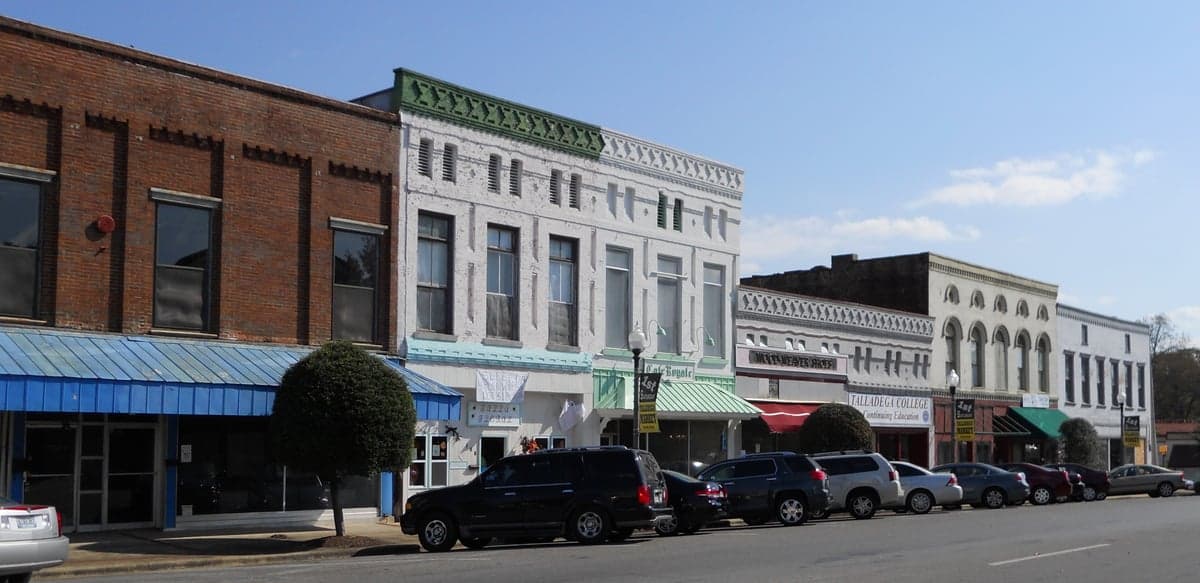
Talladega was founded in 1834 as a county seat and trading post on land that had been Creek Indian territory before forced removal. The earliest white settlers were largely Scots-Irish and English farmers migrating from the Carolinas and Georgia, drawn by fertile bottomland and the promise of cotton cultivation. A small planter class built large homes in what is now the Alpine district, which remains a historic pocket of antebellum architecture. The arrival of the Selma, Rome and Dalton Railroad in the 1850s brought a modest wave of German and Irish laborers, many of whom settled near the depot in what is today Downtown Talladega. After the Civil War, the economy shifted toward timber and textiles, and the founding of Talladega College in 1867 by the American Missionary Association became a magnet for freedmen seeking education and employment. East Talladega, the neighborhood surrounding the college, grew into the city’s historic Black professional and working-class community. The early 20th century saw textile mills rise, drawing rural white workers to West Talladega and the Battleground area, named after a minor Civil War skirmish site. By the mid-20th century, the city was a biracial Southern manufacturing town of roughly 13,000, with Black residents concentrated in East Talladega and white residents in West Talladega, Alpine, and Battleground.
Modern era (post-1965)
After the 1965 Hart-Cellar Act and the broader Civil Rights era, Talladega experienced familiar patterns of Southern demographic change. White population peaked in the 1970s then began a gradual decline as families moved to newer subdivisions in unincorporated areas or left the region entirely for Sun Belt metros. The opening of the Honda Manufacturing of Alabama plant in nearby Lincoln in 2001 brought some in-migration, but Talladega itself absorbed only modest spillover, mostly Hispanic workers in construction and service roles who settled in West Talladega and near the Industrial Park area. The Hispanic share now sits at 3.5%. The Black population grew from roughly 50% in the 1980s to 53.5% today, with the most stable concentration remaining in East Talladega and central neighborhoods near the college. The East/Southeast Asian community is very small at 0.3%, primarily individuals in professional roles at Talladega College or the local hospital. The Indian subcontinent population is effectively zero. The city’s total population has declined slightly from a 1990 peak of around 16,000, reflecting out-migration of younger, college-bound residents and an aging white cohort that has not been replaced.
The future
Talladega’s population is aging and slowly contracting. The foreign-born share, at 1.2%, is far below the national average and shows no signs of rapid growth; immigration from Latin America and Asia is negligible. The white population is older and continues to shrink through out-migration and natural decline, while the Black population remains stable but is also seeing some outward mobility among college graduates. The Hispanic community, while small, may see modest growth tied to agricultural and industrial labor demand in the surrounding county, but no significant enclave formation is underway. The college-educated share of 13.9% is low even by Alabama standards, suggesting that the city will remain a working-class and retirement-focused community. East Talladega and the central core are likely to stay majority-Black and economically modest, while Alpine and West Talladega will retain a smaller, older white population. The city is not tribalizing into distinct new enclaves but rather homogenizing by age and income as the young and the mobile continue to leave.
For someone moving in now, Talladega offers a quiet, affordable, and deeply rooted community, but one with limited economic mobility and modest demographic diversity. The city is becoming older, more settled, and more homogenous, with few new arrivals reshaping its character. Relocation here means joining a stable, traditional Southern town where family connections and local institutions—not rapid change—define daily life.

* Values derived from national, state, county, city and local statistics and may differ in a specific area. Last updated: 2026-05-14T18:50:34.000Z
Narrative content on this page is AI-generated and may contain mistakes. Verify any details that matter before acting on them.
ReloMaps may earn a commission from affiliate links at no extra cost to you.

