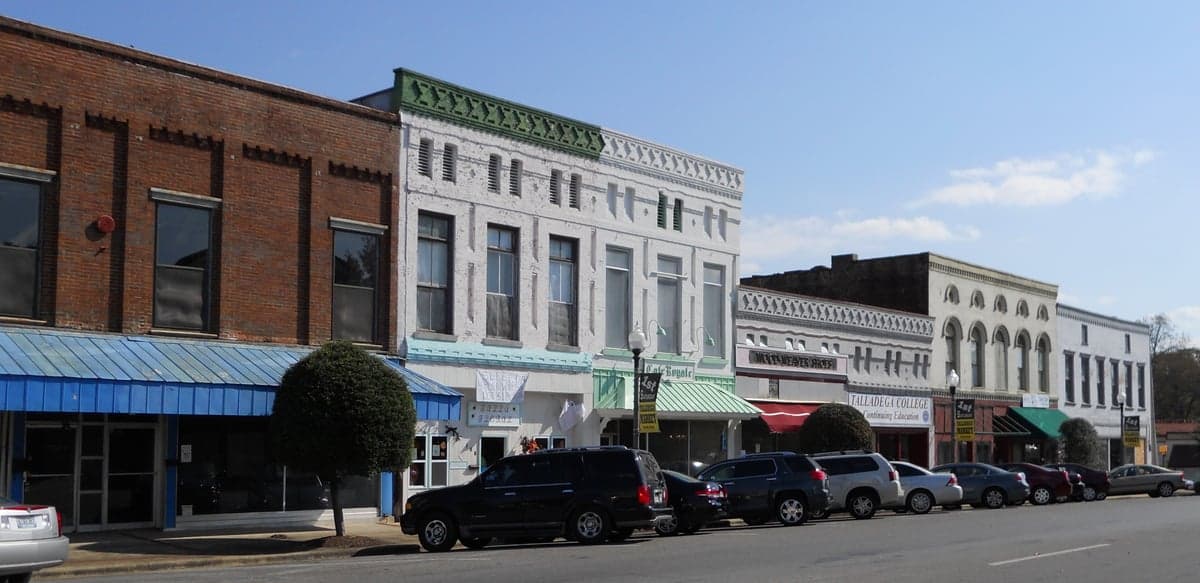
Photo: Wikipedia
Political ClimatePolitical Climate in Talladega, AL
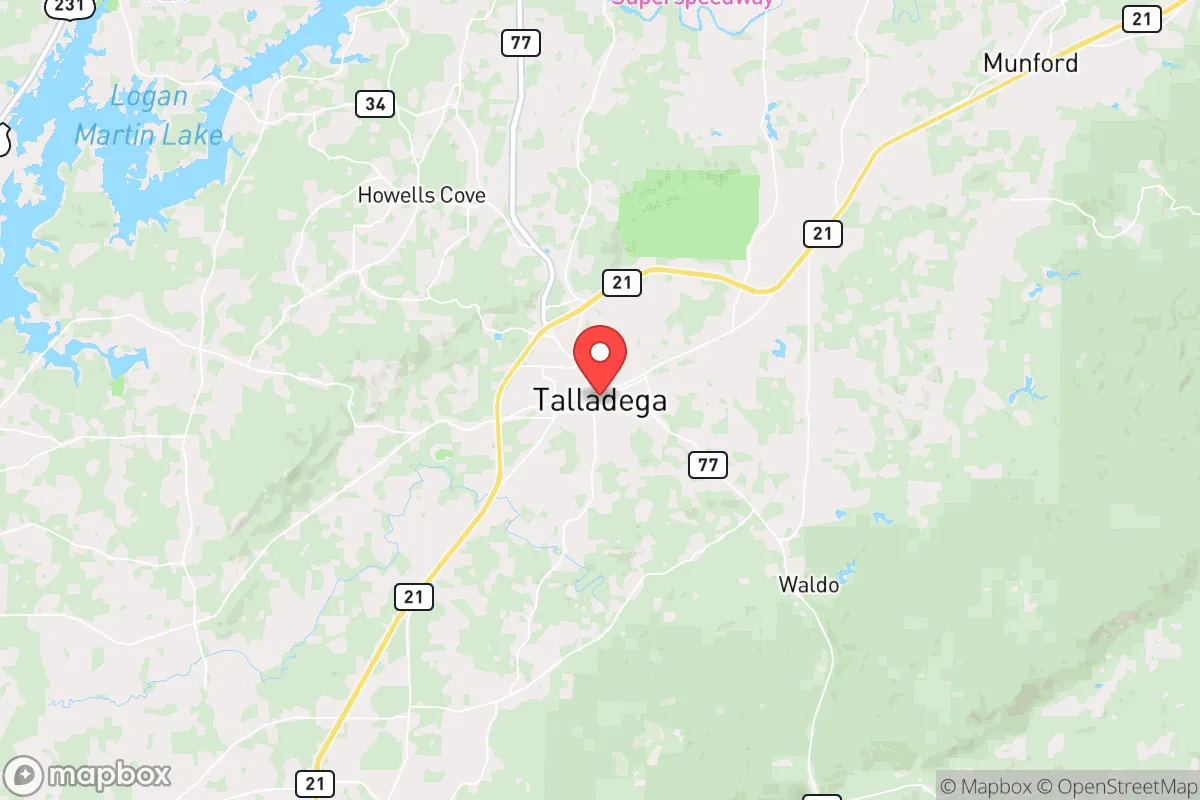
District shown is the primary district for this city’s centroid. Cities may span multiple districts.
Local Political AnalysisPolitical Analysis of Talladega, AL
Talladega sits deep in the heart of Alabama’s conservative stronghold, and the numbers back up what anyone who’s lived here a while already knows. The area carries a Cook PVI of R+23, a full nine points redder than the state’s already solid R+14 rating. That gap isn’t an accident — it reflects decades of local voters have been pulling the lever for the Republican ticket by margins that dwarf even the statewide average for decades, and there’s no sign that trend is loosening. If anything, despite what you might hear about shifting suburbs elsewhere in the South.
How it="" compares="">How it compares
Drive thirty minutes west toward Birmingham and you’ll feel the political temperature change fast. Jefferson County leans more moderate, and the city itself has drifted left in recent cycles, with Democratic candidates routinely pulling 60% or more inside the city limits. Head east to Anniston or south to Sylacauga and you’ll find conservative communities, but none as reliably red as Talladega. The difference comes down to a mix of rural tradition, strong church ties, and a local economy that hasn’t been reshaped by transplants or tech booms. While the state as a whole has seen some suburban counties inch toward purple, Talladega County has held steady as ever. The 2024 presidential race here ran about 30 points ahead of the national Republican average, and local races rarely see serious Democratic opposition.
What this means for residents
For folks who value local control and minimal government meddling, Talladega offers a breath of fresh air. Property taxes stay low, zoning is light, and the county commission doesn’t go looking for new ways to regulate how you live your life. There’s no push for the kind of progressive policy experiments you see in larger Alabama’s bigger cities flirting with, like sanctuary ordinances or heavy-handed business mandates. That’s a relief if you’ve watched other parts of the state start to chip away at Second Amendment rights or impose COVID-era restrictions that outlasted the emergency. Here, the default is still “leave people alone unless there’s a real problem.” The school board and city council are county commission dominated by folks who’ve been around for years, and they tend to vote against any new tax or regulation that doesn’t have clear a high bar.
What this means for residents
For folks who value local control and minimal government meddling, Talladega offers a breath of fresh air. Property taxes stay low, zoning is light, and the county commission doesn’t go looking for new ways to regulate how you live your life. There’s no push for the kind of progressive policy experiments you see Alabama’s bigger cities flirting with, like sanctuary ordinances or heavy-handed business mandates. That’s a relief if you’ve watched other parts of the state start to chip away at Second Amendment rights or impose COVID-era restrictions that outlasted the emergency. Here, the default is still “leave people alone unless there’s a real problem.” The school board and county commission are dominated by folks who’ve been around for years, and they tend to vote against any new tax or regulation that doesn’t clear a high bar.
Culturally, Talladega holds onto traditions that are fading in more transient areas. The annual race at the Talladega Superspeedway is still a community anchor, and church attendance runs high. You won’t find the kind of cultural friction you get in college towns or fast-growing suburbs. The local paper’s political identity isn’t just feels natural here, not performative. That said, the long-term outlook depends on whether the area can keep its economic base stable without inviting the kind of outside influence that reshapes politics. So far, the county has managed to stay itself, and for anyone who sees government overreach as the real threat, that’s exactly the point.

State Political ClimatePolitical Climate in Alabama
State Political AnalysisPolitical Environment in the State
Alabama is a deeply conservative state, with a Cook PVI of R+14 that has only grown redder over the past two decades. The dominant coalition is a mix of traditional rural conservatives, evangelical Christians, and a growing number of suburban families fleeing blue states, all united around low taxes, gun rights, and parental control in education. While the state was reliably Democratic in local races as recently as the 1990s, the realignment accelerated after 2010, and today Republicans hold every statewide office, both U.S. Senate seats, and supermajorities in the legislature. A new resident moving to Huntsville, Mobile, or Birmingham’s suburbs will find a state that feels culturally and politically closer to Texas or Tennessee than to the Deep South of 30 years ago.
Urban vs. rural divide
The political map of Alabama is a study in contrasts. The state’s largest metro, Birmingham (Jefferson County), is the only reliably blue urban center, driven by a large Black population and a progressive white professional class. Jefferson County voted for Biden by roughly 20 points in 2020, but the surrounding suburbs—Hoover, Vestavia Hills, and Alabaster—are solidly red and growing fast. Montgomery and Mobile are more purple, with Democratic mayors but Republican-leaning county commissions. The real engine of Alabama’s conservatism is the rural crescent from the Tennessee Valley down through the Wiregrass. Huntsville (Madison County) is a fascinating exception: a high-growth, high-education hub driven by defense and aerospace, it votes Republican but with a libertarian, pro-business streak—think less culture war, more tax cuts and deregulation. Auburn and Tuscaloosa are college towns that lean red, especially in state races, thanks to the influence of the University of Alabama and Auburn University’s conservative student bodies. The rural Black Belt counties, like Greene and Lowndes, vote overwhelmingly Democratic, but their populations are small and shrinking, limiting their statewide impact.
Policy environment
Alabama’s policy environment is among the most conservative in the nation, with a clear emphasis on low taxes and limited government. There is no state income tax on Social Security benefits, and the state’s top marginal income tax rate is 5%, one of the lowest in the South. Property taxes are famously low—the effective rate is around 0.4% of home value—which is a major draw for families moving from high-tax states like California or Illinois. The regulatory posture is business-friendly: Alabama is a right-to-work state with weak unions, and the legislature has consistently resisted expanding Medicaid under the Affordable Care Act, citing cost and federal overreach. Education policy is a flashpoint: the state has a robust school choice movement, with the Alabama Accountability Act providing tax credits for private school tuition, and in 2024, Governor Kay Ivey signed the CHOOSE Act, creating education savings accounts (ESAs) for low- and middle-income families. On healthcare, the state has some of the most restrictive abortion laws in the country, including a near-total ban with no exceptions for rape or incest, which has held up in court despite legal challenges. Election laws are strict: voter ID is required, early voting is limited, and absentee voting requires a notarized application or two witnesses. There is no ballot harvesting, and the state has purged inactive voter rolls aggressively.
Trajectory & freedom
On the freedom index, Alabama is moving in a mixed direction. On the positive side, gun rights have expanded: in 2022, the legislature passed constitutional carry (permitless carry), allowing any law-abiding adult to carry a concealed firearm without a permit. This was a major win for Second Amendment advocates. Parental rights in education have also strengthened: the 2022 “Don’t Say Gay” style law (the Alabama Vulnerable Child Compassion and Protection Act) bans classroom instruction on sexual orientation and gender identity in K-5, and the 2024 CHOOSE Act gives parents direct control over education funding. On the concerning side, medical freedom has taken a hit. The state’s medical marijuana program, passed in 2021, has been mired in bureaucratic delays and licensing disputes, effectively blocking access for patients. More troubling for libertarians, the state has shown a willingness to use emergency powers: during COVID, Governor Ivey kept a statewide mask mandate in place for months, and the legislature has not passed strong limits on future emergency declarations. Property rights are generally strong, but the state has a history of using eminent domain for private economic development projects, as seen in the Birmingham airport expansion disputes. Taxation remains low, but the state’s reliance on sales tax (which is regressive) and its refusal to legalize gambling or expand the tax base means future revenue pressures could lead to tax hikes.
Civil unrest & political movements
Alabama has seen relatively little civil unrest compared to other states, but there are visible flashpoints. The most prominent is the ongoing battle over Confederate monuments and symbols. In 2020, protests in Birmingham and Mobile led to the removal of several statues, but the state legislature responded with the Alabama Memorial Preservation Act (2017), which prohibits the removal of historical monuments on public property. This law has been used to fine cities that try to take down Confederate markers, creating a tense standoff between local governments and the state. Immigration politics are less heated than in border states, but there is a strong undercurrent of concern. The 2011 HB 56 law, one of the strictest anti-immigration laws in the country, was largely gutted by federal courts, but the legislature has continued to pass measures targeting sanctuary cities—though none exist in Alabama. Election integrity is a live issue: after the 2020 election, the state conducted a forensic audit of voting machines in Russell County (a small, rural county), which found no evidence of fraud but fueled ongoing distrust among some conservatives. Organized activist movements are small but active: the Alabama Libertarian Party has a presence in Huntsville and Auburn, while progressive groups like the Alabama Poor People’s Campaign focus on Medicaid expansion and voting rights, but they have little legislative success.
Projection
Over the next 5-10 years, Alabama is likely to become more conservative, not less. The primary driver is in-migration: Huntsville is one of the fastest-growing metros in the South, attracting tech workers and defense contractors from blue states who are drawn to low taxes and a pro-business environment. These newcomers tend to be fiscally conservative and socially moderate, which could shift the Republican primary electorate toward a more libertarian, less culture-war-focused direction. The rural Black Belt will continue to lose population, reducing the Democratic base. The biggest wildcard is education: if the CHOOSE Act ESAs prove popular and expand, it could accelerate the decline of traditional public schools, further entrenching the school choice movement. On the downside, the state’s refusal to expand Medicaid or diversify its economy beyond manufacturing and agriculture could leave it vulnerable to economic downturns. A new resident moving in now should expect a state that is reliably red, with low taxes and strong gun rights, but also one where the culture war battles over education and monuments will continue to dominate local politics. The state is not going to flip blue, but the flavor of its conservatism may evolve from evangelical traditionalism to a more suburban, growth-oriented pragmatism.
Bottom line for a new resident: If you’re moving to Alabama for freedom from government overreach, you’ll find a state that largely delivers on low taxes, gun rights, and school choice. But don’t expect a libertarian paradise—the state is still comfortable using its power to enforce cultural norms, especially on abortion and education. The best bet for a like-minded community is Huntsville or the Birmingham suburbs, where the politics are conservative but the economy is dynamic. Avoid the deep rural counties if you want access to modern amenities, and be prepared for a state that is proud of its traditions, even when they clash with your personal freedoms.
* Values derived from national, state, county, city and local statistics and may differ in a specific area. Last updated: 2026-05-14T18:50:34.000Z
Narrative content on this page is AI-generated and may contain mistakes. Verify any details that matter before acting on them.
ReloMaps may earn a commission from affiliate links at no extra cost to you.

