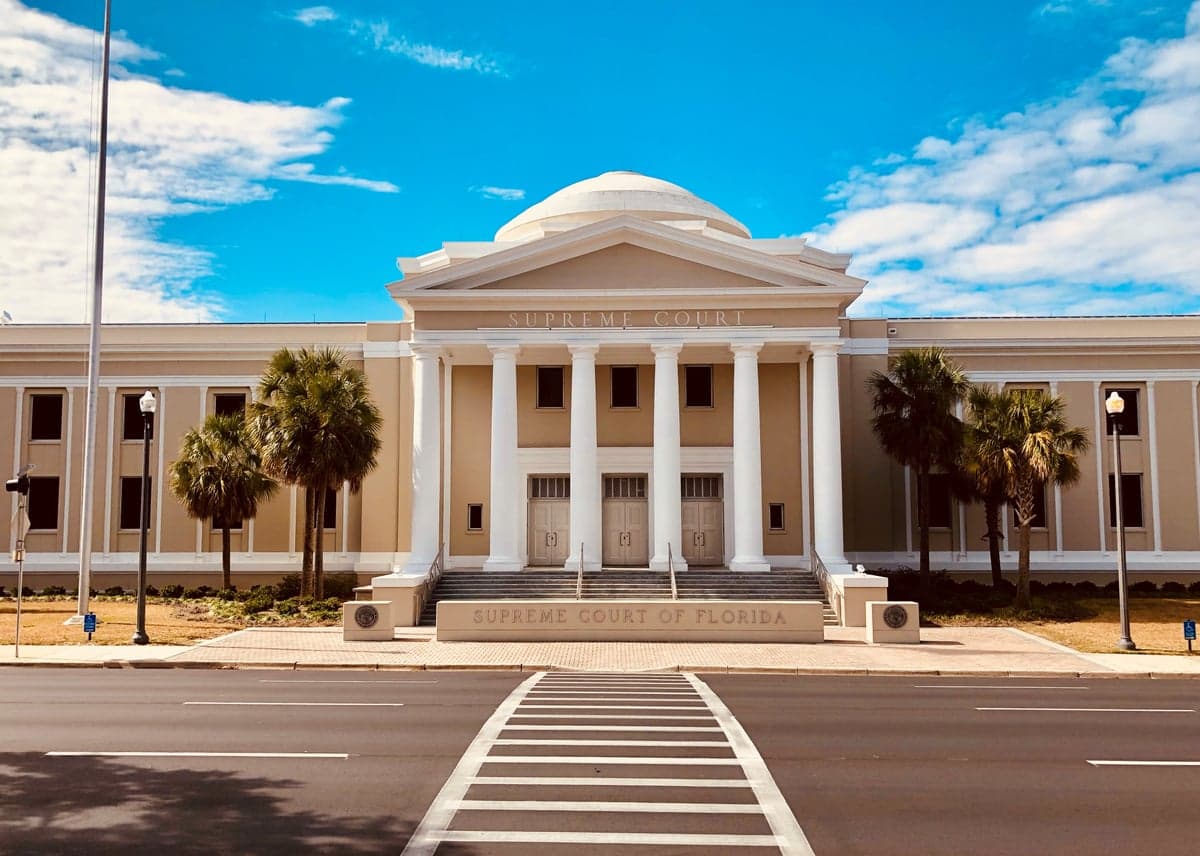
Photo: Wikipedia
Strategic Assessment of Tallahassee, FL
Meaningful friction. Expect exposure to either population pressure, blast zones, or natural disaster risk. Consider buying a retreat property.
What does the Strategic Assessment tell us?
Our Strategic Assessment grades tactical survivability of an area. Major population centers, military targets, fallout zones, natural disasters, and border exposure all drive risk — lower exposure means a more defensible position in a crisis.
This is heavily inspired by Joel Skousen's Strategic Relocation book. Highly recommended you checkout the book ($)What does this tell us?
Our Strategic Assessment grades tactical survivability of an area. Major population centers, military targets, fallout zones, natural disasters, and border exposure all drive risk — lower exposure means a more defensible position in a crisis.
This is heavily inspired by Joel Skousen's Strategic Relocation book. Highly recommended you checkout the book ($)Strategic Pillars

Key Distances
Regional Safe Places
Below is our recommended "safe zones" in Florida and the surrounding area based on our strategic heuristics. For most people, it's unrealistic to live in a “safe zone” full-time due to work, family or other personal reasons. They tend to be more rural. However, many of these areas are perfect for second homes and retreat properties that double as a vacation home or even a short-term rental.

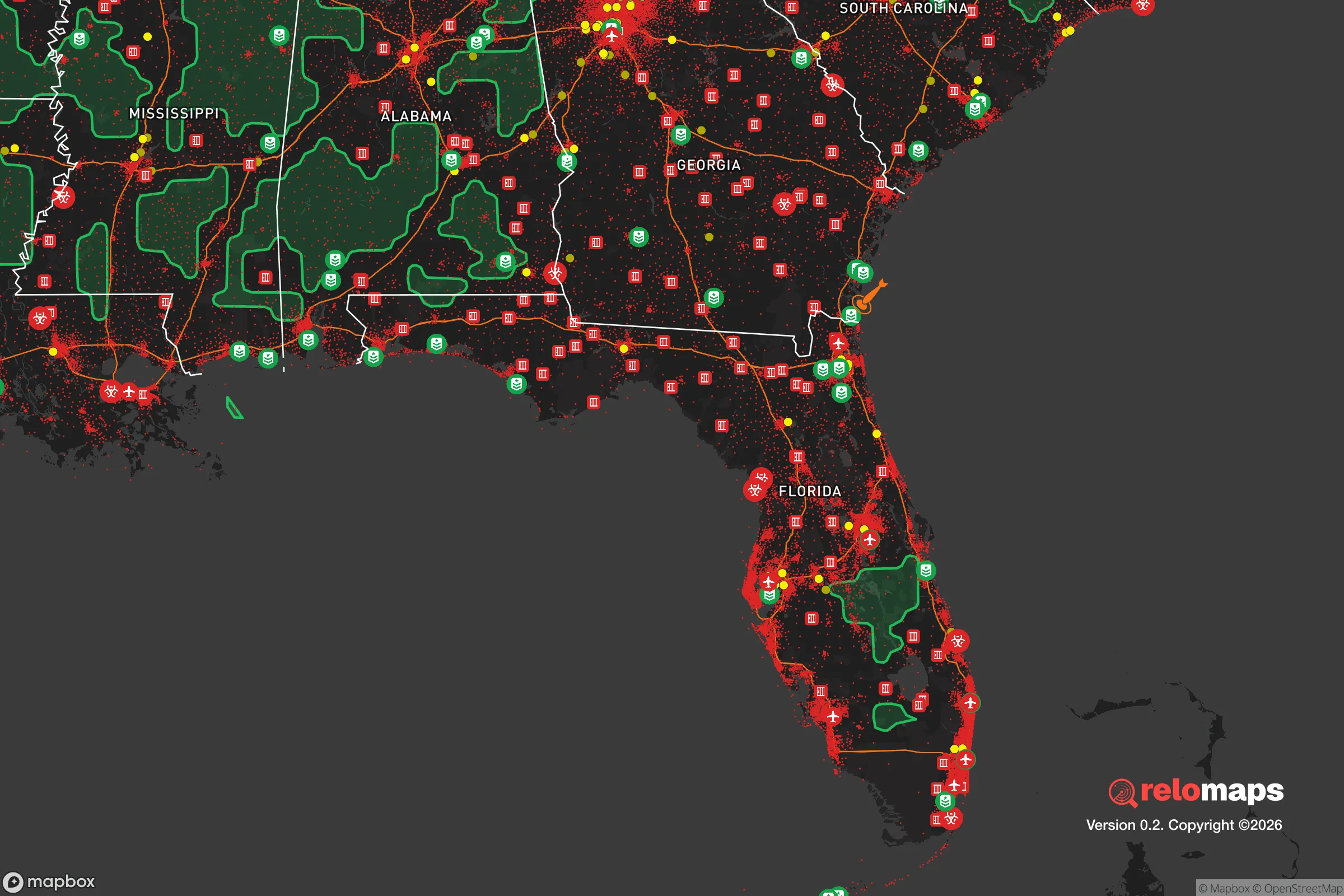


Important Note: For informational purposes only. This does not mean nothing bad ever happens in the green zones. Please use common sense. This is based on public data and modeled with AI. We tried to take a conservative approach but mistakes happen. We update this regularly as new information becomes available.
Solar Generator Recommendations
Backup power matters more here than in safer locations. We've picked three solar generators across budgets and capacity tiers — start with the budget unit if you only need a few essentials, or step up if you want to run a fridge and HVAC for days at a time.

Jackery Portable Power Station Explorer 300
Budget OptionPower on the Go: Weighing only 11 lbs, it's convenient to set up and store with book-sized foldable solar panels

BLUETTI Portable Power Station AC180
Designed for both indoor and outdoor scenarios, AC180 is highly capable as it has a robost capacity and continuous output power.

EF ECOFLOW DELTA Pro Ultra Power Station
Upgraded PickEcoFlow DELTA Pro Ultra is a whole-home energy system designed to grow with your family. Integrated with the Smart Home Panel 2, it scales to meet your evolving energy needs — keeping your home powered, intelligent, and secure through every stage of life.
We earn a commission, at no additional cost to you.
Strategic Assessment Analysis
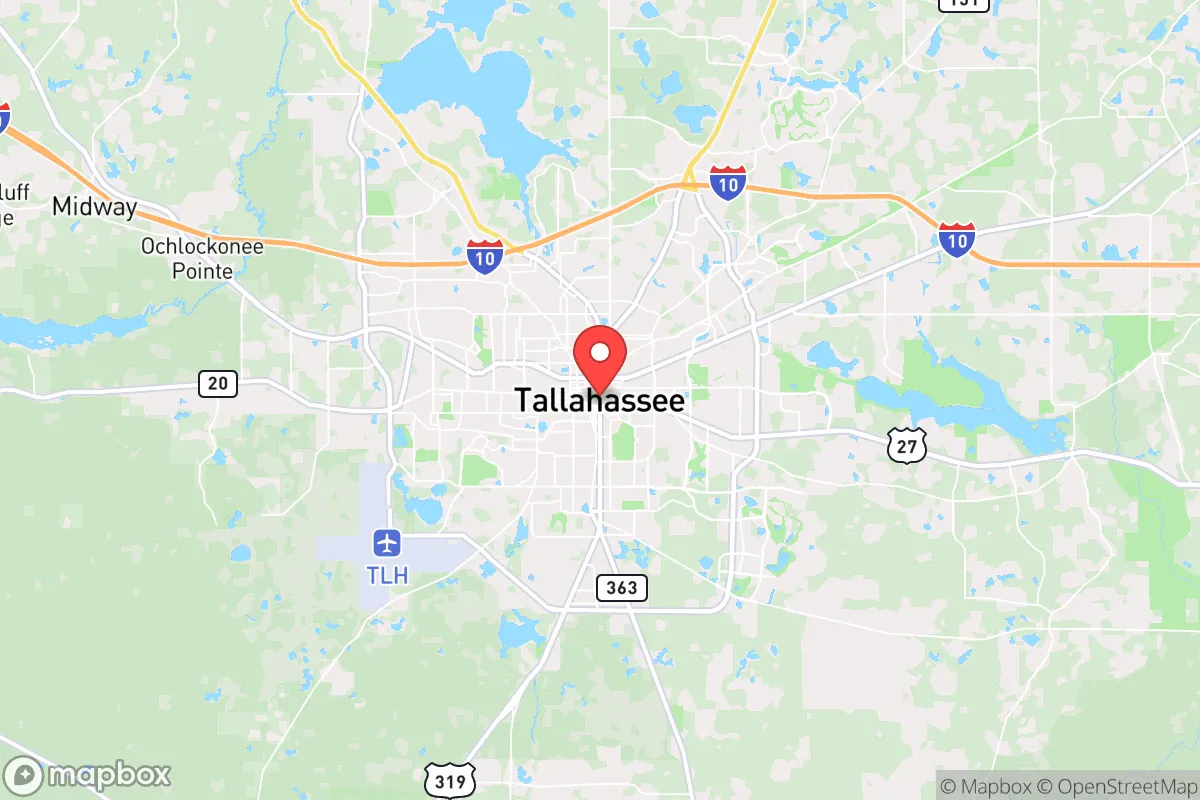
Tallahassee, Florida, occupies a unique strategic position that blends the advantages of a state capital with the relative isolation of the Florida Panhandle, making it a serious contender for those prioritizing resilience and self-sufficiency. While not a remote mountain redoubt, its location roughly 20 miles from the Georgia border and 60 miles from the Gulf of Mexico places it outside the immediate blast zones of major metropolitan targets like Jacksonville, Atlanta, or Tampa. For a relocator concerned with civic unrest or mass casualty events, Tallahassee offers a middle ground: enough infrastructure to support a functional community, but far enough from primary fallout dangers to provide a meaningful buffer. The city’s role as a political and administrative hub also means it has a robust emergency management apparatus, though this same centrality could make it a secondary target in a widespread conflict scenario.
Geographic position and natural advantages for strategic relocation
Tallahassee sits on the rolling red hills of the Florida Panhandle, a region that offers more topographic variety than most of the state. The area is defined by the Cody Escarpment, which provides natural drainage and elevation changes that are rare in Florida—useful for water management and defensive positioning. The city is surrounded by the Apalachicola National Forest to the southwest and numerous state forests and wildlife management areas to the north and east, creating a green belt that can serve as both a resource zone and a buffer against urban sprawl. The Ochlockonee River and Lake Talquin provide significant freshwater sources, while the region’s high water table and abundant rainfall (averaging 55 inches annually) support year-round agriculture. For a prepper, this means reliable access to surface water and the potential for off-grid food production, though the humid subtropical climate requires careful planning for mold and pest control. The proximity to the Gulf Coast also offers maritime resources, but the 60-mile distance from the coast reduces vulnerability to storm surge and naval threats.
Risks, exposures, and proximity to fallout-relevant landmarks
The primary strategic risk for Tallahassee is its status as the state capital, which could make it a target for civil unrest or targeted attacks during a breakdown of federal or state authority. The Capitol complex, Florida State University (FSU), and the Tallahassee International Airport are all potential flashpoints. While the city’s population of roughly 200,000 is small compared to major metros, it is dense enough that a mass casualty event—such as a coordinated attack or a pandemic outbreak—could overwhelm local healthcare resources. The city has only two major hospitals (Tallahassee Memorial Healthcare and Capital Regional Medical Center), and both are within a few miles of the Capitol. In terms of fallout from nuclear events, Tallahassee is roughly 200 miles from the nearest major nuclear power plant (the Joseph M. Farley Nuclear Plant in Alabama) and 250 miles from the Hatch Nuclear Plant in Georgia. This distance provides a significant safety margin, but prevailing winds from the west and northwest could carry fallout from a strike on Atlanta (250 miles north) or Jacksonville (160 miles east) within 12-24 hours. The city’s location in a hurricane-prone zone also means annual exposure to tropical storms and hurricanes, though the inland position reduces wind damage risk compared to coastal areas. Flooding is a concern in low-lying areas near Lake Talquin and the Ochlockonee River, but the elevated terrain of the city core offers natural protection.
Practical resilience for a relocator: food, water, energy, and defensibility
For a relocator focused on practical self-sufficiency, Tallahassee offers several advantages. The surrounding agricultural region supports cattle, poultry, and row crops like peanuts and cotton, and the city has a strong network of farmers’ markets and local food producers. The Apalachicola National Forest provides hunting opportunities for deer, turkey, and wild hogs, as well as timber for construction and fuel. Water access is excellent: Lake Talquin and the Ochlockonee River are reliable sources, and the high water table means shallow wells are feasible in most areas outside the city limits. The region’s energy grid is served by Talquin Electric Cooperative and the city’s own utility, which provides some redundancy, but solar potential is moderate due to frequent cloud cover and tree canopy. Defensibility is a mixed bag: the rolling hills and dense forests offer cover and chokepoints for those with rural property, but the city itself is relatively flat and open, with major highways (I-10 and US-319) providing easy access for potential adversaries. The best strategy for a prepper is to secure land in the rural counties surrounding Tallahassee—Leon, Gadsden, Wakulla, or Jefferson—where population density drops sharply and natural barriers increase. The local gun culture is strong, with numerous shooting ranges and a high rate of firearm ownership, which aligns with a conservative mindset focused on self-defense. However, the city’s liberal-leaning university population means political tensions could flare during unrest, so choosing a location outside the immediate urban core is advisable.
Overall, Tallahassee presents a balanced strategic picture for the conservative relocator: it is not a hardened survivalist retreat, but it offers a viable base of operations with access to resources, a manageable population density, and a buffer from the worst fallout dangers of the East Coast megalopolis. The key is to treat it as a hub rather than a final destination—a place to build networks, stockpile supplies, and establish a foothold in the region while maintaining the option to relocate deeper into the rural Panhandle or southern Georgia if conditions deteriorate. The city’s resilience is tied to its political and educational institutions, which could become liabilities in a collapse, but for those willing to navigate that complexity, Tallahassee provides a rare combination of infrastructure and isolation that is hard to find elsewhere in the Southeast. As with any strategic relocation, the real value lies not in the location itself, but in the preparation and community you build once you arrive.

* Values derived from national, state, county, city and local statistics and may differ in a specific area. Last updated: 2026-04-15T23:48:29.000Z
Narrative content on this page is AI-generated and may contain mistakes. Verify any details that matter before acting on them.
ReloMaps may earn a commission from affiliate links at no extra cost to you.

