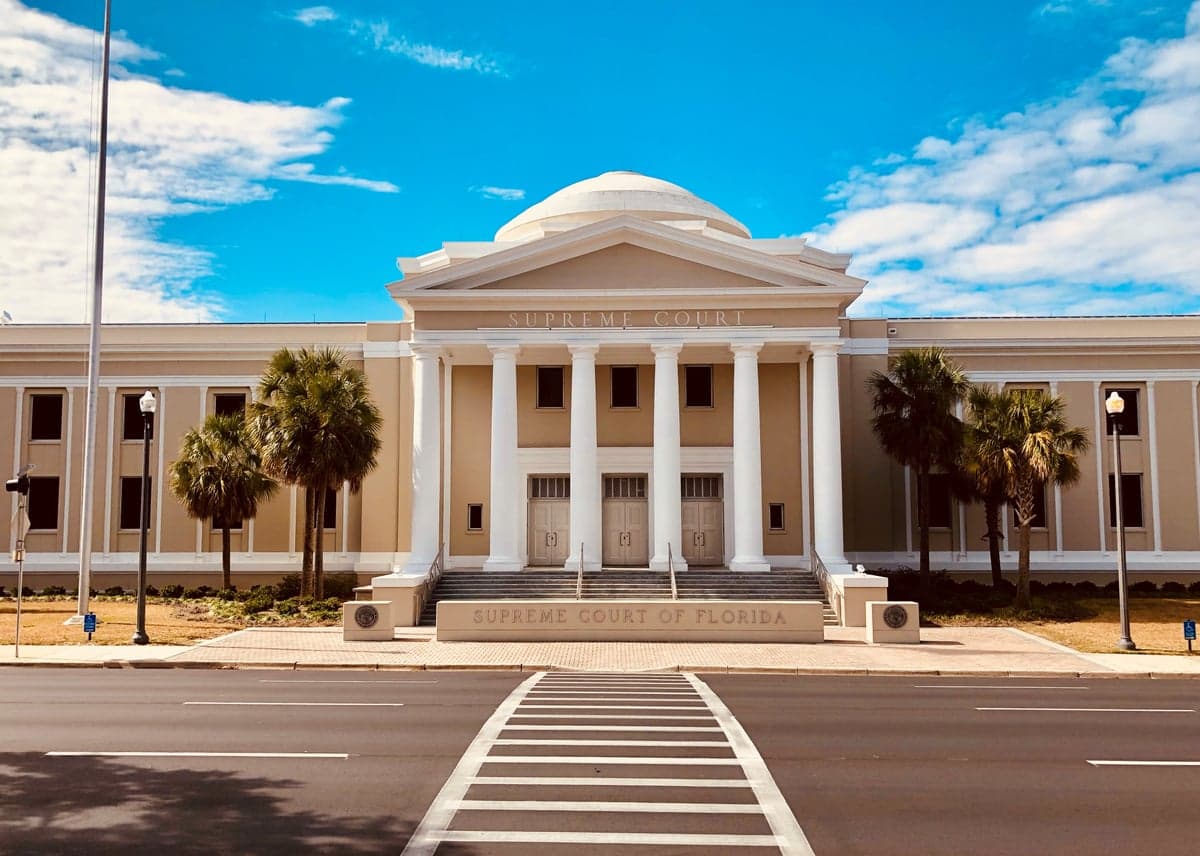
Photo: Wikipedia
Demographics of Tallahassee, FL
Affluence Level in Tallahassee, FL
A middle-class area roughly in line with national averages across income, home values, education, and employment.
People of Tallahassee, FL
Today, Tallahassee’s 199,696 residents form a politically and culturally bifurcated city: a majority-Black and white-collar professional hub where 51.1% of adults hold a bachelor’s degree or higher, yet the foreign-born share sits at just 3.8%—one of the lowest among Florida state capitals. The population is 47.8% white, 35.3% Black, 8.6% Hispanic, 2.3% East/Southeast Asian, and 1.7% Indian (subcontinent). This is a city shaped less by international immigration than by domestic migration tied to government, education, and historically Black institutions, producing a dense, insular character where longtime Black neighborhoods and university-anchored white enclaves coexist with little intermixing.
How the city was settled and grew
Tallahassee’s population origins trace to its 1824 designation as Florida’s territorial capital, chosen as a compromise between St. Augustine and Pensacola. The first white settlers were territorial officials, lawyers, and cotton planters who established plantations on the fertile red hills. Enslaved Black laborers constituted the majority of the local population by 1840, working cotton and tobacco fields. After the Civil War, freedmen established independent communities, most notably Frenchtown (northwest of downtown), which became the city’s historic Black commercial and residential heart, settled by formerly enslaved people and later by Black railroad workers in the 1880s. The founding of Florida State University (1851 as a seminary, later a women’s college) and Florida A&M University (1887 as the State Normal College for Colored Students) drew two distinct populations: white educators and students to the area around FSU’s campus, and Black educators, professionals, and students to the area around FAMU. By 1900, the city’s population was roughly 45% Black, with white residents concentrated in the Park Avenue historic district and Black residents in Frenchtown and the Bond neighborhood (south of FAMU). The 1920s land boom brought a small wave of white Northerners, but Tallahassee remained a sleepy government and college town through the 1940s, with little industrial migration.
Modern era (post-1965)
The post-1965 era transformed Tallahassee through two forces: the expansion of state government and the desegregation of schools and universities. The 1970s and 1980s saw a surge of white in-migration from across Florida and the South as state agencies grew, settling in new suburban subdivisions such as Killearn Estates (northeast Tallahassee, developed from the 1970s onward) and SouthWood (a master-planned community in the southeast, built from the 1990s). These areas remain predominantly white and affluent. Meanwhile, the Black population, which had been concentrated in Frenchtown and Bond, began a gradual outward movement to middle-class neighborhoods like Griffin Heights (northwest) and Providence (northeast), though Frenchtown retains a symbolic and residential Black presence. The Hispanic share grew slowly, from under 2% in 1980 to 8.6% today, driven largely by Puerto Rican and Mexican migrants working in construction, hospitality, and state government; they are dispersed but have a small cluster in the Lake Jackson area (north). The East/Southeast Asian population (2.3%) is primarily tied to FSU and FAMU—faculty, researchers, and graduate students from China, South Korea, and Vietnam—and lives near the universities in the Collegeside district. The Indian-subcontinent population (1.7%) is similarly university- and tech-connected, with many working at FSU’s engineering and medical programs or at the nearby Tallahassee Memorial Hospital; they are residentially scattered but visible in the midtown area. The foreign-born share has remained flat at roughly 3-4% since 2000, as Tallahassee lacks the coastal immigrant economies of Miami or Orlando.
The future
Tallahassee’s population is heading toward modest growth—projected at roughly 0.5-1% annually through 2035—driven by natural increase and domestic in-migration of retirees and remote workers seeking lower costs than South Florida. The city is not homogenizing; rather, it is tribalizing along geographic and racial lines. White flight to the northeast suburbs (Killearn, Bradfordville) continues, while Black residents are consolidating in the south and west (Providence, Griffin Heights). The Hispanic share is expected to rise slowly to 10-12% by 2040, but will remain far below state averages. The East/Southeast Asian and Indian populations will likely grow modestly as FSU and FAMU expand their international graduate programs, but neither group is large enough to create distinct ethnic enclaves. The biggest demographic wildcard is whether the state government workforce—which is aging and increasingly remote—will continue to draw young white professionals, or whether Tallahassee will become a more retirement-oriented city.
For a conservative-leaning mover, Tallahassee offers a stable, low-immigration environment with a strong Black middle class and a white professional class that is culturally Southern and politically mixed. The city is not becoming more diverse in the way coastal Florida is; it is becoming more internally sorted by race and class. New arrivals should expect to choose a neighborhood that aligns with their demographic and lifestyle preferences, as cross-group social mixing is limited outside of university and government workplaces.

* Values derived from national, state, county, city and local statistics and may differ in a specific area. Last updated: 2026-04-15T23:48:29.000Z
Narrative content on this page is AI-generated and may contain mistakes. Verify any details that matter before acting on them.
ReloMaps may earn a commission from affiliate links at no extra cost to you.

