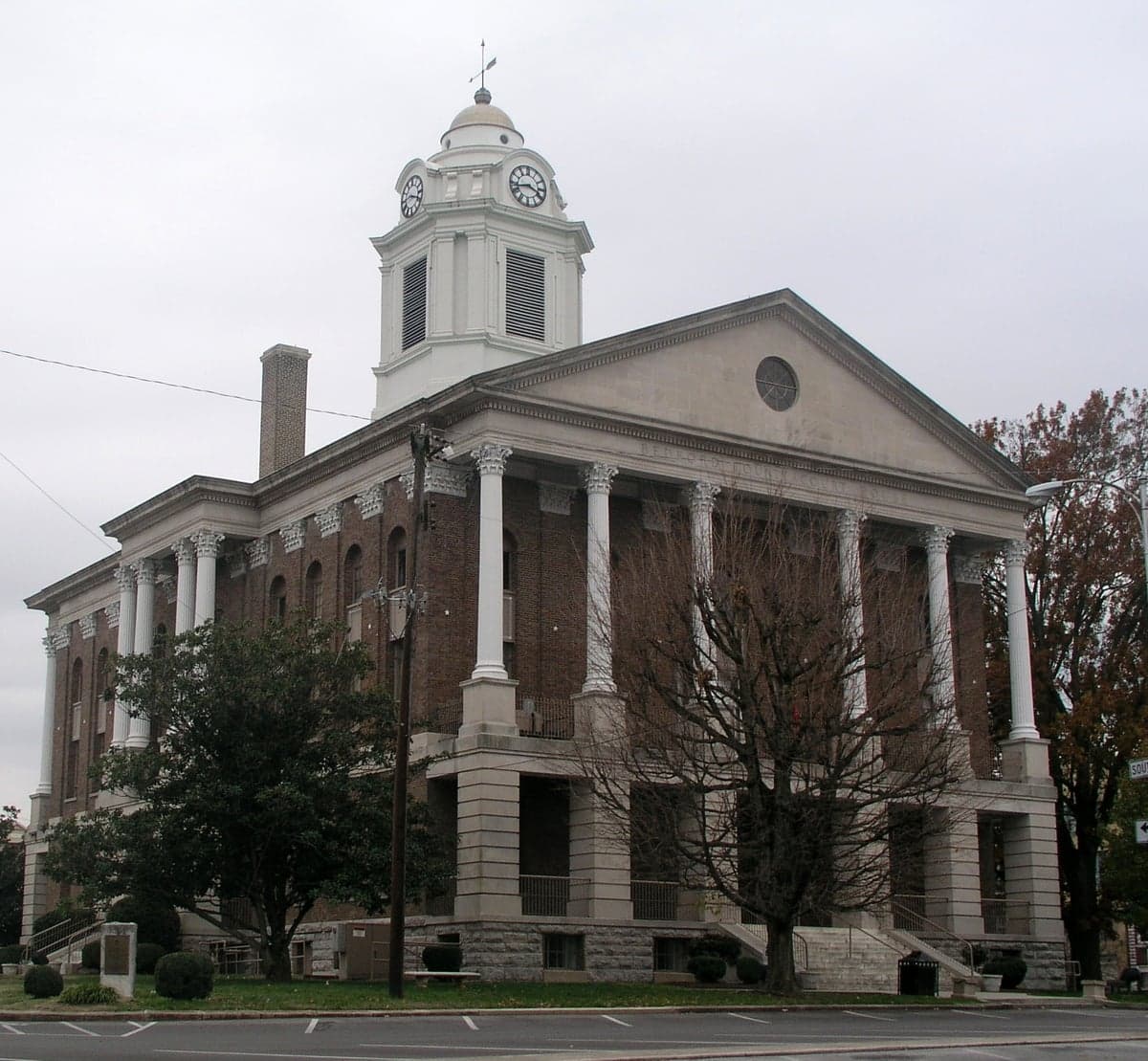
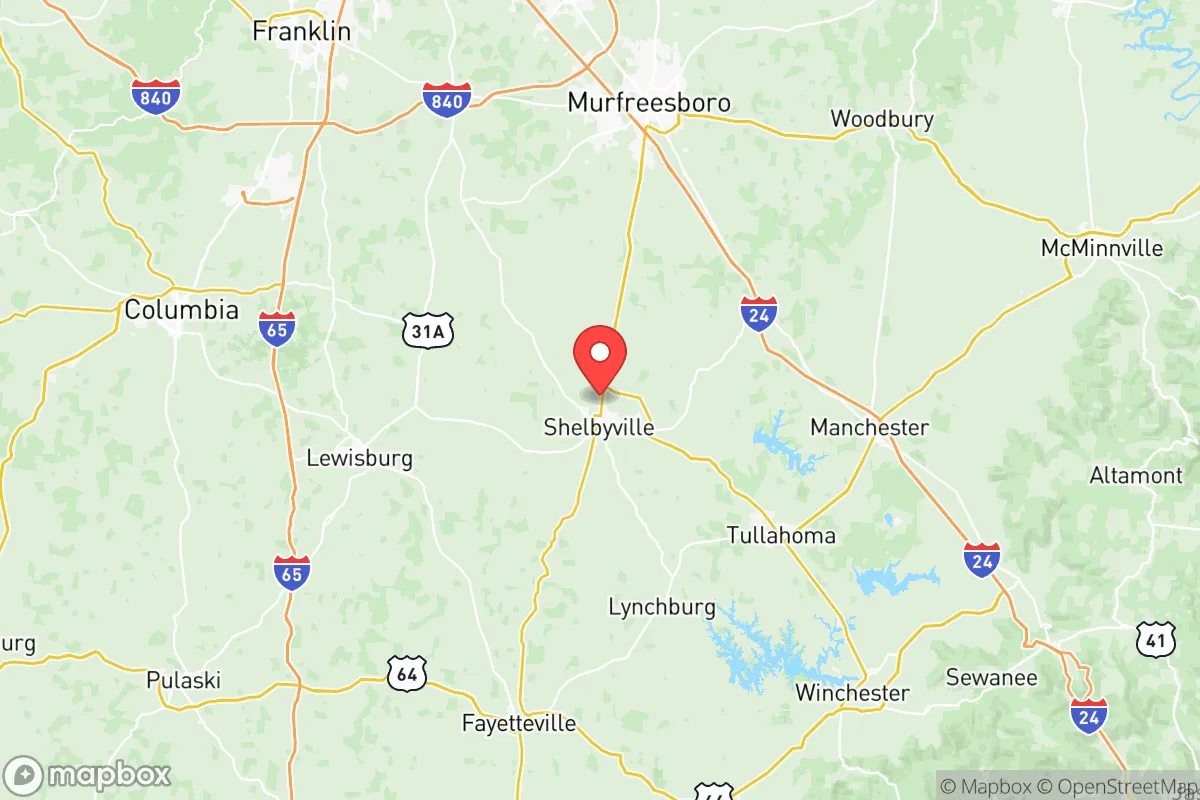
Photo: Wikipedia
Demographics of Bedford County
Affluence Level in Bedford County
A middle-class area roughly in line with national averages across income, home values, education, and employment.
People of Bedford County
Bedford County, Tennessee, is a predominantly white, rural community of 51,291 residents with a fast-growing Hispanic minority that now makes up 15.5% of the population. The county remains culturally anchored in its Scots-Irish and English frontier roots, while a blue-collar economy centered on poultry processing and dairy farming draws a steady stream of Latino workers to Shelbyville, Wartrace, and the surrounding countryside. With only 16.9% of adults holding a college degree, Bedford County leans conservative and working-class, distinct from the suburban boom in neighboring Williamson and Rutherford counties.
Settlement & growth (pre-1960)
Before American settlement, the region that is now Bedford County was part of the Cherokee and Chickasaw hunting grounds, with no permanent villages within the county's current boundaries. The area was ceded to the United States in the 1806 Cherokee treaty and opened for white settlement soon after. The first wave of settlers—Scots-Irish and English families from Virginia, North Carolina, and eastern Tennessee—arrived in the 1810s, drawn by the fertile limestone soil and the promise of affordable land grants. They founded Shelbyville in 1810 as the county seat, and smaller communities like Bell Buckle (a stagecoach watering stop established in the 1850s) and Wartrace (originally a Native American path turned pioneer settlement) grew as market towns and trade depots.
By the 1830s, Bedford County had a thriving plantation economy built on tobacco, corn, and later livestock. Enslaved African Americans made up roughly 40% of the county’s population by 1860, concentrated on large farms around Shelbyville and Unionville. After the Civil War, many freedmen remained as sharecroppers and tenant farmers, while small-scale subsistence farming continued into the early 1900s. The late 1800s also brought a small number of German and Czech immigrant families to the area around Normandy and Fairfield, where they established mixed farms and dairies. A short-lived railroad boom in the 1850s–1870s turned Wartrace into a shipping hub, but the county never saw the large-scale industrial immigration that reshaped Northern cities.
The first half of the 20th century saw gradual out-migration of Black residents to urban industrial centers during the Great Migration, reducing the Black population share from roughly a third in 1900 to 20% by 1950. Meanwhile, the rural white population remained stable, sustained by the growing dairy and poultry industries. Bedford County’s population hovered around 30,000 to 35,000 for much of the early 1900s, with little foreign-born presence beyond a handful of European-origin farming families.
Modern era (post-1965)
The 1965 Hart-Cellar Act had little direct effect on Bedford County’s demographics; the county attracted almost no Asian or Indian immigrants through the family-reunification and professional visa channels that reshaped metro areas. Instead, the post-1965 transformation came from domestic agricultural labor demand. From the 1970s onward, the poultry industry—anchored by Tyson Foods and other processors in Shelbyville and Fosterville—began recruiting Hispanic workers from Texas, California, and eventually directly from Mexico and Central America. The Hispanic population grew from under 1% in 1980 to roughly 8% by 2000 and 15.5% by 2026. These workers settled mainly in Shelbyville’s older neighborhoods and in trailer parks and small subdivisions around the poultry plants in Wartrace and Normandy. A smaller secondary migration of Hispanic families also arrived to work on large dairy farms near Bell Buckle and Unionville.
Domestic migration into Bedford County has been modest compared to Middle Tennessee’s explosive growth counties. The county gained some white in-movers from the Rust Belt and coastal states after 2000, drawn by lower housing costs and a conservative culture, but the population growth rate (about 6% per decade) has been steady rather than rapid. The Black population declined further to 7.1%, as younger generations left for Nashville, Atlanta, or other metro areas. East and Southeast Asian residents (0.6%) and Indian subcontinent residents (0.1%) are limited to a handful of professionals in healthcare and manufacturing, living mostly in Shelbyville with no visible enclave. The foreign-born share stands at 5.8%, almost entirely Hispanic.
The 2020s have brought some spillover from Nashville’s exurban expansion, particularly along the Interstate 24 corridor near the county’s northern edge. New subdivisions have appeared around Cascade and Fairfield, attracting white families seeking larger lots and lower taxes. But the county’s rural zoning, low college-attainment rate, and limited high-wage job base keep this growth slower than in Williamson or Rutherford counties.
The future
Bedford County’s population is on a trajectory of gradual diversification, driven almost entirely by Hispanic in-migration. The Hispanic share is likely to reach 20–22% by 2035 as families already in the county have children and additional workers arrive for the poultry and logistics sectors. These families are concentrated in Shelbyville but are beginning to purchase homes in Wartrace and Bell Buckle, where they are integrating into local schools and churches. The white population is aging but remains stable, with some new arrivals from exurban Nashville offsetting out-migration of younger whites to cities.
The Black population is unlikely to grow significantly, as no major pull factors exist for Black domestic migrants. The Asian and Indian populations will remain trace-level unless a large employer relocates to the county—unlikely given the low college-educated labor pool. The county is not tribalizing into separate enclaves; rather, Hispanic residents are dispersing into existing white-majority neighborhoods and rural areas, though some clustering persists near plant housing. Cultural assimilation is occurring: second-generation Hispanic youth are predominantly English-speaking and often identify as Southerners, while maintaining Mexican or Central American traditions.
Over the next 10–20 years, Bedford County will remain predominantly white (65–70%), with

* Values derived from national, state, county, city and local statistics and may differ in a specific area. Last updated: 2026-06-02T19:45:47.000Z
Narrative content on this page is AI-generated and may contain mistakes. Verify any details that matter before acting on them.
ReloMaps may earn a commission from affiliate links at no extra cost to you.

