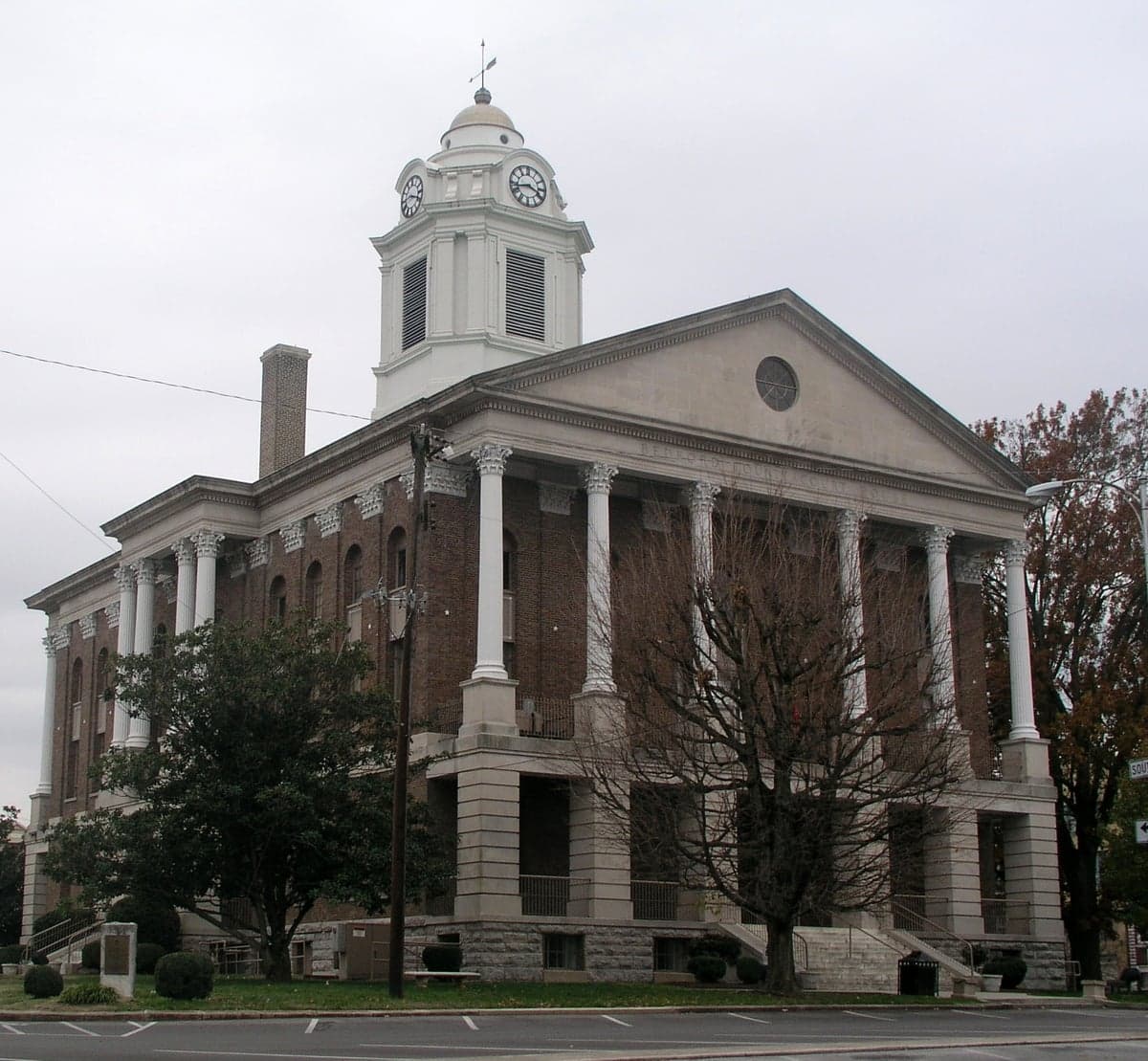
Photo: Wikipedia
Political ClimatePolitical Climate in Bedford County
Showing district-level results — no local-only data available.
Local Political AnalysisPolitical Analysis of Bedford County
Bedford County, Tennessee runs deep red with a Cook PVI of R+21—significantly more conservative than the state’s R+13 average. In Shelbyville, the county seat, you’ll still find folks fly Confederate flags from their trucks and small-business owners grumbling about property taxes, but there are a few precincts near the industrial parks along US-231 that lean slightly more moderate. Bell Buckle and Wartrace are about as Republican as it gets; I’ve seen those towns turn out 80% for the GOP in state elections year after year. The broader trend? Steady as a rock. While Nashville’s progressive wave has lapped at nearby Rutherford County, Bedford has held its ground—though the 2020 primary showed a trickle of suburban-style ticket-splitting in Shelbyville’s newer subdivisions. That’s something to keep an eye on.
How it compares
Tennessee as a whole carries a Cook PVI of R+13, solidly red but not as deeply committed as Bedford. The county’s extra +8 points come from its rural, church-heavy culture and a population that strongly distrusts state-mandated COVID rules and federal gun grabbers. Neighboring Lincoln County is R+20, Coffee County R+19—so Bedford is right in the heart of the state’s most conservative tier. But inside Bedford itself, there are micro-differences. The precinct around South Brittain Street and the downtown square in Shelbyville occasionally goes more purple; some of the Mexican-owned tiendas and the working-class renters near the GM plant tend to vote more pragmatically. Meanwhile, the farmland east of Highway 231 is solidly Trump country. Compared to Tennessee’s blue outposts like Memphis or Nashville, Bedford is almost a different planet politically.
What this means for residents
For everyday life, this means less government overreach in personal decisions—no one here is enforcing a mask mandate or restricting your right to carry. County commissioners voted down a proposed noise ordinance last year after residents called it an overreach on backyard gatherings. Taxes stay low because voters punish any hint of budget bloat. The main concern is that progressive ideas filter in through state-level laws—like new mandated DEI training for school staff that some locals see as federal creep. But locally, the school board remains conservative, pushing back on controversial library books and keeping curriculum focused on traditional values. If you value freedom from bureaucracy and want your local leaders to mind their own business, Bedford County delivers. It’s not perfect—property assessments can sting—but the political culture fights hard against unnecessary rule-making.
Culturally, Bedford still feels like the Tennessee of the 1990s: churches are social hubs, the county fair draws thousands, and nobody blinks at a gun rack in a truck. Policy-wise, the biggest distinction from urban Tennessee is the refusal to accept state-funded housing vouchers that would alter the rural character. There’s a quiet pride in keeping things small, local, and free from outside influence. That’s the Bedford way, and it’s not changing anytime soon.

State Political ClimatePolitical Climate in Tennessee
State Political AnalysisPolitical Environment in the State
Tennessee is a deeply conservative state, carrying a Cook PVI of R+13, meaning it votes about 13 points more Republican than the national average in presidential elections. The dominant coalition is a mix of rural and suburban voters who prioritize limited government, low taxes, and traditional values, with the state having voted Republican in every presidential election since 2000. Over the past 10-20 years, the trajectory has been a steady march rightward, driven by in-migration from more liberal states and a Republican supermajority in the state legislature that has consistently passed conservative legislation.
Urban vs. rural divide
The political map of Tennessee is a classic tale of three distinct regions. The major metros—Nashville (Davidson County) and Memphis (Shelby County)—are the state's blue islands, consistently voting Democratic by wide margins. Nashville, in particular, has seen a surge of out-of-state transplants from places like California and New York, which has made its politics more progressive, but it remains a small, isolated bubble. In contrast, the vast rural expanse of West and Middle Tennessee, including cities like Jackson and Clarksville, is deeply red. East Tennessee, anchored by Knoxville and Chattanooga, is the most reliably Republican region in the state, with counties like Sevier and Blount often voting 70-80% Republican. The real political action is in the suburbs. Counties like Williamson (south of Nashville) and Rutherford (east of Nashville) have become conservative strongholds, with Williamson County being one of the wealthiest and most Republican counties in the nation. These suburban areas are the engine of the state's conservative majority, and they are growing fast.
Policy environment
Tennessee's policy environment is a model for conservative governance. There is no state income tax on wages, a major draw for individuals and families looking to keep more of what they earn. The sales tax is high (around 9.5% in many areas), but the overall tax burden is low. The regulatory posture is business-friendly, with a right-to-work law and minimal red tape. On education, the state has aggressively expanded school choice, including the Education Savings Account (ESA) program, which allows parents to use state funds for private school tuition or homeschooling expenses. Healthcare policy is a mixed bag; Tennessee did not expand Medicaid under the Affordable Care Act, but it has pursued a block grant model for its Medicaid program (TennCare) to give the state more control. Election laws are strict: voter ID is required, and the state has purged inactive voters from rolls, which conservatives see as protecting election integrity. The state also passed a law banning "ballot harvesting" and limiting drop boxes, moves that have been praised by those concerned about fraud.
Trajectory & freedom
Tennessee is becoming more free in many respects, particularly on Second Amendment and parental rights. In 2021, the state passed constitutional carry, allowing law-abiding citizens to carry a handgun without a permit. This was a major expansion of personal liberty. On parental rights, the legislature passed the "Parental Bill of Rights" in 2022, which affirms parents' authority over their children's education and medical decisions, including the right to opt out of mask mandates or objectionable curriculum. The state also passed a law banning transgender procedures on minors, a move that has drawn national attention but is popular with the conservative base. However, there are concerns about government overreach in the name of public health. During the COVID-19 pandemic, Governor Bill Lee resisted lockdowns and mask mandates, but local health departments in Nashville and Memphis imposed their own restrictions, creating a patchwork of rules that frustrated many. The state has since passed laws limiting the emergency powers of local governments, a positive step for personal freedom.
Civil unrest & political movements
Tennessee has seen its share of political flashpoints, but they are largely contained to the urban centers. In 2020, Nashville experienced significant protests following the death of George Floyd, including a destructive riot that damaged the historic downtown. This event galvanized conservative voters and led to a push for stronger law-and-order policies. The state legislature responded by passing a law increasing penalties for rioting and blocking local efforts to defund the police. Immigration politics are relatively quiet, as Tennessee is not a border state, but the legislature has passed laws requiring local law enforcement to cooperate with federal immigration authorities (287(g) agreements). There is no sanctuary city policy in the state; in fact, the legislature has banned sanctuary city ordinances. Election integrity remains a hot topic. In 2020, Tennessee was one of the first states to audit its election results, finding no widespread fraud, but the legislature still passed stricter voter ID laws and banned private funding of election administration (a response to the "Zuckerbucks" controversy). You won't see secessionist rhetoric here, but there is a strong strain of nullification sentiment, particularly around federal gun laws. In 2023, the legislature passed a resolution affirming the state's right to nullify federal gun control measures, though it is largely symbolic.
Projection
Over the next 5-10 years, Tennessee is likely to become even more conservative. The primary driver is in-migration. Tens of thousands of people are moving to the state each year, many from deep-blue states like California, Illinois, and New York. While a small percentage of these transplants are progressives who settle in Nashville, the vast majority are conservatives or libertarians fleeing high taxes, crime, and overreach in their home states. They are moving to the suburbs of Nashville, Knoxville, and Chattanooga, as well as smaller towns like Franklin and Murfreesboro. This influx is reinforcing the state's conservative majority. The Republican supermajority in the legislature is likely to hold, and we can expect further expansions of school choice, tax cuts, and protections for gun rights. The only wild card is the continued growth of Nashville's progressive enclave, which could lead to more state-local conflicts, but the state legislature has shown a willingness to preempt local ordinances, so the overall trajectory remains firmly rightward.
For a new resident, the bottom line is this: Tennessee offers a political environment that respects personal freedom, keeps taxes low, and protects traditional values. You will find a government that is generally on your side, not in your way. The biggest practical consideration is where you choose to live. If you want the full conservative experience, the suburbs and rural areas are your best bet. If you move to Nashville proper, you'll be in a blue bubble, but even there, the state government will ensure your rights are protected. Just be prepared for the culture war to occasionally flare up, especially around education and public health. Overall, Tennessee is a safe bet for anyone looking to escape the progressive policies of other states.
* Values derived from national, state, county, city and local statistics and may differ in a specific area. Last updated: 2026-06-02T19:45:47.000Z
Narrative content on this page is AI-generated and may contain mistakes. Verify any details that matter before acting on them.
ReloMaps may earn a commission from affiliate links at no extra cost to you.

