
Photo: Wikipedia
Demographics of Maury County
Affluence Level in Maury County
A middle-class area roughly in line with national averages across income, home values, education, and employment.
People of Maury County
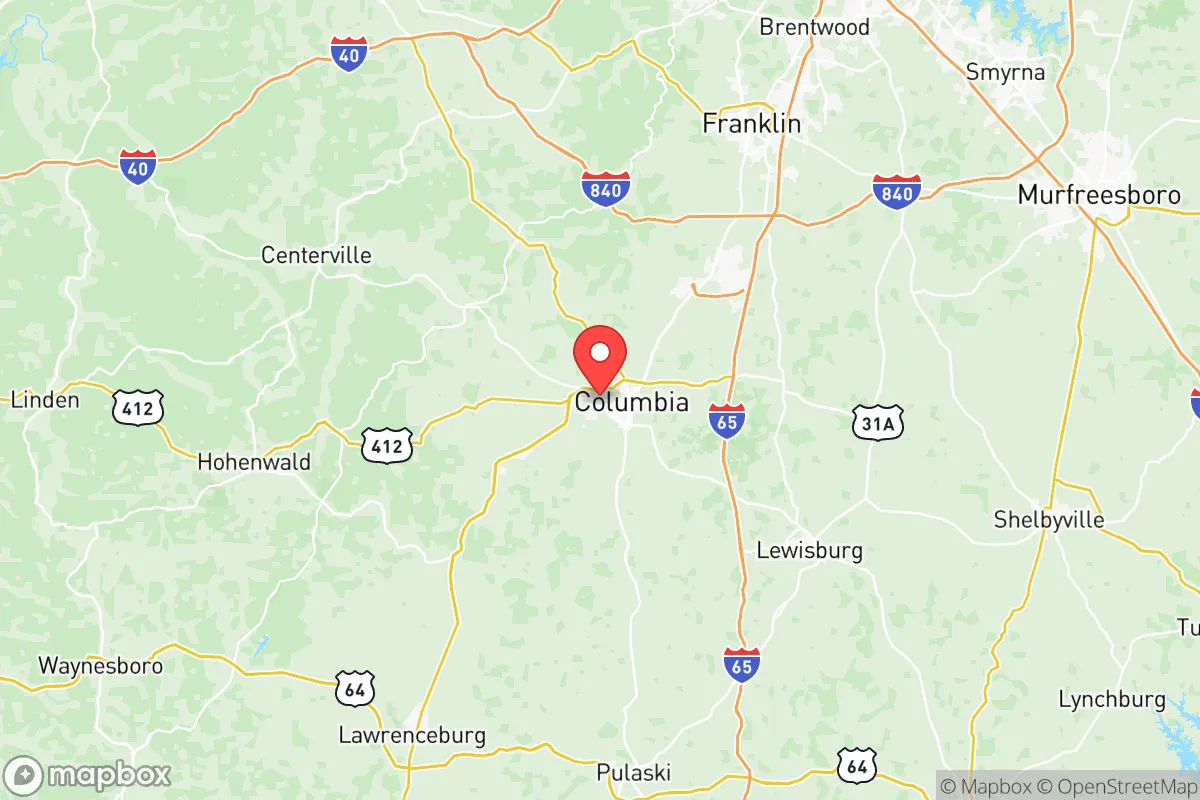
Maury County, Tennessee, is home to roughly 104,855 residents, a population that remains predominantly white (76.7%) with a notable Black minority (10.6%) and a growing Hispanic community (7.8%). The county’s foreign-born population is low at just 1.9%, reflecting a deeply rooted, native-born character shaped by generations of settlement. Its people are concentrated in the county seat of Columbia, the historic town of Mount Pleasant, and the smaller communities of Spring Hill, Culleoka, and Santa Fe, each retaining distinct identities tied to the area’s agricultural and industrial past. The county’s identity is marked by a blend of Southern tradition, a strong manufacturing and logistics workforce, and a conservative political leaning that aligns with the broader Middle Tennessee region.
Settlement & growth (pre-1960)
Before European settlement, the area now known as Maury County was part of the hunting grounds of the Cherokee and Chickasaw nations, who used the region for seasonal hunting but maintained no permanent large villages within the county’s boundaries. The first European incursion came in the late 18th century, with long hunters and traders from Virginia and North Carolina crossing the Appalachian Mountains. The county was formally established in 1807, carved from Williamson County, and named after Tennessee state senator Abram Maury. The earliest permanent settlers were overwhelmingly Scots-Irish and English migrants from the Upper South, drawn by the promise of fertile land in the Duck River Valley. They established the town of Columbia in 1807 as the county seat, and it quickly became a center for cotton and tobacco agriculture, relying heavily on enslaved African labor.
By the 1830s, Maury County had become one of Tennessee’s wealthiest and most populous counties, driven by the plantation economy. The Black population grew substantially during this period, reaching nearly 50% of the total by 1860, as enslaved people were brought in to work the cotton fields. The Civil War and emancipation dramatically reshaped the county’s demographics: many freed African Americans remained in the area, forming communities in Columbia’s “Black Bottom” neighborhood and in rural settlements like Bigbyville and Williamsport. The post-Reconstruction era saw a slow outmigration of Black residents to Northern industrial cities during the Great Migration, but a significant Black population persisted, concentrated in Columbia and Mount Pleasant. Meanwhile, white farmers shifted from cotton to diversified agriculture and tobacco, and the county’s population remained relatively stable through the early 20th century.
The 1940s and 1950s brought a new wave of domestic migration, as the Tennessee Valley Authority (TVA) electrified the region and the federal government established the Monsanto chemical plant in Columbia (1949) and the Arnold Air Force Base (1951) in nearby Tullahoma, which drew workers from across the rural South. These industrial jobs, along with the growth of the automotive parts industry in Spring Hill, began to shift the county from an agricultural to a manufacturing economy. The population grew modestly, from about 40,000 in 1940 to about 52,000 in 1960, with most new arrivals being white families from neighboring rural counties in Tennessee and Kentucky.
Modern era (post-1965)
The 1965 Hart-Cellar Act had a minimal direct impact on Maury County, as the area did not attract significant international immigration. The foreign-born share remains very low at 1.9%, and the county’s demographic changes since 1965 have been driven almost entirely by domestic migration. The most transformative event was the 1985 announcement that General Motors would build its Saturn plant in Spring Hill, a decision that reshaped the county’s population and economy. The plant opened in 1990 and drew thousands of workers from across the United States, particularly from the Midwest and the Rust Belt. Spring Hill, once a small farming community, exploded into a fast-growing suburb, attracting white-collar and blue-collar families alike. This wave of in-migration was overwhelmingly white and native-born, reinforcing the county’s existing racial composition.
Since 2000, Maury County has experienced sustained growth, with the population rising from about 69,000 to over 104,000 by 2024. The expansion of the GM plant (now a joint venture with LG Energy Solution producing electric vehicle batteries) and the broader Nashville metropolitan area’s sprawl have been the primary drivers. The Hispanic population has grown from negligible levels to 7.8%, largely through domestic migration from other U.S. states rather than direct immigration. Many Hispanic residents work in construction, manufacturing, and agriculture, and they are concentrated in Columbia and Spring Hill, though no distinct ethnic enclave has formed. The Black population has declined as a share of the total, from over 20% in 1970 to 10.6% today, as white in-migration has outpaced Black population growth. The Asian population remains tiny at 0.7%, and the Indian subcontinent population is negligible at 0.2%, with most Asian residents being professionals employed at the GM plant or in healthcare in Columbia.
Suburbanization has been the dominant trend since 1990. Spring Hill has grown from a village of 1,000 to a city of over 50,000, absorbing much of the county’s new housing development. Columbia has expanded outward, with new subdivisions on its northern and western edges. Smaller towns like Mount Pleasant (population ~5,000) and Culleoka (unincorporated) have seen slower growth, retaining a more rural character. The county’s college-educated share is 26.5%, below the national average, reflecting the blue-collar nature of the manufacturing economy, though this is slowly rising as professionals move in from the Nashville area.
The future
Maury County’s population is projected to continue growing, likely reaching 130,000–140,000 by 2040, driven by the expansion of the GM/LG battery plant and the continued spillover of Nashville’s housing market. The county is not homogenizing into a single cultural bloc; rather, it is developing a subtle internal divide. Spring Hill is becoming a more affluent, suburban, and politically moderate area, while Columbia and the rural south of the county remain more traditional, conservative, and working-class. The Hispanic population is expected to grow slowly, possibly reaching 10–12% by 2040, but will likely assimilate into the broader community rather than forming a distinct enclave. The Black population is likely to remain stable or decline slightly as a share, as white in-migration continues to dominate. The foreign-born share may rise to 3–4% as the battery plant attracts some international engineers, but the county will remain overwhelmingly native-born.
Cultural identity in Maury County is being reshaped by in-migration, but not overwhelmed. New arrivals from the Midwest and California are bringing different political and lifestyle preferences, but they are largely being absorbed into the county’s existing conservative, family-oriented character. The next 10–20 years will likely see a gradual increase in educational attainment and income levels, but the county will retain its manufacturing base and its predominantly white, native-born demographic profile. For someone moving in now, Maury County offers a growing economy, relatively low cost of living, and a community that values tradition, but with the trade-off of limited ethnic diversity and a slower pace of cultural change compared to Nashville’s urban core.

* Values derived from national, state, county, city and local statistics and may differ in a specific area. Last updated: 2026-05-19T03:33:51.000Z
Narrative content on this page is AI-generated and may contain mistakes. Verify any details that matter before acting on them.
ReloMaps may earn a commission from affiliate links at no extra cost to you.

