
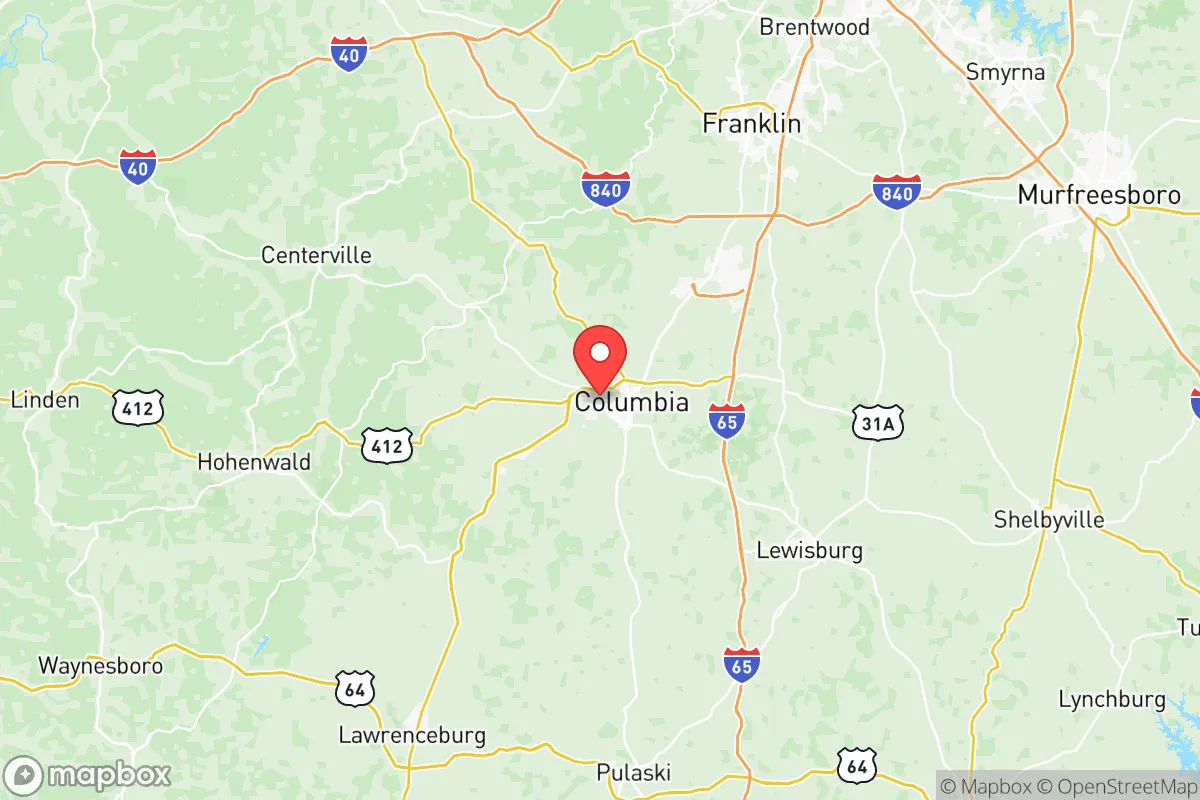
Photo: Wikipedia
Personal Sovereignty in Maury County
Viable for self-reliance. Generally workable, though some barriers may limit total independence.
What does Personal Sovereignty tell us?
Personal Sovereignty measures your capacity for self-reliance and independence with minimal government friction. Higher scores mean fewer barriers between you and the way you want to live... but it assumes you have the space you need and good neighbors.
What does this tell us?
Personal Sovereignty measures your capacity for self-reliance and independence with minimal government friction. Higher scores mean fewer barriers between you and the way you want to live... but it assumes you have the space you need and good neighbors.
State Policy
Energy independence: Importer (25% of energy produced in-state)
Personal Liberty
Homesteading

Personal Liberty Analysis
Maury County, Tennessee, offers a notably high degree of personal sovereignty compared to much of the Southeast, with a local governance culture that generally resists the kind of expansive regulatory overreach found in metropolitan areas like Nashville or Knoxville. The county’s political posture leans heavily toward individual autonomy, particularly in matters of self-defense, property use, and family decision-making, making it a serious consideration for those prioritizing freedom from government intrusion. While no location is a libertarian utopia, Maury County’s combination of state-level protections and local restraint creates an environment where a survivalist or prepper mindset can operate with fewer legal entanglements than in many other parts of the country.
Tax burden and regulatory posture: how Maury County compares to surrounding areas
Tennessee’s lack of a state income tax is the foundation of Maury County’s tax advantage, but the local picture is equally important. The county’s property tax rate sits at roughly $2.30 per $100 of assessed value, which is moderate for Middle Tennessee but significantly lower than Davidson County (Nashville) at over $3.00. Sales tax in Maury County is 9.75%, which includes state and local portions, but the absence of a city income tax in places like Columbia, Spring Hill, and Mount Pleasant means residents keep more of what they earn. Regulatory posture is similarly restrained: Maury County does not impose the kind of burdensome business licensing or zoning overlays seen in Williamson County to the north. For someone running a small homestead operation or a home-based firearms-related business, the county’s planning department is generally hands-off, especially outside the city limits of Columbia. The city of Columbia itself has slightly more zoning oversight, but towns like Culleoka, Hampshire, and Santa Fe remain largely unregulated, allowing for greater operational freedom without municipal interference.
Self-defense and gun law specifics: what the Second Sanctuary status means for residents
Maury County is a certified Second Amendment Sanctuary, a formal resolution passed by the county commission that signals local law enforcement will not enforce any state or federal gun laws deemed unconstitutional. This is not merely symbolic: the sheriff’s office in Maury County has a stated policy of not participating in federal firearms confiscation schemes or red flag orders that lack due process. Tennessee itself is a permitless carry state for anyone 21 or older, and Maury County issues enhanced handgun carry permits with a 90-day turnaround typical. For the survivalist, the practical implication is that you can carry openly or concealed in most public spaces, including parks and restaurants that serve alcohol, without fear of local prosecution. The county’s gun culture is deeply embedded—there are multiple private ranges near Columbia and a strong presence of the Tennessee Firearms Association in local politics. If you are concerned about federal overreach, Maury County’s sanctuary status provides a legal buffer that counties like Davidson or Shelby simply do not offer.
Self-reliance and homesteading viability: lot sizes, zoning, and off-grid feasibility
Maury County’s rural zoning codes are among the most permissive in Middle Tennessee for those seeking self-reliance. Outside the city limits of Columbia, Spring Hill, and Mount Pleasant, there is no county-wide minimum lot size for agricultural use, though the typical rural parcel sold for homesteading runs between 5 and 20 acres. The county does not require building permits for structures under 200 square feet, which means a small cabin, tool shed, or chicken coop can be erected without county approval. Off-grid living is legally feasible: there are no county ordinances prohibiting rainwater collection, composting toilets, or solar panel installation, though a septic permit is required for any dwelling with plumbing. The towns of Culleoka and Hampshire are particularly attractive for off-grid setups, with large tracts of undeveloped land and minimal code enforcement. However, the city of Columbia does enforce building codes and requires permits for any habitable structure, so those wanting full autonomy should focus on unincorporated areas. The county’s agricultural extension office is supportive of small-scale farming, offering soil testing and livestock workshops without the bureaucratic hurdles seen in more urbanized counties.
Personal liberties: parental rights, medical autonomy, speech, and property
Parental rights in Maury County are strongly protected under Tennessee’s parental bill of rights, which gives parents explicit authority over their children’s education, medical decisions, and religious upbringing. The county’s school board has resisted federal curriculum mandates and maintains a policy of not requiring vaccines for school attendance beyond state minimums. Medical autonomy is similarly robust: Tennessee does not have a state-level vaccine passport mandate, and Maury County’s health department does not enforce federal public health orders that conflict with local practice. Free speech is protected by the county’s general conservative culture, with no local ordinances restricting political expression or assembly. Property rights are the strongest pillar: Maury County does not have a county-wide zoning code for rural areas, meaning you can use your land for hunting, target practice, or even a small firearms business without special use permits. The city of Spring Hill has more restrictive covenants in its subdivisions, but the unincorporated areas of Santa Fe and Williamsport offer near-total freedom to build, farm, or shoot on your own land without neighbor complaints leading to code enforcement.
Overall, Maury County ranks among the top 10% of Tennessee counties for personal sovereignty, particularly when measured against the regulatory creep seen in Williamson, Davidson, and Rutherford counties. The combination of a Second Amendment sanctuary, minimal rural zoning, no income tax, and strong parental rights creates a legal environment where a prepper or survivalist can operate with far less government friction than in most of the country. While no county is immune to federal overreach, Maury County’s local governance culture actively resists it, making it a strategic relocation choice for those prioritizing autonomy over convenience. If you are looking for a place where the government stays out of your gun safe, your garden, and your family decisions, Maury County delivers a level of sovereignty that is increasingly rare in the modern United States.

* Values derived from national, state, county, city and local statistics and may differ in a specific area. Last updated: 2026-05-19T03:33:51.000Z
Narrative content on this page is AI-generated and may contain mistakes. Verify any details that matter before acting on them.
ReloMaps may earn a commission from affiliate links at no extra cost to you.

