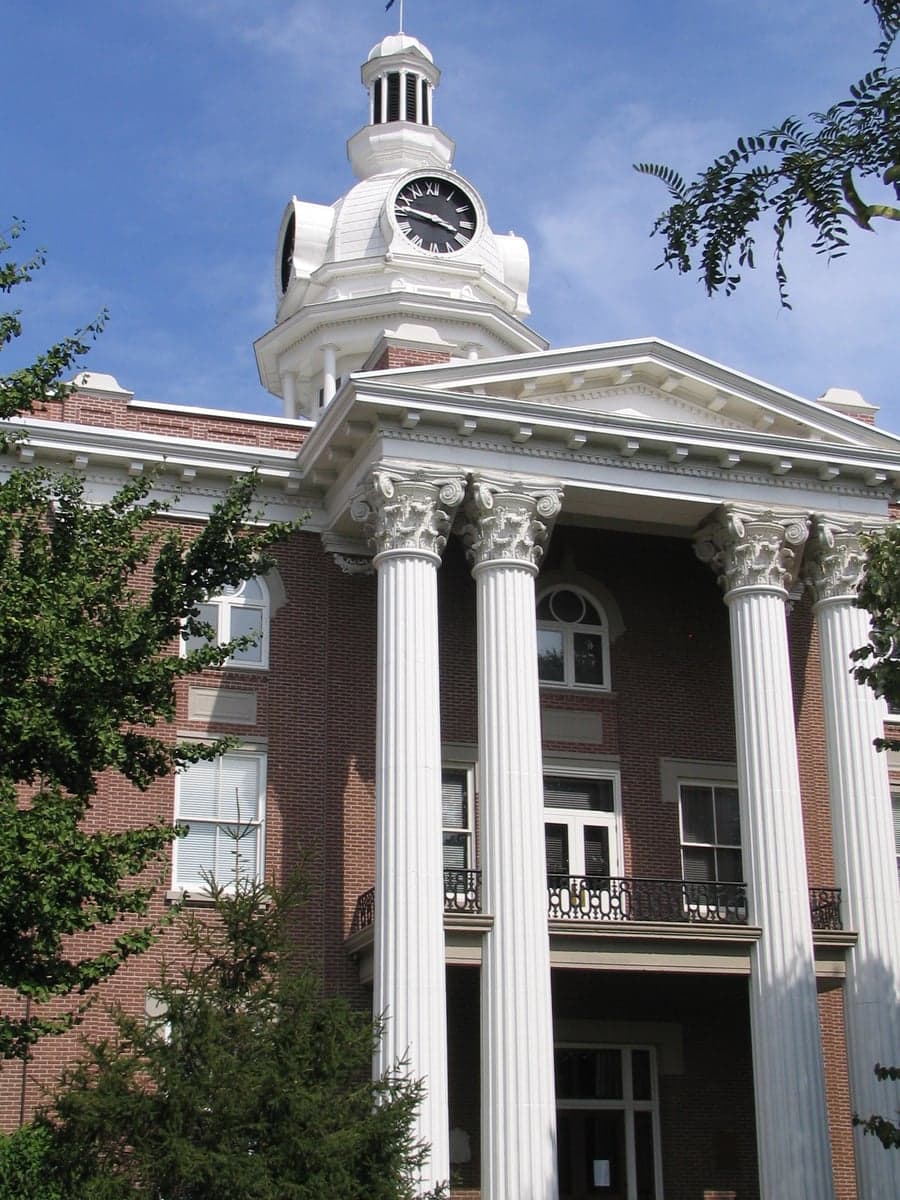
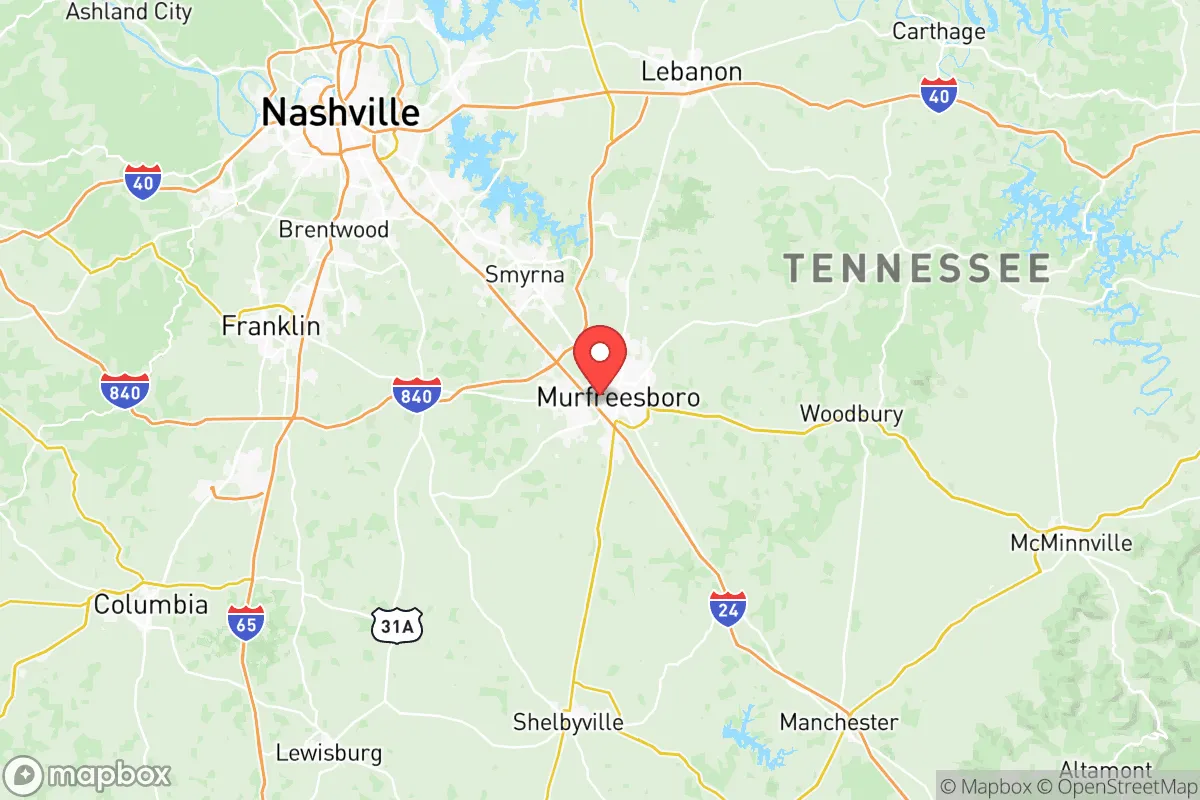
Photo: Wikipedia
Political ClimatePolitical Climate in Rutherford County
Showing district-level results — no local-only data available.
Local Political AnalysisPolitical Analysis of Rutherford County
Rutherford County is a solidly conservative stronghold, with a Cook PVI of R+21 that makes it significantly redder than Tennessee as a whole (R+13). This isn't some recent shift, either. I've watched this area grow for decades, and while the influx of folks from bluer states has nudged things a little in the more populated spots, the county's core values have held firm. The real story here is the tension between the old guard in the rural stretches and the newer, more moderate voters clustering around the cities, but make no mistake—this is still a place where conservative principles dominate the conversation.
How it compares
That R+21 rating puts Rutherford County in a different league than the state's R+13 average. The difference is baked into the local culture. Drive out to Eagleville or Rockvale, and you'll find precincts that vote 75-80% Republican—these are folks who see government overreach as the biggest threat to their way of life. Compare that to the state-level numbers, which get dragged down by blue dots like Nashville and Memphis. Inside Rutherford, the political map is more nuanced. Murfreesboro is the bellwether: its older neighborhoods near the square lean red, but the precincts around Middle Tennessee State University and the newer apartment complexes near I-24 have started to trend purple. I've seen precincts there swing within 5-10 points of a split in recent midterms, which would have been unthinkable twenty years ago. Meanwhile, Smyrna and La Vergne are where you see the most visible progressive drift, especially in La Vergne's growing Hispanic and immigrant communities, where local school board races have gotten surprisingly competitive. But even in those towns, the countywide margins stay deep red because the rural vote is so reliable.
What this means for residents
For anyone who values limited government and personal freedoms, Rutherford County is still a refuge. The local commission and school board have consistently pushed back against state-level mandates they see as overreaching, whether that's COVID-era restrictions or curriculum battles. You don't feel the heavy hand of bureaucracy here the way you might in Davidson County. Property taxes remain among the lowest in the region for a growing county, and there's a genuine distrust of any new "quality of life" ordinances that smell like social engineering. That said, the warning signs are there. The progressive shift in La Vergne's city council—where a few seats flipped in 2022—has led to debates over zoning changes and police funding that would have been unthinkable a decade ago. If you're looking at moving here, pay attention to those local races. The county's conservative majority is still comfortable, but the margins are shrinking in the bedroom communities.
Culturally, Rutherford County still feels like the Tennessee I grew up in. Church attendance is high, gun rights are assumed, and the phrase "government knows best" gets laughed out of most conversations. The biggest distinction from the state at large is the sheer resistance to anything resembling Nashville's progressive agenda. You won't see bike lane mandates or sanctuary city talk here. But if the trend lines in Smyrna and La Vergne continue, I'd expect the next decade to bring more fights over school library books and development regulations. For now, though, this is still a place where a conservative can breathe easy—just keep an eye on those city council meetings.

State Political ClimatePolitical Climate in Tennessee
State Political AnalysisPolitical Environment in the State
Tennessee is a solidly conservative state with a Cook PVI of R+13, meaning it votes about 13 points more Republican than the national average in presidential elections. The dominant coalition is a mix of rural and suburban conservatives, evangelical Christians, and a growing number of fiscally conservative transplants from blue states. Over the last 10-20 years, the state has shifted from a purple-ish lean-red to deep red, driven by the exodus of Democrats from rural areas and the influx of conservative-leaning migrants to places like Williamson County and the Chattanooga suburbs. The last time Tennessee voted for a Democratic presidential candidate was Bill Clinton in 1996, and since 2000, the GOP has only strengthened its grip, now holding supermajorities in both chambers of the state legislature and all nine U.S. House seats.
Urban vs. rural divide
The political map of Tennessee is a textbook study in the urban-rural split. The major metros—Nashville (Davidson County), Memphis (Shelby County), and to a lesser extent Chattanooga (Hamilton County) and Knoxville (Knox County)—are the blue islands in a sea of red. Nashville and Memphis are reliably Democratic, with Davidson County voting +30 D in 2024, while Shelby County went +25 D. But the moment you leave those city limits, the landscape flips hard. The suburbs of Nashville—places like Franklin and Brentwood in Williamson County—are among the most conservative in the nation, with Williamson County voting +35 R in 2024. The rural counties in Middle and East Tennessee, like Grundy County and Scott County, routinely vote +60 to +70 R. The divide isn't just about party ID; it's about culture. Urban voters prioritize transit, public schools, and progressive social policies, while rural and suburban voters focus on property rights, gun access, and low taxes. The state legislature, dominated by rural and suburban Republicans, often clashes with Nashville and Memphis over issues like mask mandates, sanctuary city policies, and local control.
Policy environment
Tennessee's policy environment is aggressively conservative. There is no state income tax on wages—only a 6.5% flat tax on interest and dividends, which is being phased out by 2029. Sales tax is high, at 7% state plus local add-ons (up to 9.75% in some counties), but the overall tax burden is low. The regulatory posture is business-friendly, with right-to-work laws and no state-level minimum wage above the federal $7.25. Education policy has shifted hard right: the state has a robust school voucher program (the Education Savings Account pilot, expanded in 2023), and in 2024, Governor Bill Lee signed a law allowing teachers to carry firearms on campus. Healthcare is a mixed bag—Tennessee did not expand Medicaid under the ACA, leaving a coverage gap, but the state has a conservative alternative called TennCare. Election laws are strict: voter ID is required, early voting is limited to 14 days, and in 2023, the legislature passed a law making it a felony for election officials to send unsolicited absentee ballot applications. Abortion is effectively banned after six weeks (the "Heartbeat" law, SB 1257, passed in 2020 and triggered in 2022), with no exceptions for rape or incest. The state also has a permitless carry law for firearms (SB 1657, 2021) and a "Don't Say Gay" style law (HB 1233, 2023) restricting classroom discussion of sexual orientation and gender identity.
Trajectory & freedom
Tennessee is becoming more free in many respects, but with some concerning caveats. On the plus side, the state has expanded gun rights significantly: permitless carry (2021), the ability to carry in parks and on public transportation, and the 2024 teacher carry law. Property rights are strong, with no state-level rent control and a low property tax rate (average 0.71% of home value). Parental rights have been a major focus: the 2023 "Parental Bill of Rights" (HB 1177) gives parents explicit authority over their child's education and medical decisions. On the downside, the state has seen a troubling expansion of government overreach in the name of "public health" and "safety." During COVID, Governor Lee imposed a mask mandate in schools (later rescinded) and allowed local health departments to close businesses—a move that angered many conservatives. More recently, the state has cracked down on the one hand banned vaccine passports (2021), but on the other hand, the legislature passed a law in 2023 allowing the state to seize property for "blight remediation" in Memphis, which critics call a backdoor eminent domain power grab. Medical autonomy is a mixed bag: the abortion ban is strict, but the state also protects alternative medicine practitioners from prosecution. The trajectory is toward more individual liberty in the cultural and economic spheres, but with a growing willingness by the state to intervene in local governance—especially in blue cities.
Civil unrest & political movements
Tennessee has seen its share of political flashpoints. The most visible was the Nashville Christmas Day bombing in 2020, which was a lone-wolf act but highlighted the state's vulnerability to domestic extremism. More recently, the 2023 Covenant School shooting in Nashville sparked massive protests for gun control, with thousands marching on the state capitol. The legislature responded by passing the teacher carry law, not by restricting guns. On the right, the "Tennessee Three" (three Democratic state representatives expelled for protesting gun laws on the House floor) became a national flashpoint, with the GOP supermajority expelling two of them—a move that energized both sides. Immigration politics are heated: the state passed a law in 2024 requiring local law enforcement to cooperate with ICE (HB 2315), and there have been protests in Nashville over a proposed "sanctuary city" ordinance, which was ultimately defeated. Election integrity remains a hot topic: the 2023 law making it a felony to send unsolicited absentee ballot applications was framed as a response to 2020 concerns, but critics say it suppresses turnout. There is no serious secession or nullification movement, but there is a strong "Tennessee is not the South" identity in East Tennessee, where some counties have discussed seceding from the state over gun laws (they wanted more freedom, not less). A new resident would notice the political tension most in Nashville, where "F You can see "Fuck the Police" graffiti alongside "Trump 2024" flags, and in Memphis, where the city's Democratic leadership frequently clashes with the state over funding and policy.
Projection
Over the next 5-10 years, Tennessee will likely become even more conservative, but with a growing urban-rural tension. The in-migration from California, Illinois, and New York is overwhelmingly conservative-leaning—these are people fleeing high taxes and progressive policies, crime, and progressive policies. They are settling in Williamson County, Rutherford County, and the Chattanooga suburbs, reinforcing the GOP's base. The state's population is projected to grow by 10% by 2030, with most growth in the red counties gaining and blue counties like Shelby losing residents. This demographic shift means the GOP supermajority will likely hold or expand. However, the urban centers will become more progressive and more vocal, leading to more state preemption of local laws (e.g., banning Nashville's transit tax, overriding Memphis's police reforms). The biggest wildcard is the state's education system: if the voucher program expands, it could drain funding from rural public schools, creating a backlash. On the freedom front, expect more gun rights expansion (maybe constitutional carry for all ages) and more parental rights legislation, but also more state control over blue cities. A new resident moving in now should expect a state that is deeply red, with low taxes and high personal liberty in most areas, but with a growing tension between the state and its urban centers that will occasionally boil over into legislative battles.
For a new resident, the bottom line is this: Tennessee offers a low-tax, high-freedom environment for those who align with its conservative values. You'll have strong gun rights, no income tax, and a government that respects parental authority. But you'll also face a state that is increasingly willing to override local control, especially in Nashville and Memphis, and a political climate that can be confrontational. If you're moving to a suburb like-minded areas like Franklin, Brentwood, or Collierville (a conservative suburb of Memphis), you'll find a comfortable, safe, and growing community. If you're moving to Nashville proper, expect to be in a blue bubble that clashes with the state. Either way, the state's trajectory is clear: more red, more growth, and more fights over who gets to decide the rules.
* Values derived from national, state, county, city and local statistics and may differ in a specific area. Last updated: 2026-05-19T13:46:46.000Z
Narrative content on this page is AI-generated and may contain mistakes. Verify any details that matter before acting on them.
ReloMaps may earn a commission from affiliate links at no extra cost to you.

