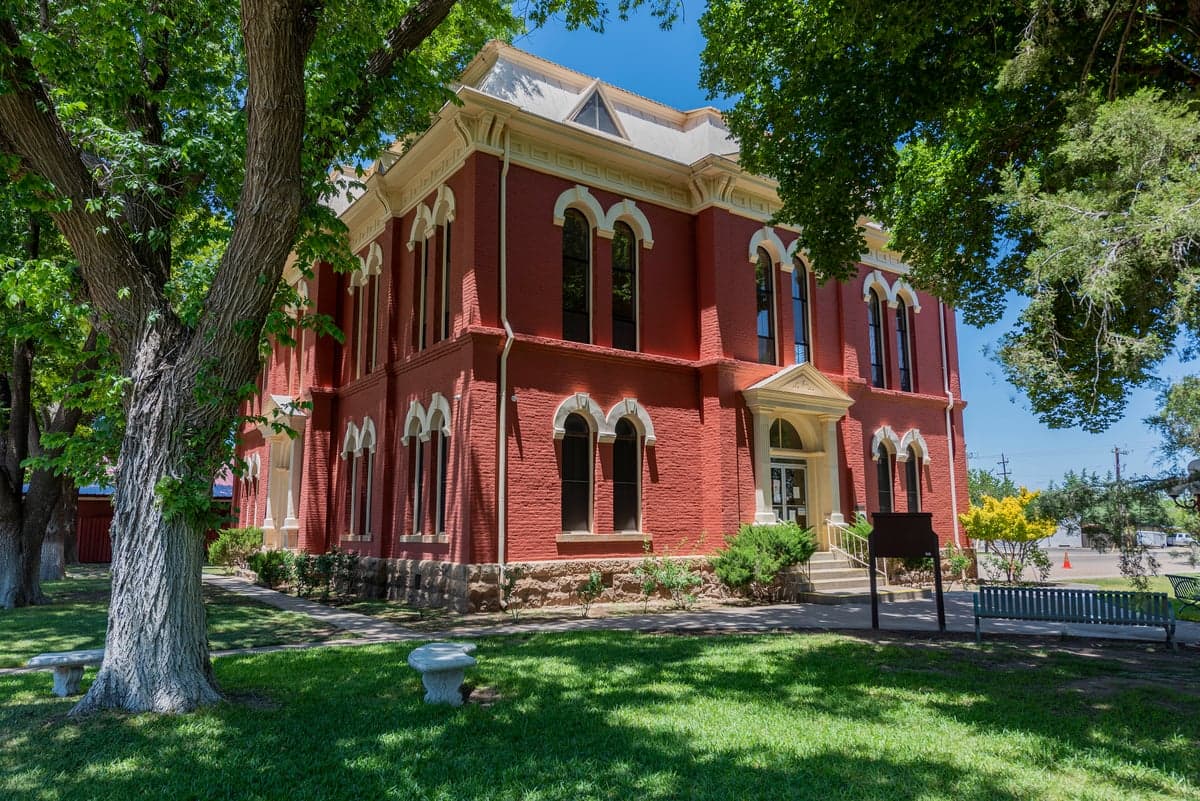
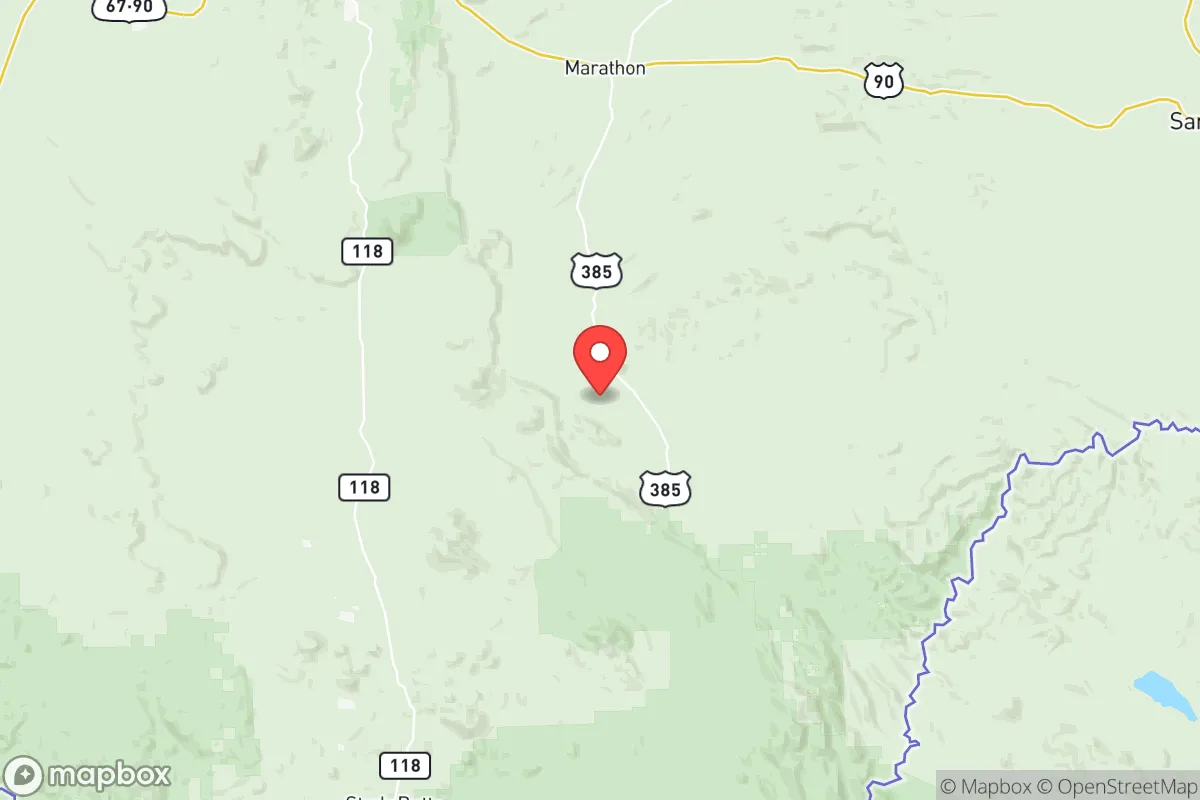
Photo: Wikipedia
Demographics of Brewster County
Affluence Level in Brewster County
A middle-class area roughly in line with national averages across income, home values, education, and employment.
People of Brewster County
Brewster County, Texas, is home to roughly 9,464 residents, making it the most populous county in the vast Trans-Pecos region yet one of the least densely settled in the state. Its people are defined by a stark blend of long-established Anglo ranching families and a growing Hispanic community, with a small but influential academic population centered in Alpine. The county’s character remains deeply tied to the land—cattle, conservation, and tourism—and its residents value self-reliance, wide-open spaces, and a slower pace of life far removed from urban Texas.
Settlement & growth (pre-1960)
Before any permanent non-Native settlement, the area that is now Brewster County was part of the homeland of the Lipan Apache and later the Comanche, who used the region’s springs and canyons for seasonal hunting and raiding. Spanish explorers passed through as early as the 16th century, but no lasting missions or settlements were established due to the harsh aridity and distance from supply lines. The first sustained American presence came after the Mexican-American War and the 1848 Treaty of Guadalupe Hidalgo, when the U.S. Army built Fort Davis (in neighboring Jeff Davis County) and Fort Stockton to protect travelers on the San Antonio-El Paso Road. A few hardy ranchers began grazing cattle in the southern part of what would become Brewster County in the 1870s, but true settlement did not begin until the arrival of the railroad.
The Galveston, Harrisburg and San Antonio Railway (later the Southern Pacific) reached the future townsite of Alpine in 1882, spurring the county’s first real population wave. Alpine was founded as a railroad division point and quickly became the commercial hub for the surrounding ranches. The county itself was created in 1887 from Presidio County, with Alpine named the seat. The early Anglo settlers were predominantly of Scots-Irish and English descent, drawn by the promise of cheap land for cattle ranching under the open-range system. These families—names like Kokernot, Evans, and Gage—established vast spreads that remain in operation today. A smaller but notable group of German and Czech families arrived in the 1890s, settling around Marathon and Terlingua, where they found work in the mercury mines that boomed from the 1890s through World War II. The mining town of Terlingua grew to several hundred residents, mostly Anglo and Hispanic laborers, but the industry collapsed after the war, leaving a ghost town that later revived as a tourist attraction.
The county’s population peaked at around 6,000 in the 1910 census, then declined as the mining bust and the Great Depression drove people away. Ranching remained the economic backbone, but the establishment of Sul Ross State University in Alpine in 1920 brought a new, more educated population—teachers, professors, and their families—that stabilized the county’s numbers. By 1950, Brewster County’s population had fallen to about 5,000, with the majority still living in Alpine and the surrounding ranchlands. The Hispanic population, though present since the Spanish era, remained a minority, working as cowboys, miners, and laborers, often living in separate communities like the colonias of Study Butte and the older sections of Alpine.
Modern era (post-1965)
The 1965 Hart-Cellar Act did not directly transform Brewster County’s demographics as it did in major cities, but its long-term effects are visible in the county’s growing Hispanic share. Prior to 1965, immigration from Mexico was restricted; after the act, family reunification and labor demand in Texas agriculture and construction drew more Mexican-born residents to the region. Today, 42.1% of Brewster County’s population identifies as Hispanic, up from roughly 25% in 1980. Most of this growth has occurred in Alpine, where Hispanic residents now make up a majority of the public school enrollment, and in the Terlingua/Study Butte area, where many work in tourism, hospitality, and construction. The foreign-born share remains low at 3.8%, indicating that most Hispanic residents are U.S.-born citizens or long-term legal residents.
Domestic migration has been modest but notable. Since the 1970s, Brewster County has attracted a steady trickle of retirees, artists, and outdoor enthusiasts from other parts of Texas and the West Coast, drawn by the low cost of land, the Big Bend National Park (established 1944), and the county’s reputation for dark skies and solitude. These newcomers tend to settle in the Terlingua ghost town area, Lajitas (a resort community), and the outskirts of Alpine. The county’s college-educated share is a striking 45.3%, far above the national average, reflecting the presence of Sul Ross State University and a disproportionate number of professionals in education, government, and conservation. The Black population is negligible at 0.3%, and East/Southeast Asian residents make up just 1.2%, concentrated among university faculty and staff in Alpine. There is no measurable Indian-subcontinent population.
Suburbanization has not occurred in any conventional sense; the county’s vast size (over 6,000 square miles) and low density mean that most residents live in small, unincorporated clusters or on isolated ranches. The only incorporated city is Alpine (population about 6,000), which functions as a regional service center. Marathon (population ~400) and Terlingua (census-designated place, ~1,000) are unincorporated but serve as secondary population nodes.
The future
Brewster County’s population is projected to grow slowly, perhaps reaching 10,000–11,000 by 2040, driven primarily by natural increase among the Hispanic population and continued in-migration of retirees and remote workers. The county is becoming more diverse in the sense that the Hispanic share will likely rise to near 50% over the next two decades, while the White non-Hispanic share declines gradually. However, the county remains overwhelmingly non-Hispanic White and Hispanic, with little growth in other racial groups. The cultural identity is evolving from a purely Anglo ranching heritage toward a bicultural blend, with Spanish increasingly heard in public spaces and bilingual services expanding in Alpine. New residential development is concentrated in the Terlingua-Lajitas corridor, where vacation homes and short-term rentals are proliferating, and in Alpine’s newer subdivisions. The university will continue to anchor the county’s educated class, while tourism and second-home ownership will keep the economy afloat. For families and individuals moving in now, Brewster County offers a stable, low-crime environment with strong community ties, but also limited job diversity and a very isolated lifestyle.
Brewster County is becoming a place where traditional ranching values coexist with a growing Hispanic cultural presence and a small but influential academic community. For someone moving in today, it offers a rare combination of wide-open spaces, low taxes, and a tight-knit, self-reliant population—but also a very limited job market and a long drive to any major city. The county’s future is one of slow, steady change, not rapid transformation, making it a stable choice for those seeking a quiet, land-based life in far West Texas.

* Values derived from national, state, county, city and local statistics and may differ in a specific area. Last updated: 2026-10-10T09:59:44.000Z
Narrative content on this page is AI-generated and may contain mistakes. Verify any details that matter before acting on them.
ReloMaps may earn a commission from affiliate links at no extra cost to you.

