Photo: Wikipedia
Demographics of Hood County
Affluence Level in Hood County
A middle-class area roughly in line with national averages across income, home values, education, and employment.
People of Hood County
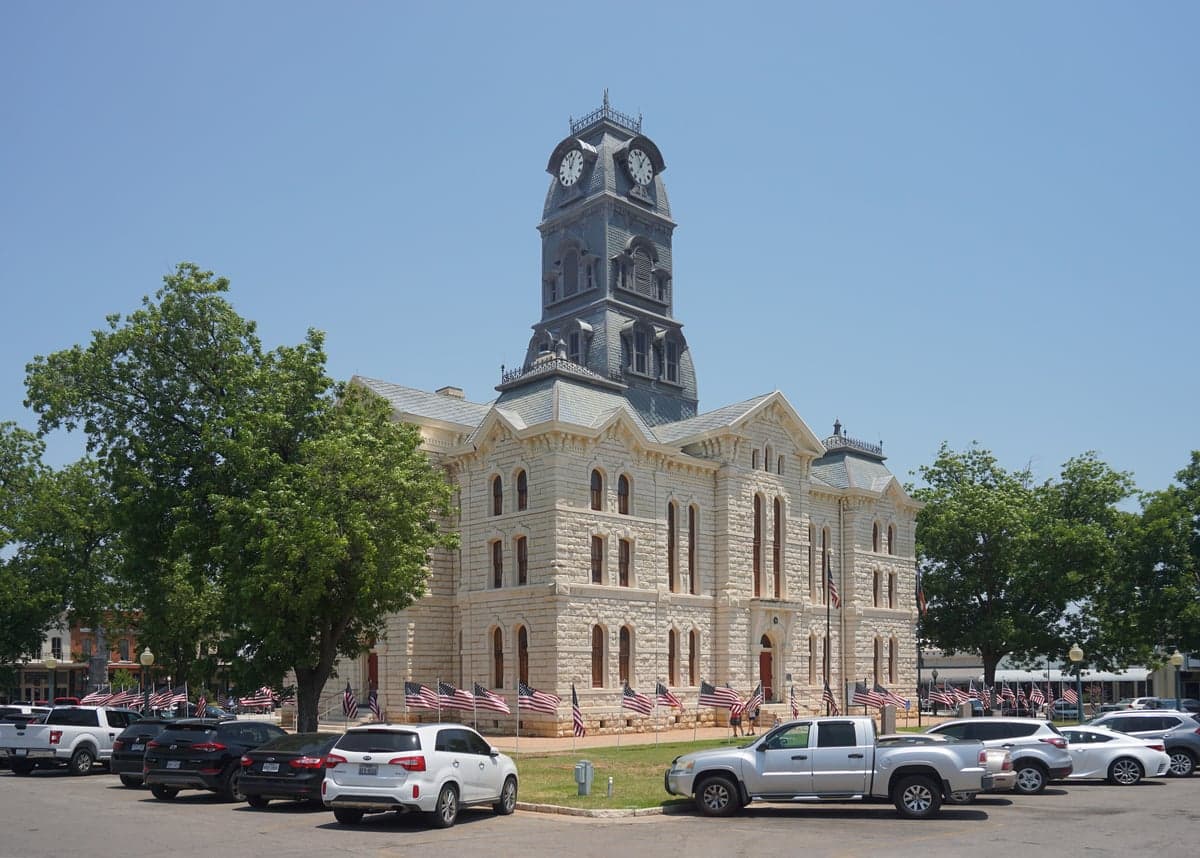
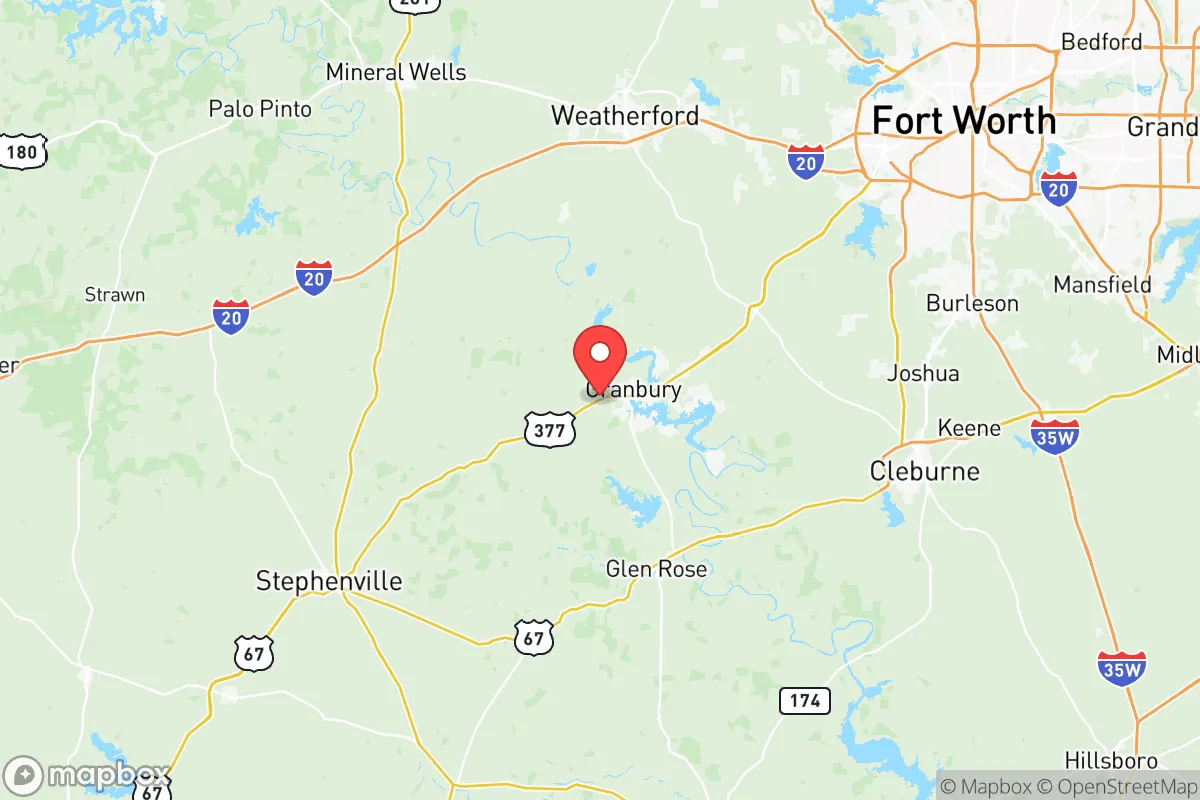
Hood County, Texas, is a predominantly white, politically conservative, and family-oriented community of 64,198 residents, characterized by its rural heritage, growing exurban development, and a strong sense of local identity rooted in ranching and small-town life. The county’s population is 81.1% white, with a Hispanic share of 13.3% and a notably low foreign-born rate of 2.3%, reflecting a population shaped overwhelmingly by domestic migration rather than international immigration. Distinctive markers include a deep attachment to the county seat of Granbury, its historic town square, and Lake Granbury, which serve as social and economic anchors for a community that values self-reliance, faith, and traditional family structures.
Settlement & growth (pre-1960)
Before American settlement, the area now known as Hood County was inhabited by various Native American groups, primarily the Comanche and Tonkawa, who used the region for hunting and seasonal camps. Spanish and later Mexican claims to the land had little permanent impact, as the area remained a sparsely populated frontier. The first significant wave of Anglo-American settlers arrived in the 1850s, drawn by the promise of cheap land under the Texas land grant system. These early pioneers were predominantly of Scots-Irish and English descent, moving west from the older settled areas of East Texas and the Lower South. They established small farms and ranches, and the town of Granbury was founded in 1854 as the county seat, named after Confederate General Hiram B. Granbury. The post-Civil War period saw a slow but steady influx of families, many of them former Confederates seeking a fresh start, and the county’s economy became firmly tied to cotton, cattle, and subsistence agriculture.
By the early 20th century, Hood County remained a rural, agricultural community with a population that barely exceeded 10,000. The arrival of the railroad in the 1880s spurred modest growth in towns like Tolar and Lipan, connecting local farmers to regional markets. The Dust Bowl and Great Depression of the 1930s brought a small number of displaced farmers from Oklahoma and the Texas Panhandle, but the county’s population actually declined during this period as young people left for urban jobs. The construction of the DeCordova Bend Dam on the Brazos River in the 1960s, creating Lake Granbury, marked a turning point. This project, completed in 1969, transformed the county’s economic base by attracting retirees, weekenders, and second-home buyers from the Dallas-Fort Worth metroplex, setting the stage for the modern era of growth.
Modern era (post-1965)
The post-1965 period in Hood County has been defined not by international immigration but by sustained domestic in-migration, primarily from the Dallas-Fort Worth area and other parts of Texas. The 1965 Hart-Cellar Act, which reshaped U.S. immigration patterns nationally, had a minimal direct effect here: the county’s foreign-born population remains at just 2.3%, far below the national average. Instead, the demographic story is one of suburban and exurban expansion. Beginning in the 1970s and accelerating through the 1990s and 2000s, families and retirees seeking lower taxes, larger lots, and a slower pace of life moved to Hood County, particularly to Granbury and the unincorporated areas around Lake Granbury. This wave was overwhelmingly white and middle-class, drawn by the area’s conservative reputation, good schools, and recreational opportunities.
The Hispanic population, now 13.3%, grew steadily from the 1980s onward, driven by labor demand in construction, landscaping, and service industries tied to the county’s growth. Many Hispanic families settled in Granbury and the smaller community of Acton, often working in trades and hospitality. Unlike in many Texas counties, there has been little formation of distinct ethnic enclaves; the Hispanic population is dispersed and largely integrated into the broader community. The Black population remains very small at 1.0%, a legacy of the county’s historical lack of industrial or urban centers that might have attracted African American migrants during the Great Migration. East and Southeast Asian communities (0.4%) and Indian subcontinent residents (0.3%) are present in tiny numbers, typically professionals or business owners in Granbury, but do not form a visible enclave. The county’s racial and ethnic composition has thus remained remarkably stable compared to the state as a whole, with white non-Hispanic residents maintaining an overwhelming majority.
The future
Hood County’s population is projected to continue growing, driven by ongoing spillover from the Dallas-Fort Worth metroplex, which is expected to add millions of residents in the coming decades. This in-migration will likely remain predominantly white and domestic, reinforcing the county’s existing cultural and political character. The Hispanic share may increase modestly as younger families move in, but the foreign-born rate is unlikely to rise significantly given the lack of established immigrant networks or large employers that attract international labor. The county is not tribalizing into distinct enclaves; rather, it is homogenizing around a shared exurban lifestyle centered on Granbury’s historic square, lake recreation, and conservative values. The biggest demographic challenge will be managing growth without losing the small-town identity that draws newcomers. For a family or individual moving in now, Hood County offers a stable, culturally cohesive environment where the population is growing but not diversifying rapidly, and where the dominant political and social norms are unlikely to shift in the foreseeable future.
Bottom-line: Hood County is becoming a more populous, slightly more Hispanic version of its current self, absorbing new residents into its existing cultural framework rather than being transformed by them. For someone moving in now, this means a community where conservative values, outdoor recreation, and a strong sense of local history remain central, and where demographic change is gradual enough to feel like continuity rather than disruption.

* Values derived from national, state, county, city and local statistics and may differ in a specific area. Last updated: 2026-06-06T08:43:49.000Z
Narrative content on this page is AI-generated and may contain mistakes. Verify any details that matter before acting on them.
ReloMaps may earn a commission from affiliate links at no extra cost to you.

