
Photo: Wikipedia
Personal Sovereignty in Orange County
Strong independent fundamentals that actively favor personal liberty and low regulation.
What does Personal Sovereignty tell us?
Personal Sovereignty measures your capacity for self-reliance and independence with minimal government friction. Higher scores mean fewer barriers between you and the way you want to live... but it assumes you have the space you need and good neighbors.
What does this tell us?
Personal Sovereignty measures your capacity for self-reliance and independence with minimal government friction. Higher scores mean fewer barriers between you and the way you want to live... but it assumes you have the space you need and good neighbors.
State Policy
Energy independence: Net exporter (220% of energy produced in-state)
Personal Liberty
Homesteading

Personal Liberty Analysis
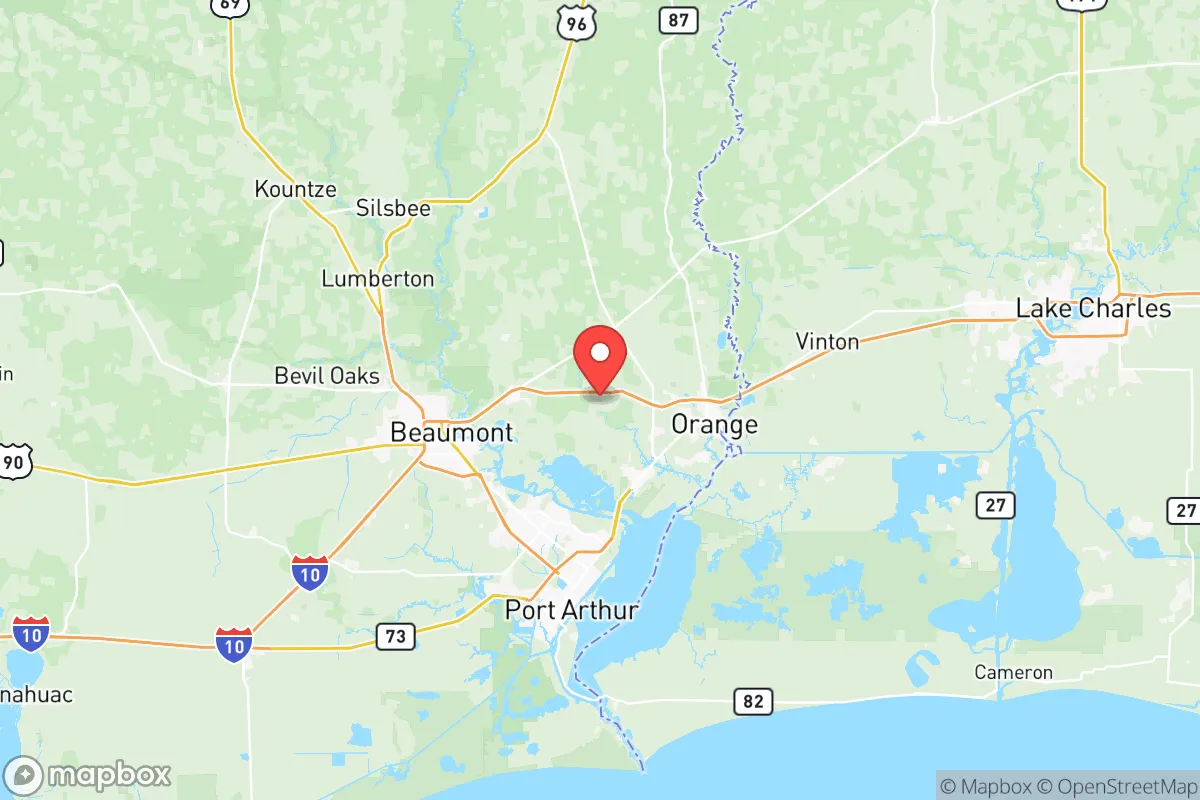
Orange County, Texas, offers a notably high degree of personal sovereignty, rooted in Texas’s strong state-level protections for gun rights, property use, and limited local government interference. Located in the southeastern corner of the state along the Louisiana border, the county presents an environment where individual autonomy is the default, particularly when compared to more heavily regulated urban centers like Houston or Austin. For single individuals and families who prioritize self-reliance and minimal government intrusion, Orange County provides a legal and cultural framework that supports independent decision-making across taxation, self-defense, and land use.
Tax burden and regulatory posture: how local rules compare to state-level limits
Texas has no state income tax, which immediately benefits residents of Orange County by preserving more of their earned income. The county’s property tax burden is moderate relative to the state average, with effective rates around 1.6% to 1.8% of assessed home value, depending on the specific city or school district. Orange County’s regulatory posture is generally light-touch, with no county-wide zoning in unincorporated areas, meaning property owners in places like Little Cypress or Mauriceville face fewer restrictions on how they use their land than they would inside the city limits of Orange or Vidor. The cities themselves maintain basic building codes and subdivision regulations, but these are not onerous compared to major metro areas. Business licensing requirements are minimal, and the county does not impose additional local sales taxes beyond the state’s 6.25% rate, though some cities add up to 2% for local infrastructure. Overall, the tax and regulatory environment leans toward personal discretion rather than bureaucratic oversight.
Self-defense and gun law specifics: what Texas’s permitless carry means locally
Texas’s permitless carry law, effective since September 2021, allows any law-abiding adult 21 or older to carry a handgun in public without a license, and Orange County fully reflects that state-level policy. Local law enforcement in Orange County is generally supportive of gun rights, and there are no county-specific restrictions that exceed state law. Open carry of long guns is also legal and culturally accepted, particularly in rural areas like Deweyville and Orangefield. The county has a strong hunting tradition, and firearm ownership rates are high. For those who wish to obtain a License to Carry (LTC) for reciprocity with other states, the process is straightforward, with multiple local instructors offering courses. Stand-your-ground and castle doctrine laws apply fully, providing legal protection for the use of deadly force in self-defense without a duty to retreat. Orange County’s gun culture is practical and ingrained, not performative, and residents generally view firearm ownership as a normal part of daily life.
Self-reliance and homesteading viability: lot sizes, zoning, and off-grid feasibility
Homesteading and self-reliance are highly viable in Orange County, particularly outside the city limits of Orange and Vidor. Unincorporated areas have no county-wide zoning, which means residents can keep livestock, build workshops, and manage their land with minimal permitting. Lot sizes in rural areas like Little Cypress and Mauriceville commonly range from one to five acres, with larger parcels available in the northern part of the county near Deweyville. Off-grid living is feasible, though Texas law requires connection to a permitted septic system for wastewater; rainwater collection is legal and encouraged, and solar panels face no local restrictions. The county does not enforce building codes in unincorporated areas, so owner-built structures are allowed as long as they meet basic health and safety standards. Agricultural exemptions are available for properties used for farming or ranching, reducing property tax burdens for those who actively use their land for food production. The Sabine River and numerous bayous provide water access, and the climate supports year-round growing seasons, making subsistence gardening practical.
Personal liberties: parental rights, medical autonomy, speech, and property
Texas law provides strong protections for parental rights, including the right to direct a child’s education and medical care, and Orange County’s school districts — such as Little Cypress-Mauriceville CISD and Orangefield ISD — generally defer to parental authority on matters of curriculum and health decisions. Medical autonomy is supported by state-level laws that protect informed consent and prohibit vaccine mandates by private employers in most cases, though local healthcare options are limited to the Orange County Hospital and clinics in Beaumont. Freedom of speech is robustly protected, with no local ordinances restricting public expression beyond standard nuisance laws. Property rights are strongly defended; eminent domain is rarely used for non-infrastructure projects, and the county does not impose rent control or short-term rental bans in unincorporated areas. Orange County’s legal climate favors individual decision-making over collective mandates, which aligns with the priorities of residents who value personal responsibility and minimal government overreach.
Compared to other regions in Texas and the broader United States, Orange County offers a high degree of personal sovereignty, particularly in the areas of gun rights, property use, and tax burden. While it does not have the extreme libertarian lean of some West Texas counties, it provides a balanced environment where state-level protections are respected and local interference is limited. For individuals and families who prioritize autonomy in daily life — from carrying a firearm to building a homestead — Orange County ranks favorably among Southeast Texas locales, offering a practical, low-friction setting for self-directed living.

* Values derived from national, state, county, city and local statistics and may differ in a specific area. Last updated: 2026-08-08T13:20:18.000Z
Narrative content on this page is AI-generated and may contain mistakes. Verify any details that matter before acting on them.
ReloMaps may earn a commission from affiliate links at no extra cost to you.

