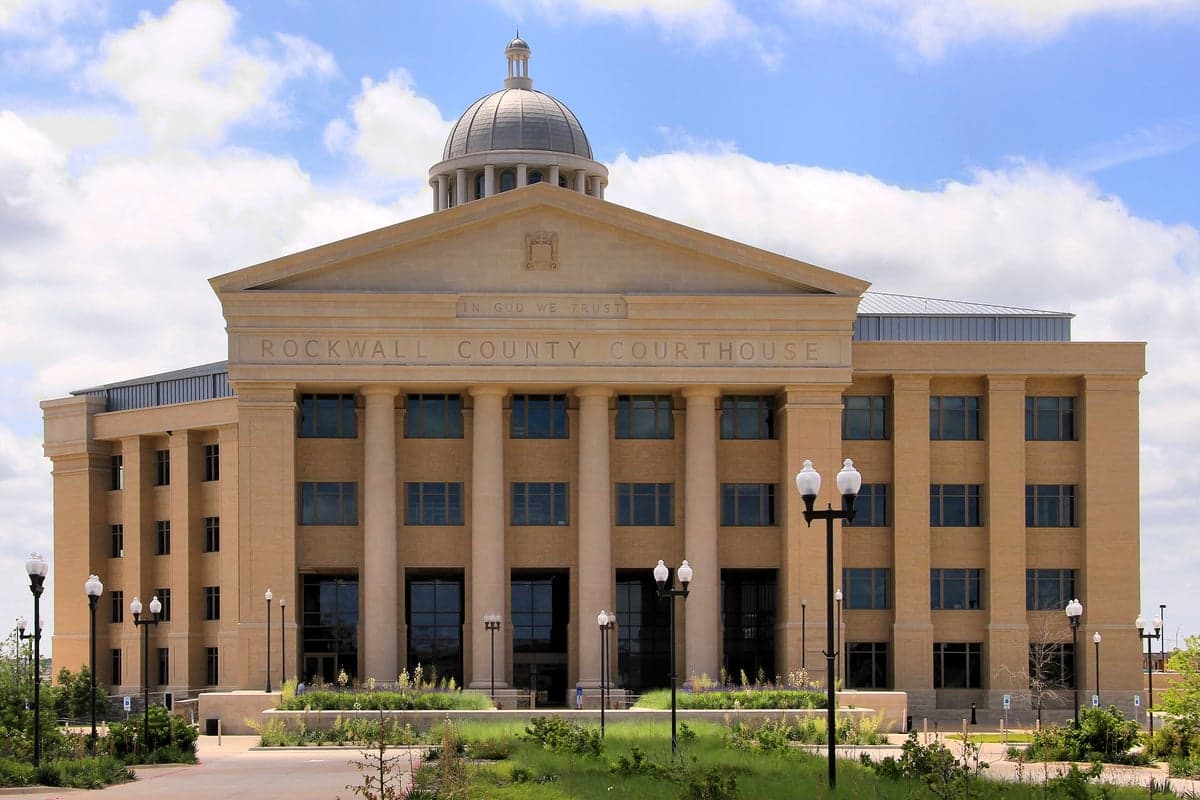
Photo: Wikipedia
Demographics of Rockwall County
Affluence Level in Rockwall County
An upper-middle-class area. Household wealth, education levels, and homeownership run ahead of national benchmarks.
People of Rockwall County
Today, Rockwall County is home to 116,931 residents who form one of the fastest-growing and most affluent suburban populations in North Texas. The county’s character is defined by a predominantly white (64.9%) and Hispanic (20.2%) population, with a notably high college education rate of 44.0% and a very low foreign-born share of just 3.4%. This creates a distinctive identity: a conservative-leaning, family-oriented suburb where native-born Texans and domestic migrants from other states have built a community centered on Rockwall, Heath, and Fate, with a strong sense of local pride and a rapidly expanding footprint.
Settlement & growth (pre-1960)
Before American settlement, the area now known as Rockwall County was part of the traditional territory of the Caddo Confederacy, particularly the Hasinai and Kadohadacho groups, who lived in settled agricultural villages along the Trinity River and its tributaries. Spanish and French explorers passed through the region in the 17th and 18th centuries, but no permanent European colonies were established here. The land remained sparsely populated by Native peoples until the 1830s, when Anglo-American settlers began arriving under the empresario land grant system of the Republic of Texas.
The first major wave of settlers were primarily of Scots-Irish and English descent, migrating from the Upper South (Tennessee, Kentucky, Arkansas) and the Deep South (Alabama, Mississippi) between 1840 and 1860. These families were drawn by cheap, fertile blackland prairie soil suitable for cotton farming and by the promise of land grants under the Texas Preemption Act. They founded the county seat of Rockwall in 1854, named for a unique natural rock wall formation discovered by early surveyors. Small farming communities like Fate (originally a railroad stop called “Fate’s Switch”) and Royse City (partly in Rockwall County) emerged as cotton-ginning and trading centers. The county’s population in 1860 was about 1,200, almost entirely white and native-born, with a small number of enslaved African Americans who worked the cotton fields.
After the Civil War and Reconstruction, the county’s Black population grew modestly as freedmen established small farming communities, most notably around McClendon-Chisholm, where a rural Black settlement persisted into the early 20th century. The post-Reconstruction era saw little new immigration; the county remained a homogeneous, agrarian Anglo-Protestant society through the 1920s. The Dust Bowl and Great Depression of the 1930s caused some out-migration, but the county’s population held steady at around 6,000. No significant European immigrant groups (Germans, Poles, Italians) settled here in numbers, unlike in Central Texas. The county’s population remained overwhelmingly native-born white until after World War II.
The post-war period (1945–1960) brought the first major demographic shift: the beginning of suburbanization from Dallas, located just 20 miles west. The construction of Interstate 30 (then US 67) and the Lake Ray Hubbard reservoir (completed 1969) transformed Rockwall County from an isolated farming area into a bedroom community for Dallas professionals. By 1960, the population had grown to about 8,000, still predominantly white and native-born, but with a growing number of middle-class families moving from Dallas seeking larger lots and lower taxes.
Modern era (post-1965)
The 1965 Hart-Cellar Act had a minimal direct impact on Rockwall County, as the area attracted very few foreign-born immigrants compared to Dallas or Houston. Instead, the county’s modern growth has been driven overwhelmingly by domestic migration from other parts of Texas and the United States. The foreign-born population today stands at just 3.4%, far below the national average of 13.7% and even below the Texas average of 17.1%. This makes Rockwall County one of the least immigrant-reliant counties in the Dallas-Fort Worth metroplex.
The dominant demographic story since 1970 has been the explosive growth of the white, native-born population through suburban expansion. The county’s population grew from 8,000 in 1970 to 43,000 in 2000, and then to 117,000 today. This growth was fueled by families moving from Dallas, Collin County, and other parts of Texas, drawn by new master-planned communities, excellent public schools, and a reputation for safety and conservative values. The city of Heath, incorporated in 1953, became a magnet for affluent families, with large estate homes and a low-density, semi-rural character. Fate transformed from a tiny farming hamlet into a booming suburb, its population leaping from 600 in 2000 to over 20,000 today. Rockwall itself grew from a small town of 10,000 in 1990 to a city of 47,000, with dense suburban development along the IH-30 corridor.
The Hispanic population has grown significantly, from about 5% in 1990 to 20.2% today. This growth is primarily driven by domestic migration from other parts of Texas (especially the Rio Grande Valley and San Antonio) and by second- and third-generation Mexican-American families moving from Dallas. Hispanic residents are concentrated in the older neighborhoods of Rockwall and in the more affordable housing areas of Fate and unincorporated parts of the county. The Black population, at 8.3%, has grown steadily since 2000, largely through domestic migration from other parts of Texas and the South, with concentrations in Rockwall and Royse City. The East/Southeast Asian population (2.1%) and Indian-subcontinent population (1.2%) are small but growing, primarily composed of professionals working in Dallas’s technology and healthcare sectors who choose Rockwall County for its schools and housing values.
The county’s political identity has solidified as strongly conservative. Rockwall County voted for Donald Trump by a margin of +24 points in 2024, reflecting its white, native-born, and family-oriented character. The county has no significant ethnic enclaves; instead, it is a relatively integrated suburb where racial and ethnic groups are dispersed across neighborhoods, though some clustering exists by income level.
The future
Rockwall County’s population is projected to continue growing rapidly, reaching an estimated 150,000–170,000 by 2040, driven by continued domestic migration from California, the Northeast, and other parts of Texas. The county is not homogenizing into a single cultural bloc; rather, it is tribalizing along income and lifestyle lines. The affluent lakefront communities of Heath and Rockwall’s Harbor area will remain predominantly white and wealthy, while the more affordable subdivisions in Fate and Royse City will attract a more diverse mix of Hispanic, Black, and white middle-class families.
The immigrant communities are likely to remain small and assimilated, as the county’s low foreign-born share and high native-born majority create strong cultural pressure toward English-language use and American norms. The Hispanic population will continue to grow through domestic migration and natural increase, but it will likely become more integrated and less distinct as an ethnic enclave. The East/Southeast Asian and Indian populations will grow slowly, primarily through professionals moving from Dallas, but will remain a small minority.
The cultural identity of Rockwall County is being reshaped by in-migration from other states, particularly California and the Northeast, which brings more politically moderate and culturally diverse influences. However, these newcomers are largely absorbed into the existing conservative, family-oriented culture rather than transforming it. The next 10–20 years will see a county that is more populous, more diverse, and more suburban, but still fundamentally defined by its native-born, white-majority character and its role as a safe, high-amenity suburb for Dallas commuters.
For someone moving in now, Rockwall County offers a stable, growing community with strong schools, low crime, and a conservative social environment. The population is becoming more diverse but remains overwhelmingly native-born and English-speaking, with little of the ethnic tension or cultural fragmentation seen in larger cities. It is a place where domestic migrants from across the United States are building a new version of the traditional American suburb, one that is prosperous, family-focused, and politically conservative.

* Values derived from national, state, county, city and local statistics and may differ in a specific area. Last updated: 2026-05-28T02:14:59.000Z
Narrative content on this page is AI-generated and may contain mistakes. Verify any details that matter before acting on them.
ReloMaps may earn a commission from affiliate links at no extra cost to you.

