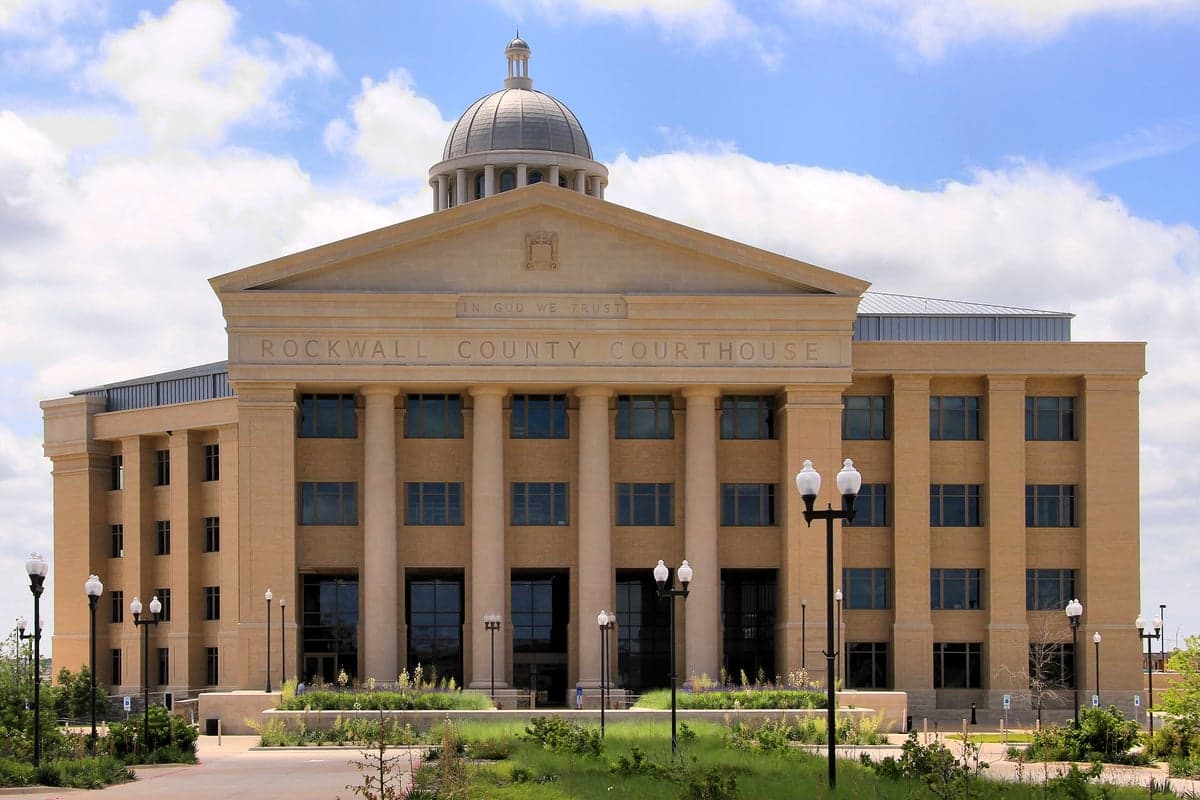
Photo: Wikipedia
Political ClimatePolitical Climate in Rockwall County
Showing district-level results — no local-only data available.
Local Political AnalysisPolitical Analysis of Rockwall County
Rockwall County has long been a conservative stronghold, and honestly, it’s one of the last places in the Dallas-Fort Worth metroplex where you can still breathe easy without feeling like the government is breathing down your neck. The Cook PVI sits at R+16, which is a full 12 points more Republican than Texas as a whole (R+4), and that gap has only widened in recent cycles. In 2024, Donald Trump carried the county by over 20 points, and local races rarely see a Democrat crack 40% of the vote. But if you’ve been here as long as I have, you’ve noticed the winds shifting—especially in the newer subdivisions near Fate and Royse City, where folks moving in from Dallas and Collin County are bringing a more progressive mindset that feels out of step with the area’s traditional values.
How it compares
Compared to Texas at large, Rockwall County is a political outlier in a state that’s already pretty red. While Texas as a whole has been inching toward purple—especially in Harris, Bexar, and Travis counties—Rockwall has held the line. The difference is stark when you look at the precincts. In the city of Rockwall itself, you’ll find a few pockets near the lake and the historic downtown that lean slightly more moderate, but they’re still solidly conservative. Meanwhile, the rural stretches around McLendon-Chisholm and the unincorporated areas east of Highway 205 are about as red as it gets—think 80%+ Republican turnout. The real battleground is in Fate, where the rapid growth has brought in a mix of young families and remote workers who sometimes vote more like their old neighbors in Plano than their new ones in Rockwall. That’s where you’ll see the closest races, and it’s a trend that worries me—if we’re not careful, those swing precincts could tip the county in a direction that feels less like home.
What this means for residents
For folks living here, the political climate translates directly into how much freedom you actually have in your daily life. Rockwall County’s conservative leadership means lower taxes, fewer regulations on property use, and a school board that hasn’t bought into the woke curriculum nonsense you see in districts closer to Dallas. The county commissioners have consistently pushed back against state-level overreach on things like mask mandates and vaccine passports, which is exactly the kind of local control we need. But the influx of new residents—many of whom are used to HOA-heavy suburbs with strict rules and progressive city councils—is starting to change the conversation. In Rockwall city limits, you’re already seeing more noise about “equity” initiatives and zoning changes that feel like a foot in the door for bigger government. If you value your Second Amendment rights and want to raise your kids without the school system indoctrinating them, this is still a great place to be—but you’ve got to stay engaged in local elections, because the next few cycles could decide whether we keep our way of life or start sliding toward the mess you see in Austin.
Culturally, Rockwall County still feels like a place where neighbors look out for each other and the government stays out of your business. The county fair, the local rodeo, and the church potlucks are still the social backbone, not some city council task force. But there’s a growing tension between the old guard—folks who remember when this was all farmland—and the newcomers who want to turn Rockwall into another Frisco. The policy distinctions are subtle but real: Rockwall County has resisted light-rail expansion and high-density housing mandates, while cities like Fate have been more open to them. If you’re looking for a place where your voice still matters and your rights aren’t up for debate, Rockwall County is holding strong—but keep your eyes on the school board meetings and the city council races, because that’s where the fight for our future is happening right now.

State Political ClimatePolitical Climate in Texas
State Political AnalysisPolitical Environment in the State
Texas has been a reliably Republican state for decades, with a Cook PVI of R+4, but the political landscape is far more complex than a single number suggests. The dominant coalition has long been a mix of social conservatives, fiscal conservatives, and libertarian-leaning independents, but rapid in-migration from blue states and demographic shifts are slowly chipping away at that foundation. Over the last 10-20 years, the state has seen a gradual rightward shift in rural areas and a sharp leftward turn in major metros, creating a political tug-of-war that makes Texas both a conservative stronghold and a battleground for the future of American politics.
Urban vs. rural divide
The political map of Texas is a study in contrasts. The vast rural expanse—places like Lubbock, Amarillo, and the Panhandle—votes overwhelmingly Republican, often by margins of 70% or more. Meanwhile, the major urban centers are Democratic strongholds. Austin is the state's most liberal city, with Travis County voting +35 Democratic in 2024, driven by a tech-heavy, transplant-heavy population. El Paso is a Democratic fortress, with a heavily Hispanic population that leans left on immigration and labor issues. Houston (Harris County) and Dallas (Dallas County) have flipped from purple to solid blue over the past decade, fueled by suburban diversification and younger voters. The real battleground is the suburbs: Collin County (north of Dallas) and Fort Bend County (southwest of Houston) were once reliably red but are now competitive, with Collin County voting just +3 Republican in 2024 after being +20 a decade ago. San Antonio remains a moderate Democratic city, while Corpus Christi and the Rio Grande Valley are shifting rightward among Hispanic voters, particularly on economic and energy issues.
Policy environment
Texas maintains a low-tax, low-regulation posture that appeals to conservatives. There is no state income tax, and property taxes are high but capped by Proposition 2 (2023), which limits appraisal increases to 10% annually for non-homestead properties and provides a $100,000 homestead exemption for school taxes. The regulatory environment is business-friendly, with no state-level minimum wage above the federal $7.25 and a right-to-work law that weakens union power. Education policy is a flashpoint: the state has a school voucher-like program (the Texas Education Savings Account program, passed in 2023) that allows parents to use state funds for private or homeschool expenses, though it faces legal challenges. Healthcare is largely market-driven, with no state Medicaid expansion under the ACA, leaving about 1.5 million Texans in the coverage gap. Election laws tightened after 2021's Senate Bill 1, which banned 24-hour and drive-through voting, added ID requirements for mail ballots, and empowered partisan poll watchers. Abortion is effectively banned after six weeks under the Texas Heartbeat Act (2021), with no exceptions for rape or incest, and trigger laws now prohibit the procedure entirely. This policy mix makes Texas a haven for conservatives seeking limited government, but it also creates friction with the growing progressive population in cities.
Trajectory & freedom
On balance, Texas has become more free in some areas and less free in others over the past five years. On the plus side for conservatives: the permitless carry law (HB 1927, 2021) allows any law-abiding adult to carry a handgun without a license, expanding Second Amendment rights. Parental rights were strengthened with the "Save Women's Sports Act" (2023) and the ban on gender-transition procedures for minors (SB 14, 2023). Property rights saw a win with the "Take Act" (2023), which limits eminent domain abuse by private entities. However, government overreach has expanded in other areas: the state's COVID-19 response included a ban on vaccine mandates by private employers (SB 7, 2023), which some viewed as protecting freedom, but also saw the governor's office issue sweeping executive orders that bypassed local control. The state's strict abortion laws have created a "bounty hunter" enforcement mechanism (SB 8) that some libertarians find chilling. Medical autonomy is constrained: the Texas Medical Board has been aggressive in revoking licenses for doctors who perform abortions, even in emergencies. The trajectory is mixed—Texas is becoming more free on guns and parental rights, but less free on medical decisions and local governance.
Civil unrest & political movements
Texas has seen its share of political flashpoints. The 2020 Black Lives Matter protests in Austin and Dallas were large and sometimes violent, leading to property damage and a subsequent backlash that fueled the 2021 "defund the police" debate. The "Trump Train" incidents on I-35 in 2020, where vehicles surrounded a Biden campaign bus, highlighted the raw partisan divide. Immigration politics are a constant pressure point: Governor Abbott's Operation Lone Star (2021-present) has bused over 100,000 migrants to sanctuary cities like New York and Chicago, while the state has sued the Biden administration over border policies. The "sanctuary city" ban (SB 4, 2017) remains in effect, requiring local law enforcement to cooperate with federal immigration authorities. Secession rhetoric flares up periodically—the Texas Nationalist Movement has some grassroots support, but it's fringe. Election integrity remains a hot topic: the 2020 and 2022 cycles saw widespread claims of fraud (largely unsubstantiated), leading to the aforementioned SB 1. A new resident would notice the heavy police presence at polling places in urban counties and the constant political ads on TV. The state's political culture is confrontational but not violent—most Texans are polite about their disagreements, but the tension is real.
Projection
Over the next 5-10 years, Texas is likely to become more competitive at the statewide level, but not necessarily blue. The in-migration of 1,000+ people per day, mostly from California and New York, is slowly shifting the electorate. However, many of these transplants are conservatives fleeing high taxes and crime, so the net effect is unclear. The Hispanic vote is trending rightward, particularly in the Rio Grande Valley and San Antonio suburbs, which could offset urban gains. The state's Republican Party is fracturing between establishment conservatives and populist Trump-aligned factions, which could lead to primary battles that weaken the party. The Democratic Party is growing in the suburbs but is still weak in rural areas. The most likely outcome is a continued R+2 to R+4 lean, with occasional Democratic wins in down-ballot races (like the 2023 Houston mayoral race). A new resident moving in now should expect a state that remains conservative on taxes, guns, and abortion, but with a growing progressive urban core that will keep the culture wars alive. The freedom trajectory will depend on who controls the legislature after the 2030 census—if Democrats flip the Texas House, expect a rollback of some conservative policies.
For a new resident, the bottom line is this: Texas offers a low-tax, business-friendly environment with strong gun rights and parental control over education, but you'll need to navigate a polarized political landscape where your zip code determines your local government's ideology. If you're moving to Lubbock or the Panhandle, you'll find a deeply conservative community. If you're headed to Austin or El Paso, prepare for progressive local policies on housing, policing, and environmental regulation. The state government in Austin (the capital) will generally protect your conservative values, but the cities will push back. It's a trade-off—less state-level overreach than California or New York, but more local friction than a deep-red state like Alabama. If you value personal liberty and limited government, Texas is still one of the best bets in the country, but keep an eye on the demographic trends—they're moving faster than most people realize.
* Values derived from national, state, county, city and local statistics and may differ in a specific area. Last updated: 2026-05-28T02:14:59.000Z
Narrative content on this page is AI-generated and may contain mistakes. Verify any details that matter before acting on them.
ReloMaps may earn a commission from affiliate links at no extra cost to you.

