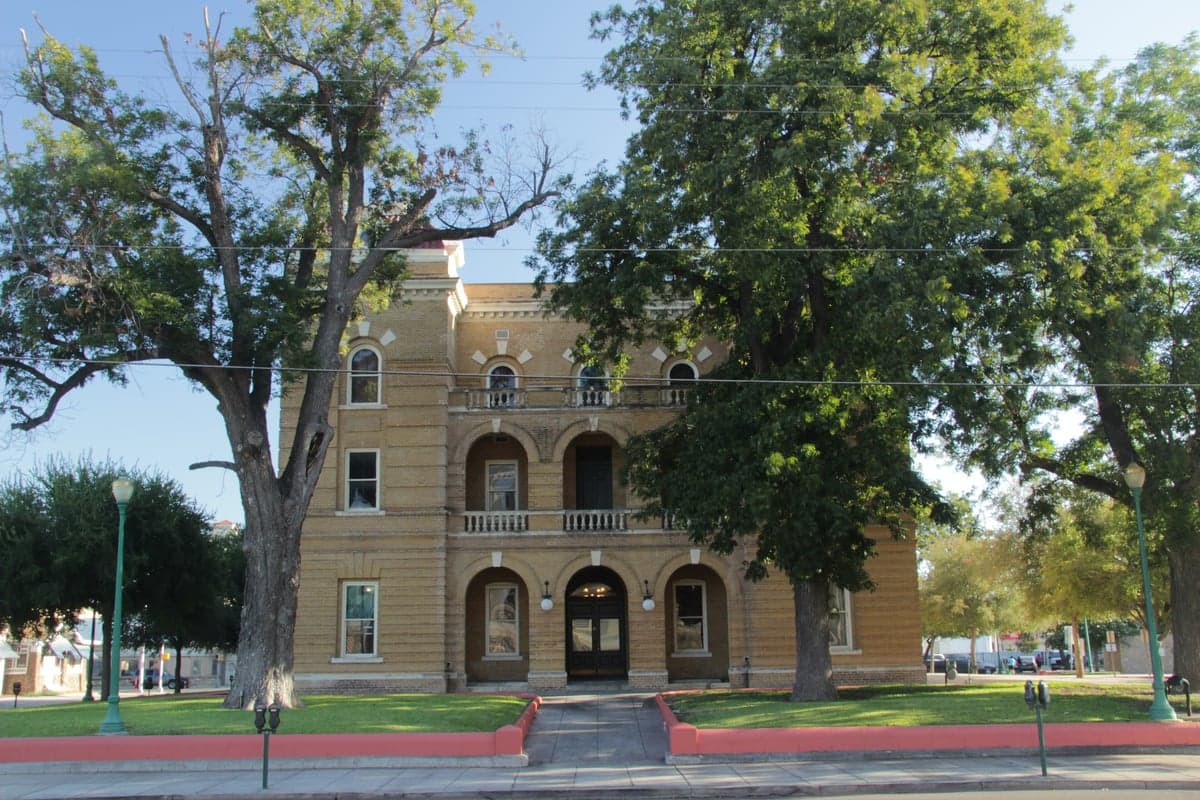
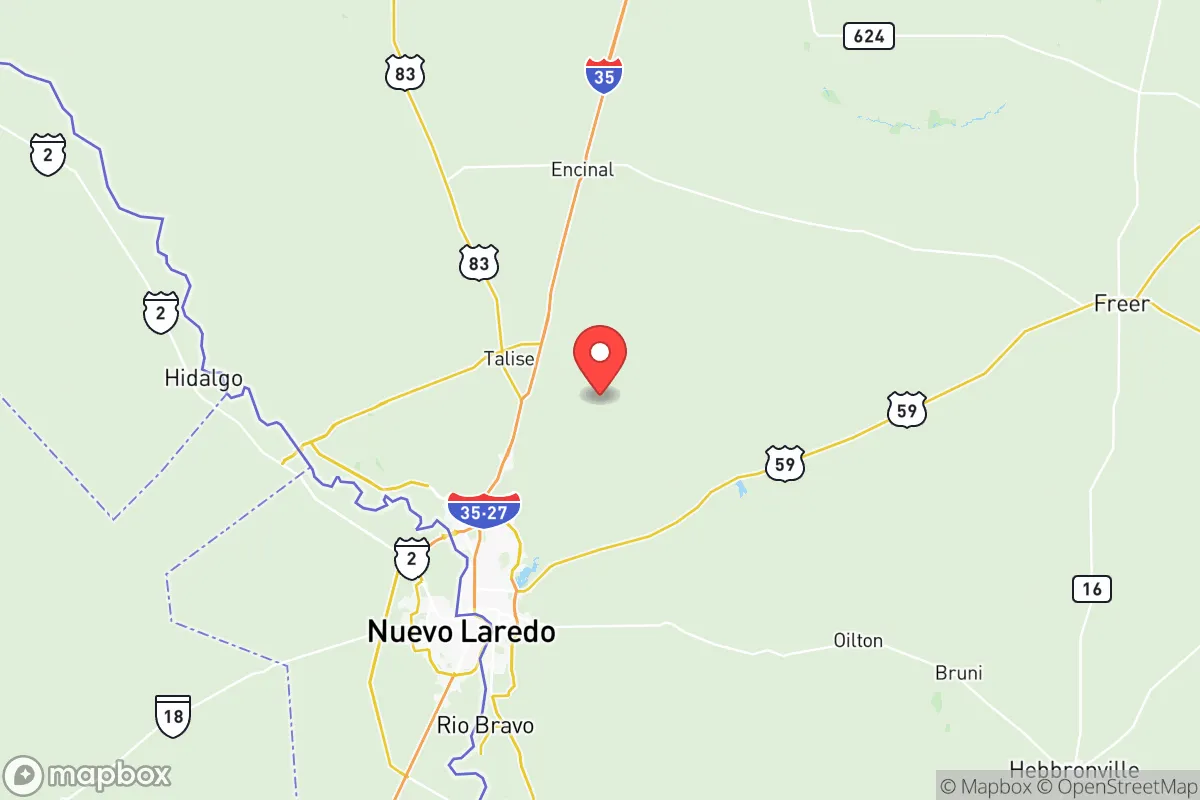
Photo: Wikipedia
Demographics of Webb County
Affluence Level in Webb County
A below-average socioeconomic profile. Incomes, home values, and educational attainment trail the U.S., with higher poverty and unemployment.
People of Webb County
Webb County, Texas, is overwhelmingly Hispanic, with 95.1% of its 267,731 residents identifying as such, making it one of the most culturally and linguistically homogeneous large counties in the United States. The population is young, with a median age well below the national average, and is concentrated in the county seat of Laredo, which anchors a binational metropolitan area of over 250,000 people. The county’s identity is deeply rooted in its border location, a history of ranching and trade, and a strong sense of family and Catholic tradition, creating a distinctive Tejano culture that sets it apart from both the rest of Texas and the broader American Southwest.
Settlement & growth (pre-1960)
Before European contact, the area now known as Webb County was inhabited by nomadic Native American groups, primarily the Coahuiltecan peoples, who lived in small bands along the Rio Grande. Spanish exploration began in the late 16th century, but permanent European settlement did not take hold until the mid-18th century, when Spanish authorities established a series of missions and presidios along the river to secure the northern frontier of New Spain. The town of Laredo was officially founded in 1755 by Spanish colonist Tomás Sánchez, who brought a small group of settlers from the interior of Mexico. This founding marks the beginning of Webb County’s continuous Hispanic settlement, predating the arrival of Anglo-Americans in Texas by several decades.
For most of the 19th century, Webb County remained a remote and sparsely populated ranching region. The area became part of the United States after the Mexican-American War in 1848, and the county was formally established in 1856. The population grew slowly, driven by Mexican migration and natural increase, with ranching and cross-border trade as the economic backbone. The arrival of the railroad in the 1880s, connecting Laredo to San Antonio and the rest of the country, spurred modest growth and transformed the city into a major port of entry for goods and people. Unlike much of Texas, which saw waves of German, Czech, and Anglo-American settlers during this period, Webb County remained overwhelmingly Hispanic, with Anglo-Americans never constituting more than a small fraction of the population. By 1900, the county had roughly 21,000 residents, nearly all of Mexican descent.
The early 20th century brought the Mexican Revolution (1910-1920), which pushed tens of thousands of refugees across the border into Laredo and the surrounding rural areas, including the small communities of Rio Bravo and El Cenizo. This wave of migration dramatically increased the population and solidified the county’s Mexican character. The Great Depression and World War II slowed growth, but the post-war period saw a resurgence, driven by the expansion of international trade and the establishment of military and customs infrastructure in Laredo. By 1960, the county’s population had reached approximately 64,000, still overwhelmingly Hispanic and concentrated in Laredo, with smaller settlements like Mirando City and Oilton serving as oilfield and ranching outposts.
Modern era (post-1965)
The 1965 Hart-Cellar Act, which ended national-origin quotas, had a more indirect effect on Webb County than on many other parts of the United States. Because the county’s population was already overwhelmingly Mexican-American, the primary demographic shift after 1965 was not the arrival of new immigrant groups from Asia or Africa, but rather a sustained and accelerated flow of migration from Mexico. This was driven by economic push factors in Mexico and the demand for labor in Texas agriculture, construction, and service industries. The population of Webb County more than doubled between 1970 and 2000, from roughly 72,000 to over 193,000, with most of the growth occurring in Laredo and its rapidly expanding suburbs, such as Ranchos Penitas West and La Presa.
Domestic migration into Webb County has been minimal compared to other Texas border regions. The county has not attracted significant numbers of Anglo retirees, Sun Belt professionals, or Rust Belt transplants. Instead, the population has remained remarkably stable in its ethnic composition, with the Hispanic share hovering around 95% for decades. The non-Hispanic white population, at just 3.6%, is largely composed of federal employees (customs, border patrol, and military personnel) and a small number of business owners, many of whom live in the newer subdivisions of Laredo near the Interstate 35 corridor. The Black population is negligible at 0.4%, and East/Southeast Asian communities account for just 0.4%, with no significant enclave forming. The Indian-subcontinent population is effectively zero. The foreign-born share stands at 17.0%, nearly all of whom are Mexican nationals, many living in colonias—unincorporated, often impoverished settlements—on the outskirts of Laredo, such as Los Altos and Larga Vista.
The modern era has also seen the rise of Laredo as a major hub for international trade, particularly after the implementation of the North American Free Trade Agreement (NAFTA) in 1994. This economic boom has created a prosperous middle class of logistics professionals, customs brokers, and trucking company owners, many of whom are native-born Mexican-Americans. However, the county also has a significant working-class and poor population, with a median household income well below the Texas average and a college education rate of just 20.9%. This economic stratification is reflected in the geography of Laredo, with wealthier neighborhoods in the north and west of the city, and poorer colonias and older barrios in the south and east.
The future
Webb County’s demographic future appears to be one of continued Hispanic dominance, with little sign of the diversification seen in other parts of Texas. The county’s population is projected to grow to over 300,000 by 2040, driven by natural increase (high birth rates among the Hispanic population) and ongoing migration from Mexico. The foreign-born share may decline slightly as second- and third-generation Mexican-Americans become a larger proportion of the population, but the cultural and linguistic identity of the county is likely to remain overwhelmingly Spanish-dominant and Catholic. The county is not tribalizing into distinct ethnic enclaves, as there are simply not enough non-Hispanic residents to form meaningful communities. Instead, the primary social divide is economic, between the trade-driven middle class and the working poor.
In-migration from outside the region will likely remain limited, as Webb County’s remote location, hot climate, and lack of high-tech employment make it unattractive to most domestic migrants. The county’s cultural identity is strong enough to absorb the small number of newcomers who do arrive, rather than being reshaped by them. The next 10-20 years will likely see continued suburban sprawl around Laredo, with new subdivisions and retail centers pushing into the surrounding ranchland, but the fundamental character of the county—a young, Hispanic, border-oriented community—will remain unchanged.
For someone moving into Webb County today, the bottom line is that they are entering one of the most culturally distinct and demographically stable regions in the United States. This is not a place of rapid ethnic change or cosmopolitan diversity, but a deeply rooted Hispanic community with a strong sense of place and tradition. New residents, particularly those who do not speak Spanish or share the Catholic faith, may find themselves in a clear minority, but they will also encounter a welcoming, family-oriented culture that prizes hospitality and hard work. The county’s future is one of steady growth within its existing identity, making it a predictable and stable choice for those seeking a community with deep historical continuity.

* Values derived from national, state, county, city and local statistics and may differ in a specific area. Last updated: 2026-05-12T06:57:04.000Z
Narrative content on this page is AI-generated and may contain mistakes. Verify any details that matter before acting on them.
ReloMaps may earn a commission from affiliate links at no extra cost to you.

