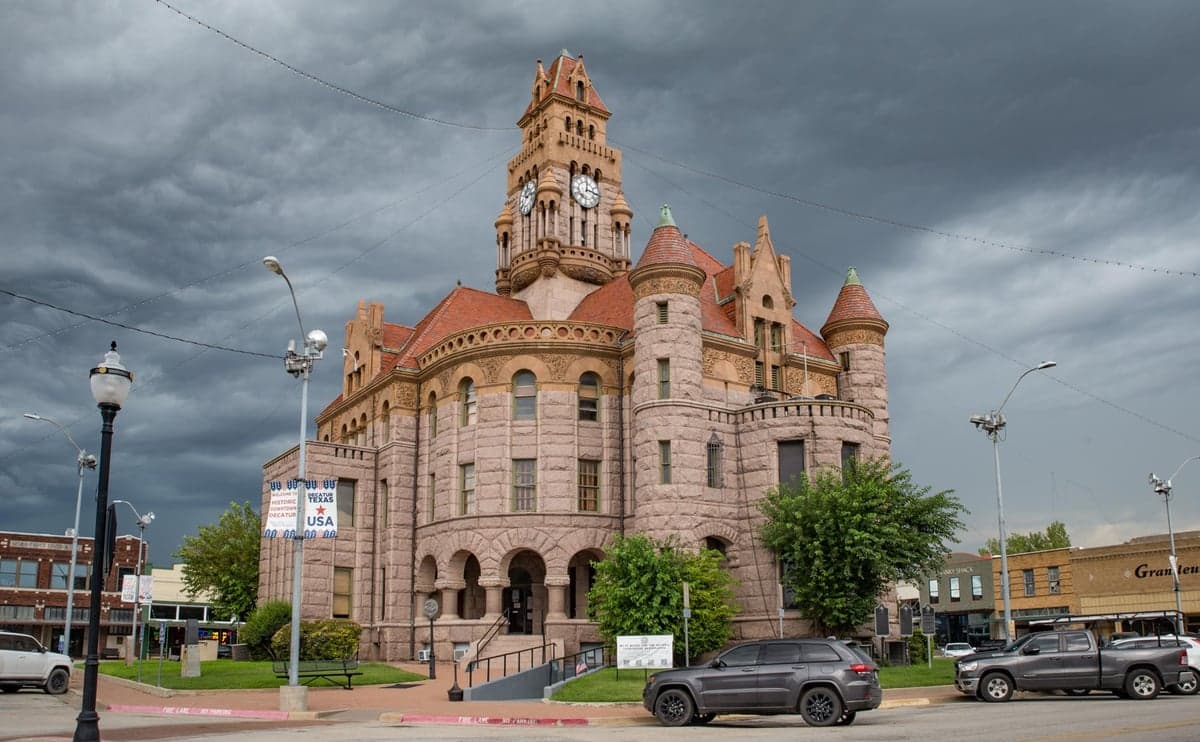
Photo: Wikipedia
Demographics of Wise County
Affluence Level in Wise County
A middle-class area roughly in line with national averages across income, home values, education, and employment.
People of Wise County
The people of Wise County, Texas today are predominantly white and native-born, with a growing Hispanic minority that now accounts for over one-fifth of the population. With 72,359 residents, the county remains one of the least densely populated in the Dallas-Fort Worth metroplex, yet it is experiencing steady suburban and exurban in-migration. Its distinctive identity is rooted in a rural, conservative, and family-oriented culture, shaped by generations of Anglo-American settlement and a relatively small but established Hispanic community concentrated in towns like Decatur and Bridgeport.
Settlement & growth (pre-1960)
Before Anglo-American settlement, the area now known as Wise County was inhabited by various Native American groups, primarily the Comanche and Kiowa, who used the region as hunting grounds. Spanish and French explorers passed through but left no permanent settlements. The first permanent non-Native settlers arrived in the 1850s, mostly from the Upper South—Tennessee, Kentucky, and Missouri—drawn by the promise of cheap land under the Texas land grant system. These early settlers were overwhelmingly of Scots-Irish and English descent, and they established small farming and ranching communities along the Trinity River and its tributaries.
The county was officially organized in 1856, with Decatur designated as the county seat. The early economy was based on subsistence farming and cattle ranching, with cotton becoming a cash crop after the Civil War. The arrival of the Fort Worth and Denver Railway in the 1880s spurred growth, connecting the county to regional markets and attracting more settlers. Towns like Bridgeport, Chico, and Alvord grew as agricultural and trade centers. A small number of German and Czech families settled in the area during this period, but they never formed the large, distinct ethnic enclaves seen in Central Texas counties like Gillespie or Lavaca.
The discovery of oil in the 1920s brought a brief boom, particularly around Newark and Boyd, attracting workers from other parts of Texas and Oklahoma. However, the Great Depression and the Dust Bowl years of the 1930s hit the county hard, causing population decline as many families left for California or urban centers. The post-World War II era saw a modest recovery, but Wise County remained overwhelmingly rural and agricultural through the 1950s, with a population that was nearly 100% white and native-born.
Modern era (post-1965)
The 1965 Hart-Cellar Act had a limited direct impact on Wise County, as the area did not attract significant numbers of post-1965 immigrants. The foreign-born population today stands at just 4.9%, well below the national average. The most notable demographic shift since the 1970s has been the growth of the Hispanic population, driven primarily by domestic migration from South Texas and Mexico, as well as natural increase. This community is concentrated in Decatur and Bridgeport, where it has established churches, small businesses, and social networks. The Hispanic share of the county's population rose from under 5% in 1980 to 20.6% today, making it the largest minority group.
The other major force reshaping Wise County has been suburban and exurban spillover from the Dallas-Fort Worth metroplex. Beginning in the 1990s and accelerating after 2010, families and individuals seeking larger lots, lower taxes, and a slower pace of life began moving to communities like Rhome, Aurora, and Newark. These newcomers are predominantly white and middle-class, often commuting to jobs in Fort Worth or Denton. This in-migration has driven population growth, increased housing demand, and introduced a more politically and culturally diverse element, though the county remains solidly conservative. The Black population remains very small at 1.4%, and East/Southeast Asian and Indian communities each account for only 0.3% of residents, with no significant enclaves forming.
The college-educated share of the population is 20.6%, reflecting the county's working-class and rural character, though this figure is rising as more professionals move in from the metroplex. The economy has diversified beyond agriculture and oil to include logistics, manufacturing, and services, with major employers like the Bridgeport Independent School District and local hospitals providing stable jobs.
The future
The population of Wise County is projected to continue growing, driven by exurban expansion from the Dallas-Fort Worth metroplex. This growth is likely to be predominantly white and Hispanic, with the Hispanic share potentially rising to 25-30% over the next two decades through both in-migration and higher birth rates. The county is not tribalizing into distinct ethnic enclaves; rather, Hispanic residents are increasingly integrated into the broader community, particularly in schools and local government. The small Black, Asian, and Indian populations are expected to remain small, as the county does not have the job base or cultural infrastructure to attract significant numbers of these groups.
The cultural identity of Wise County is likely to remain conservative and family-oriented, but it will become more suburban and less rural as development continues. Newcomers from the metroplex are being absorbed into the existing culture rather than transforming it, though they may push for more amenities and services. The county is not homogenizing in a racial sense, as the Hispanic population is growing, but it is becoming more culturally homogeneous in terms of values and lifestyle.
For someone moving in now, Wise County offers a stable, affordable, and safe environment with strong schools in towns like Decatur and Bridgeport, and easy access to the economic opportunities of the Dallas-Fort Worth region. It is a place where the rural past and suburban future are meeting, creating a community that is growing but not losing its fundamental character. The next 10-20 years will likely see continued growth, a modest increase in diversity, and a gradual shift from a farming and ranching identity to a commuter and small-town identity, all within a framework of conservative values and community cohesion.

* Values derived from national, state, county, city and local statistics and may differ in a specific area. Last updated: 2026-05-15T22:31:10.000Z
Narrative content on this page is AI-generated and may contain mistakes. Verify any details that matter before acting on them.
ReloMaps may earn a commission from affiliate links at no extra cost to you.

