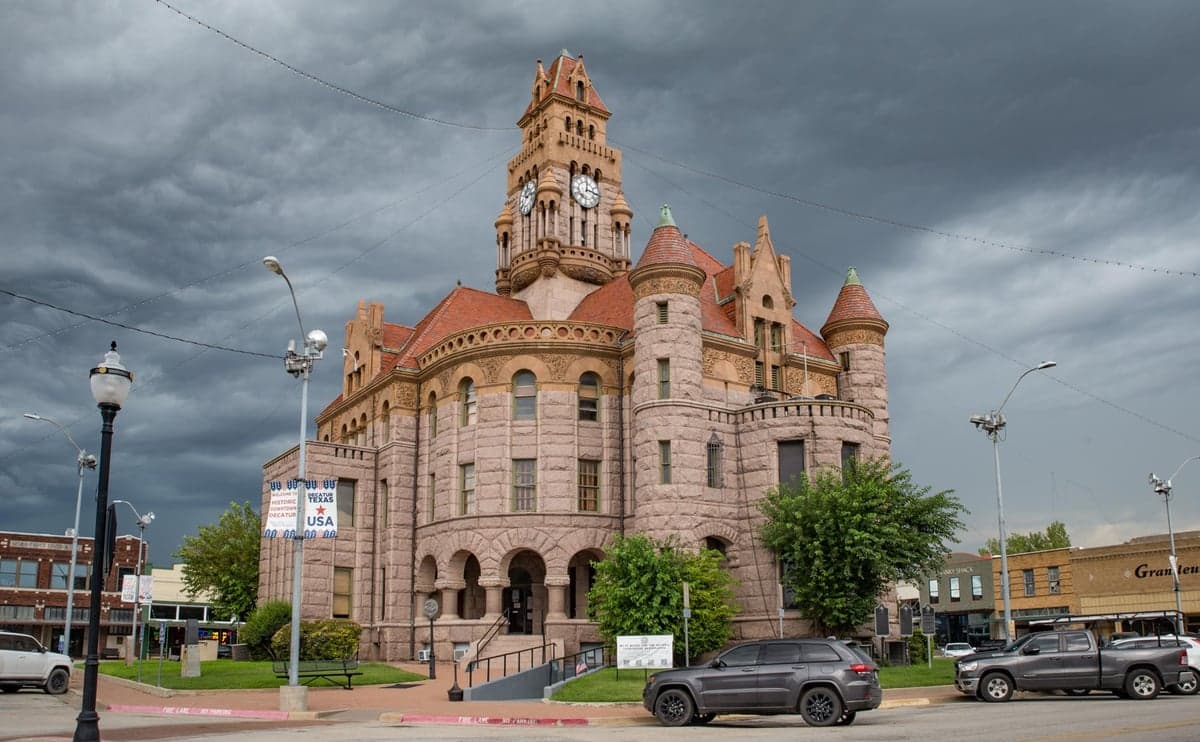
Photo: Wikipedia
Personal Sovereignty in Wise County
Strong independent fundamentals that actively favor personal liberty and low regulation.
What does Personal Sovereignty tell us?
Personal Sovereignty measures your capacity for self-reliance and independence with minimal government friction. Higher scores mean fewer barriers between you and the way you want to live... but it assumes you have the space you need and good neighbors.
What does this tell us?
Personal Sovereignty measures your capacity for self-reliance and independence with minimal government friction. Higher scores mean fewer barriers between you and the way you want to live... but it assumes you have the space you need and good neighbors.
State Policy
Energy independence: Net exporter (220% of energy produced in-state)
Personal Liberty
Homesteading

Personal Liberty Analysis
Wise County, Texas, offers one of the strongest personal sovereignty environments in the Dallas-Fort Worth periphery, where state-level preemption laws and a deeply ingrained rural culture create a buffer against the regulatory creep seen in urban centers like Austin or Dallas. For individuals and parents prioritizing autonomy—whether in self-defense, medical choices, or property use—this county represents a deliberate alternative to jurisdictions where local ordinances increasingly override individual judgment. The area’s political and legal climate, anchored by Texas’s constitutional carry and limited government ethos, provides a foundation where personal responsibility is the default, not an exception.
Tax burden and regulatory posture compared to surrounding counties
Wise County’s tax burden remains notably low relative to the DFW metroplex, with effective property tax rates hovering around 2.1% of assessed value—higher than some rural West Texas counties but significantly lower than Collin or Denton counties, where rates can exceed 2.5% due to school district and municipal bond debt. The county operates under Texas’s strict property tax caps (Proposition 4, 2023), which limit annual revenue growth to 3.5% without voter approval, a safeguard against runaway assessments. Regulatory posture is equally restrained: there is no county-wide zoning in unincorporated areas, meaning towns like Decatur (the county seat) and Bridgeport allow land use decisions to remain largely with the property owner. However, incorporated cities like Rhome and Boyd have adopted basic subdivision regulations, so buyers eyeing raw land should verify whether a property falls inside city limits or extraterritorial jurisdiction (ETJ), where rules tighten. The county’s approach to business licensing is minimal—no occupational permits for most trades—and there is no local income tax, aligning with the state’s zero-income-tax policy. For a prepper or homesteader, this means fewer layers of bureaucracy between you and your land, though the trade-off is limited public services in remote areas like Alvord or Chico.
Self-defense and gun law specifics in Wise County
Wise County is a stronghold for Second Amendment rights, operating under Texas’s permitless carry law (HB 1927, effective 2021), which allows any law-abiding adult to carry a handgun openly or concealed without a license. The sheriff’s office in Decatur is known for a pro-issuance stance on License to Carry (LTC) applications, though the permit is now optional. Crucially, the county has no local ordinances restricting magazine capacity, firearm storage, or carry in public parks—a stark contrast to cities like Austin or San Antonio, which have attempted to ban carry on public transit or in city buildings. Stand-your-ground and castle doctrine laws apply fully, with no duty to retreat in any place where the individual has a legal right to be. For parents, this extends to school zones: while federal law prohibits carry within 1,000 feet of K-12 schools, Texas law allows LTC holders to store firearms in locked vehicles on school parking lots. The county’s gun culture is visible in towns like Bridgeport, where the local gun club hosts regular competitions, and Decatur, where firearm sales at pawn shops and sporting goods stores are routine. For those concerned about government overreach, Wise County’s Second Amendment sanctuary resolution (passed in 2021) formally declares the county will not use resources to enforce federal gun laws deemed unconstitutional—a symbolic but meaningful stance in a survivalist mindset.
Self-reliance and homesteading viability: lot sizes, zoning, off-grid feasibility
Homesteading viability in Wise County varies sharply by location, driven by lot size minimums and utility access. Unincorporated areas have no minimum lot size for single-family homes, allowing parcels as small as one acre near Rhome or Boyd, though most rural tracts sold for homesteading range from 5 to 20 acres. The county’s zoning code is virtually nonexistent outside city limits, meaning you can keep livestock (chickens, goats, cattle) without permits, build a workshop or greenhouse, and install rainwater catchment systems without county interference. Off-grid feasibility is high: Texas law explicitly protects the right to use rainwater harvesting (HB 3391, 2017), and Wise County has no restrictions on solar panel installation or composting toilets. However, well drilling requires a permit from the Texas Commission on Environmental Quality (TCEQ), and septic systems must meet county health department standards—reasonable hurdles for a self-reliant setup. In towns like Alvord and Chico, where municipal water and sewer are absent, off-grid living is the norm, not an exception. The county’s agricultural exemption for property taxes (if you use the land for farming or ranching) further incentivizes self-sufficiency, reducing tax bills by up to 50% on qualifying parcels. For preppers, the key limitation is proximity to emergency services: fire and EMS response times in far northern areas near the Red River can exceed 30 minutes, so a well-stocked medical kit and fire suppression plan are non-negotiable.
Personal liberties: parental rights, medical autonomy, speech, property
Parental rights in Wise County are reinforced by Texas’s strong legal framework, including the Parental Bill of Rights (SB 220, 2023), which affirms parents’ authority over medical decisions, education, and religious upbringing. The county’s school districts—Decatur ISD, Bridgeport ISD, and Boyd ISD—have adopted policies that require parental consent for any health-related surveys or mental health screenings, and they do not teach gender identity or sexual orientation in K-3, per state law. Medical autonomy is similarly robust: Texas prohibits vaccine mandates for adults (HB 47, 2023) and allows conscientious exemptions for school vaccine requirements, though parents must submit an affidavit. Wise County has no local health ordinances that override these state protections, unlike some urban counties that attempted mask mandates during the pandemic. Speech and assembly rights are protected under the Texas Religious Freedom Restoration Act, and the county has not enacted any noise or protest ordinances that chill political expression. Property rights are the bedrock: Texas’s private property rights law (SB 421, 2021) limits eminent domain for private economic development, and Wise County has not pursued any controversial takings. For a conservative audience wary of federal overreach, the county’s resistance to CDC or EPA directives—such as the 2024 EPA water rule that would have expanded federal jurisdiction over ditches and ponds—is a practical advantage. In towns like Decatur and Bridgeport, property owners routinely build fences, hunt on their land, and host family gatherings without fear of nuisance complaints or HOA interference, provided they stay outside the few subdivisions with covenants.
Overall, Wise County ranks among the top Texas counties for personal sovereignty, offering a legal and cultural environment where individual autonomy is the baseline, not a privilege. Compared to the regulatory density of Travis County (Austin) or the HOA-heavy suburbs of Collin County, Wise County provides a rare combination of low taxes, minimal zoning, strong gun rights, and off-grid feasibility—all within an hour of DFW’s job market. For the survivalist or prepper, the county’s distance from urban overreach, combined with its pro-liberty state context, makes it a strategic relocation choice where the burden of proof falls on government, not the individual.

* Values derived from national, state, county, city and local statistics and may differ in a specific area. Last updated: 2026-05-15T22:31:10.000Z
Narrative content on this page is AI-generated and may contain mistakes. Verify any details that matter before acting on them.
ReloMaps may earn a commission from affiliate links at no extra cost to you.

