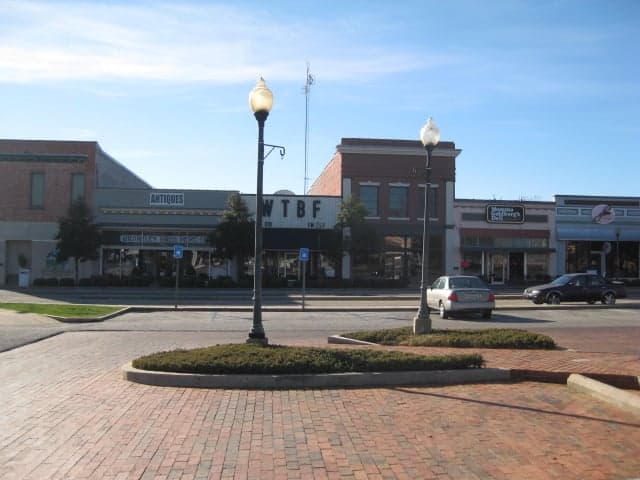
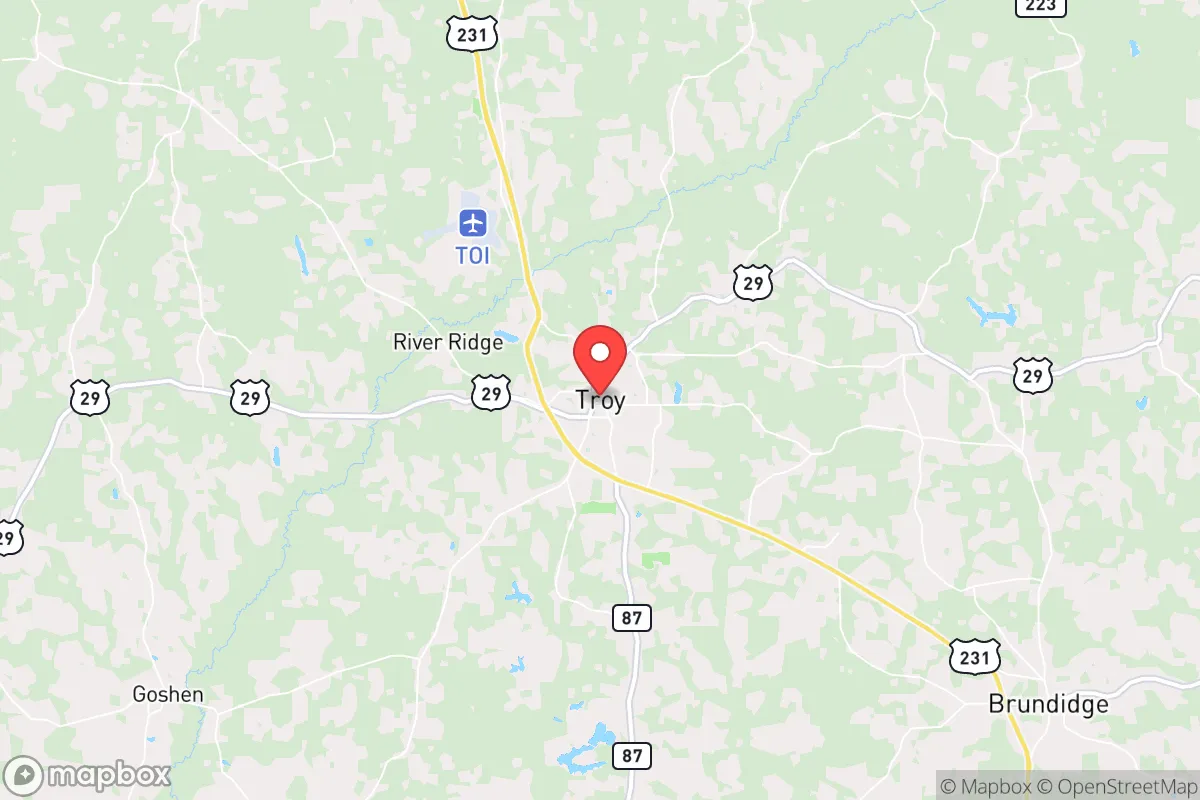
Photo: Wikipedia
Personal Sovereignty in Troy, AL
Viable for self-reliance. Generally workable, though some barriers may limit total independence.
What does Personal Sovereignty tell us?
Personal Sovereignty measures your capacity for self-reliance and independence with minimal government friction. Higher scores mean fewer barriers between you and the way you want to live... but it assumes you have the space you need and good neighbors.
What does this tell us?
Personal Sovereignty measures your capacity for self-reliance and independence with minimal government friction. Higher scores mean fewer barriers between you and the way you want to live... but it assumes you have the space you need and good neighbors.
State Policy
Energy independence: Importer (45% of energy produced in-state)
Personal Liberty
Homesteading

Personal Liberty Analysis
Troy, Alabama, offers a notably high degree of personal sovereignty relative to much of the country, functioning as a pocket where state-level protections and local culture push back against the expanding reach of federal and corporate mandates. For the strategic relocator—whether a single individual seeking to minimize government friction or a parent wanting to raise children free from ideological overreach—this small city in Pike County presents a workable balance of low regulatory burden, strong self-defense laws, and a community ethos that still values neighborly self-reliance. While no location is a fortress against national trends, Troy’s legal and social environment provides a solid foundation for those prioritizing autonomy, with the key caveat that local zoning and utility realities require careful planning for full off-grid living.
Tax burden and regulatory posture: How Alabama’s policies protect your wallet and choices
Alabama’s state-level framework is a major asset for personal sovereignty in Troy. The state has no personal property tax on vehicles or boats, and the combined state and local sales tax in Troy hovers around 10%, which is high for daily purchases but offset by the absence of a state income tax on wages—a critical factor for self-employed individuals or remote workers. Property taxes are among the lowest in the nation, with Pike County’s effective rate typically under 0.4% of assessed value, meaning a $200,000 home carries an annual tax bill of roughly $800. This low fixed cost reduces the leverage government has over your primary asset. Regulatory posture is equally light: Alabama is a right-to-work state with minimal occupational licensing burdens for common trades like handyman services or home-based food production, and there are no state-level mask or vaccine mandates currently in force. For the prepper, this means fewer bureaucratic hurdles to establishing a side business or bartering network. The trade-off is that local city ordinances in Troy can be more restrictive than the county—particularly around noise, vehicle storage, and livestock—so those seeking maximum autonomy should prioritize properties outside the city limits, where county zoning is virtually nonexistent.
Self-defense and gun law specifics: Stand your ground, permitless carry, and castle doctrine in practice
Alabama is one of the strongest states in the nation for self-defense sovereignty, and Troy residents benefit directly from these laws. Permitless carry (constitutional carry) has been in effect since 2022, allowing any law-abiding adult 19 or older to carry a concealed firearm without a permit—no training requirement, no fee, no government permission slip. The state’s Stand Your Ground statute is unambiguous: there is no duty to retreat in any place you have a legal right to be, and the castle doctrine extends to occupied vehicles and workplaces. For parents, this means you can legally store firearms in your home or vehicle without special locks or safe requirements, though common-sense storage is still advised to prevent access by unsupervised children. The local sheriff’s office in Pike County is generally pro-Second Amendment, and there are no county-level restrictions on magazine capacity or firearm types. The only practical limitation is that carrying on public school property (K-12) remains prohibited without a special permit, but the state does allow loaded firearms in locked vehicles on school parking lots. For the survivalist, this legal environment means your defensive capabilities are not hamstrung by local ordinances, and you can train and carry without fear of technical violations.
Self-reliance and homesteading viability: Lot sizes, zoning, and off-grid feasibility in Troy
Troy’s viability for self-reliance depends heavily on whether you settle inside or outside the city limits. Within the city, standard residential lots range from 0.25 to 0.5 acres, and the city zoning code restricts keeping livestock—chickens are allowed with a permit and coop setback, but goats, pigs, or larger animals are generally prohibited. Gardening is unrestricted, and rainwater collection is legal without a permit, though the city does not encourage full off-grid water systems. Outside the city limits in unincorporated Pike County, the picture changes dramatically. Lot sizes of 1 to 5 acres are common and affordable, with raw land prices around $3,000–$5,000 per acre. County zoning is minimal: no restrictions on livestock, no building permits for structures under 200 square feet, and no prohibition on composting toilets or alternative energy. Solar panels are legal and net metering is available through the local utility (Troy Utilities), but the grid is reliable enough that full off-grid is a choice, not a necessity. The major constraint for off-grid living is water: most rural properties rely on wells, which cost $5,000–$10,000 to drill, and the water table in Pike County is generally good but requires testing for iron and sulfur. Septic systems are required for any dwelling with plumbing, and the county health department inspects them, but there are no prohibitions on greywater systems for irrigation. For the prepper, the sweet spot is a 2-5 acre parcel just outside Troy’s city limits, where you can keep a few goats, grow a substantial garden, install solar panels, and store supplies without government interference.
Personal liberties: Parental rights, medical autonomy, speech, and property protections
On the broader front of personal liberties, Troy sits within a state that has actively pushed back against federal overreach in several key areas. Parental rights are strongly protected: Alabama law requires parental consent for any medical treatment of minors, including vaccinations, and the state passed the “Parental Rights in Education” act that prohibits classroom instruction on sexual orientation and gender identity in K-5. This means parents in Troy have legal backing to opt their children out of any curriculum or health mandates they find objectionable. Medical autonomy for adults is similarly robust—Alabama has no state-level vaccine passport system, no mask mandates in effect, and the state’s emergency powers law was reformed in 2021 to limit a governor’s ability to shut down businesses or mandate medical procedures without legislative approval. For the survivalist, this means you can stockpile supplements, use alternative medicine practitioners (within scope of practice), and refuse any medical treatment without fear of legal penalty. Free speech is protected under the state constitution, and Troy has no local hate speech ordinances or social media content restrictions. Property rights are strong: Alabama is a “notice pleading” state with no statewide rent control, and the state’s eminent domain laws are among the most restrictive in the South, requiring a public purpose and just compensation. The only notable limitation is that the city of Troy does have a noise ordinance that could theoretically be used against generators or late-night shooting practice, but enforcement is complaint-driven and generally lenient.
In the broader landscape of American sovereignty, Troy, Alabama, ranks as a strong contender for those seeking to minimize government intrusion while maintaining access to modern infrastructure. It lacks the extreme libertarian legal frameworks of places like rural Idaho or New Hampshire, but it compensates with a warmer climate, lower cost of land, and a state government that has consistently pushed back against federal overreach in health, education, and self-defense. The primary strategic weakness is the city’s reliance on a single utility for power and water, which creates a single point of failure in a grid-down scenario, but this is mitigated by the ease of going solar and drilling a well on rural property. For the single individual or parent who values the right to live, defend, and provide for themselves without asking permission, Troy offers a workable, low-friction base of operations in a region that still remembers what personal responsibility looks like.

* Values derived from national, state, county, city and local statistics and may differ in a specific area. Last updated: 2026-04-19T19:09:06.000Z
Narrative content on this page is AI-generated and may contain mistakes. Verify any details that matter before acting on them.
ReloMaps may earn a commission from affiliate links at no extra cost to you.

