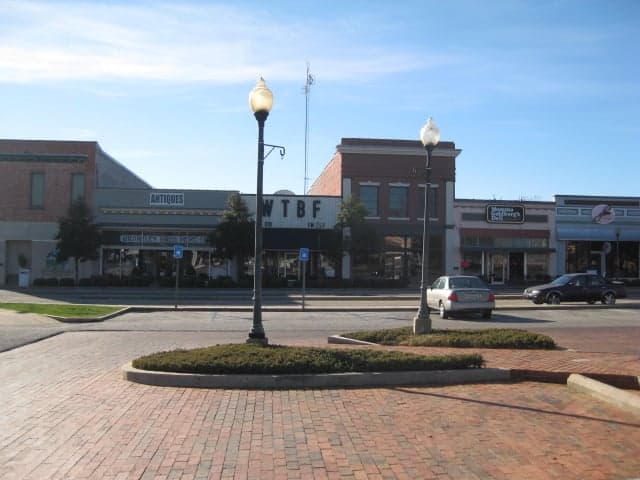
Photo: Wikipedia
Political ClimatePolitical Climate in Troy, AL
District shown is the primary district for this city’s centroid. Cities may span multiple districts.
Local Political AnalysisPolitical Analysis of Troy, AL
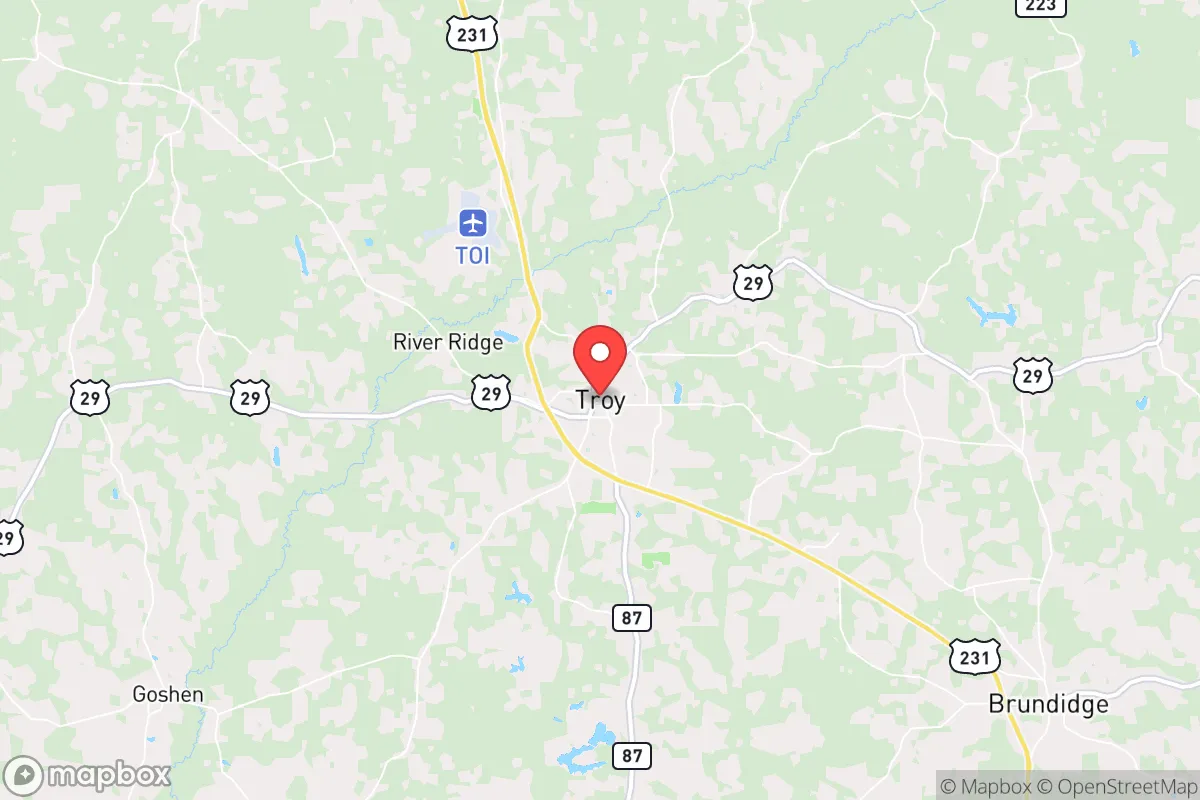
Troy, Alabama, sits in a part of the state that has historically leaned conservative, but the city itself has shifted noticeably in recent years. The Cook Partisan Voting Index (PVI) now rates the area as D+5, meaning it votes about five points more Democratic than the national average. That’s a real change from even a decade ago, when Pike County was reliably red. The shift is driven largely by the presence of Troy University, which brings in a younger, more transient population and a faculty that tends to lean left. Meanwhile, the surrounding rural areas—places like Brundidge, Goshen, and the unincorporated parts of the county—remain solidly conservative. So you’ve got a real split: the university bubble pulls the city one way, while the longtime residents and farming communities hold the line the other way.
How it compares
Compared to nearby cities, Troy stands out as the most politically mixed spot in the region. Drive 30 miles north to Montgomery, and you’re in a deep-blue city with a D+15 PVI, where progressive policies on taxes and social issues are the norm. Head 20 miles south to Enterprise, and you’re back in solid red territory, with a Cook PVI of R+15 or so. Even smaller towns like Luverne and Andalusia lean much more conservative than Troy does. What that means on the ground is that Troy’s local elections are often tight races, with university-backed candidates pushing for higher spending on public projects and more inclusive ordinances, while the rural vote tries to keep things small-government and traditional. It’s a constant tug-of-war that didn’t exist 20 years ago.
What this means for residents
For folks who’ve lived here a while, the biggest concern is how this political shift affects everyday life. The city council has flirted with zoning changes and tax hikes that feel like government overreach to many—especially when they target small businesses or property owners. There’s also been talk of expanding city services in ways that require more bureaucracy, which rubs longtime residents the wrong way. The university’s influence has also brought more progressive social policies to campus, and some worry that will spill over into the wider community. If you value personal freedoms and minimal government interference, you’ll want to keep a close eye on local elections here. The rural vote still carries weight, but the margin is shrinking every cycle.
On the cultural side, Troy still holds onto its Southern roots in many ways. You’ll find plenty of churches, hunting clubs, and family-owned businesses that reflect traditional values. The annual Pioneer Day festival and the strong sense of community at local football games are reminders of what’s at stake. But the university’s presence has also brought more diversity of thought and lifestyle, which can feel like a double-edged sword. The real test will come in the next few years, as the city decides whether to embrace more progressive policies or hold the line on conservative principles. For now, it’s a place where you can still have a good conversation with your neighbor, even if you disagree on politics—but that’s getting harder to find. If you’re thinking of moving here, just know that the political climate is shifting, and it’s worth paying attention to who’s running for city council.

State Political ClimatePolitical Climate in Alabama
State Political AnalysisPolitical Environment in the State
Alabama is a deeply conservative state, with Republicans holding every statewide elected office and supermajorities in both legislative chambers, a position they’ve solidified over the past 20 years. The state voted for Donald Trump by a margin of +25 points in 2024, a slight tightening from the +26-point spread in 2020, but still among the most Republican-leaning states in the nation. The dominant coalition is a mix of rural white evangelicals, suburban conservatives in the Birmingham and Mobile metros, and a growing number of conservative-leaning transplants from blue states, while the Democratic base is largely confined to the Black Belt counties and a handful of urban precincts in Birmingham and Montgomery.
Urban vs. rural divide
The political map of Alabama is a study in stark contrasts. The state’s largest metro, Birmingham (Jefferson County), is a Democratic stronghold, delivering about 60% of its vote to Joe Biden in 2020, driven by a large Black population and a growing progressive white professional class. However, the surrounding suburbs—places like Hoover, Vestavia Hills, and Alabaster—are reliably Republican, often voting 65-70% for GOP candidates. Mobile County, home to the port city, is a swing county that has trended right, flipping from Obama in 2012 to Trump by 18 points in 2020, thanks to working-class white voters and a growing defense industry presence. The rural Black Belt, stretching from Greene County (80% Democratic) to Macon County, remains the Democratic base, but its population is shrinking. Meanwhile, the fast-growing Gulf Coast counties—Baldwin and Shelby—are among the most Republican in the state, with Baldwin County voting 78% for Trump in 2020, driven by retirees and families fleeing higher-tax states. The Tennessee Valley, anchored by Huntsville and Madison County, is a fascinating microcosm: Huntsville itself is a purple city (Biden won it by 2 points in 2020), but the surrounding Madison County is solidly red, reflecting the tech and aerospace workforce’s mix of libertarian-leaning engineers and traditional conservatives.
Policy environment
Alabama’s policy environment is aggressively conservative, with a low-tax, low-regulation posture that appeals to freedom-minded residents. The state has no state-level property tax (counties levy it, averaging about 0.4% of home value), and the income tax is a flat 5% on all income over $3,000, with no deductions for federal taxes paid. The corporate income tax is 6.5%, but the state offers generous incentives for manufacturers and data centers. On education, Alabama passed the Alabama CHOICE Act in 2024, creating a universal school choice program that allows families to use state funds for private school tuition, homeschooling, or microschools—a major win for parental rights. The state also enacted a near-total abortion ban in 2019 (the Human Life Protection Act), with no exceptions for rape or incest, and has resisted federal pressure to expand Medicaid, leaving roughly 300,000 low-income adults in a coverage gap. Election laws are among the strictest in the South: voter ID is required, absentee voting requires a notary or two witnesses, and the state purged over 100,000 inactive voters from rolls in 2023. The legislature also passed a 2022 law banning the use of private funds for election administration, a direct response to Zuckerberg-funded grants in 2020.
Trajectory & freedom
Alabama is moving in a direction of expanded personal liberty in several key areas, though some trends are concerning. On gun rights, the state enacted constitutional carry in 2022 (HB 272), allowing permitless carry of handguns for anyone 21 or older, and preempted local gun ordinances entirely—meaning Birmingham’s attempts to ban firearms in city parks were struck down. On parental rights, the 2022 Alabama Parental Rights Act requires schools to notify parents of any changes to a child’s mental or physical health, and the 2024 CHOICE Act gives families direct control over education funding. On medical freedom, the state passed a 2023 law prohibiting COVID-19 vaccine mandates by private employers and government entities, and a 2024 law banning mRNA vaccines for children under 18. However, there are red flags: the state’s medical cannabis program, passed in 2021, remains mired in litigation and has not issued a single dispensary license as of 2026, a classic case of government overreach stifling a voter-approved initiative. Property rights are generally strong, with no state-level zoning mandates, but the Alabama Department of Transportation has aggressively used eminent domain for highway expansions, particularly in the Birmingham metro, drawing lawsuits from homeowners in places like Homewood.
Civil unrest & political movements
Alabama has seen relatively little civil unrest compared to other states, but there are flashpoints. The most visible is the ongoing fight over Confederate monuments: Montgomery removed its statue of Robert E. Lee in 2021 after a legal battle, while Birmingham’s Linn Park monument was taken down in 2020, leading to a $25,000 fine under the state’s 2017 monument preservation law. The law, which prohibits removal of “historically significant” structures, remains a point of contention, with some local governments pushing for repeal. Immigration politics are less heated than in border states, but the 2011 HB 56 law—one of the strictest in the nation—still casts a shadow, though enforcement has been lax under the Biden administration. The state has no sanctuary cities, and the legislature passed a 2024 law requiring local law enforcement to cooperate with ICE. Election integrity remains a hot-button issue: the 2022 law banning private election funding was followed by a 2024 law requiring hand-counting of all ballots in counties with fewer than 10,000 voters, a move that has slowed results in rural areas like Choctaw County. Organized activist movements are small but vocal: the Alabama Libertarian Party has seen a surge in membership, particularly in Huntsville, while the progressive Alabama Poor People’s Campaign has held rallies in Montgomery for Medicaid expansion.
Projection
Over the next 5-10 years, Alabama will likely become more conservative, not less, driven by in-migration from blue states. The Huntsville metro is expected to add 100,000 residents by 2030, many of them engineers and defense contractors who lean libertarian or conservative. Baldwin County, already the fastest-growing county in the state, will continue to attract retirees from the Midwest and Northeast, reinforcing its Republican tilt. The Black Belt will continue to lose population, weakening the Democratic base. However, there are wild cards: the growing Hispanic population in the poultry-processing towns of Cullman and DeKalb County could shift local politics, as could the influx of remote workers to places like Auburn and Fairhope. The biggest threat to the current trajectory is the state’s aging infrastructure and poor healthcare outcomes—Alabama ranks 48th in life expectancy—which could drive out young families if not addressed. Expect the legislature to double down on school choice and tax cuts, but also to face pressure to expand Medicaid as rural hospitals close.
Bottom line for a new resident: If you’re moving to Alabama for freedom from government overreach, you’ll find a state that largely delivers—low taxes, strong gun rights, school choice, and minimal COVID mandates. But don’t expect perfection: the medical cannabis program is a bureaucratic mess, eminent domain is a real threat in growing areas, and the state’s healthcare system is a mess. Pick your county wisely—Baldwin or Shelby for a classic conservative lifestyle, Huntsville for a tech-forward libertarian vibe, or the Black Belt if you want to be part of a Democratic minority. Just know that the political winds are blowing hard right, and they’re likely to stay that way for the foreseeable future.
* Values derived from national, state, county, city and local statistics and may differ in a specific area. Last updated: 2026-04-19T19:09:06.000Z
Narrative content on this page is AI-generated and may contain mistakes. Verify any details that matter before acting on them.
ReloMaps may earn a commission from affiliate links at no extra cost to you.

