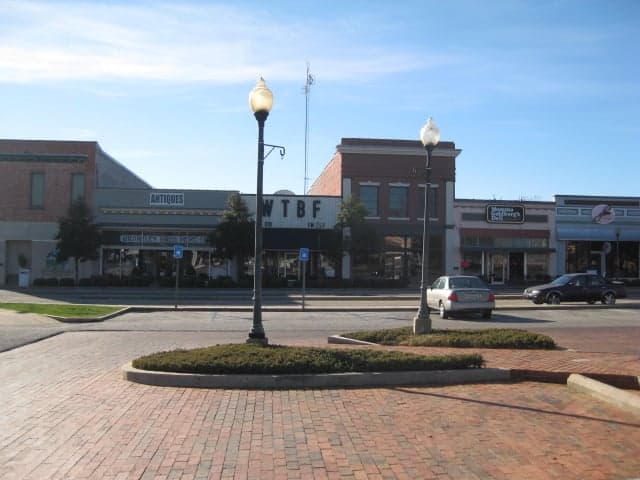
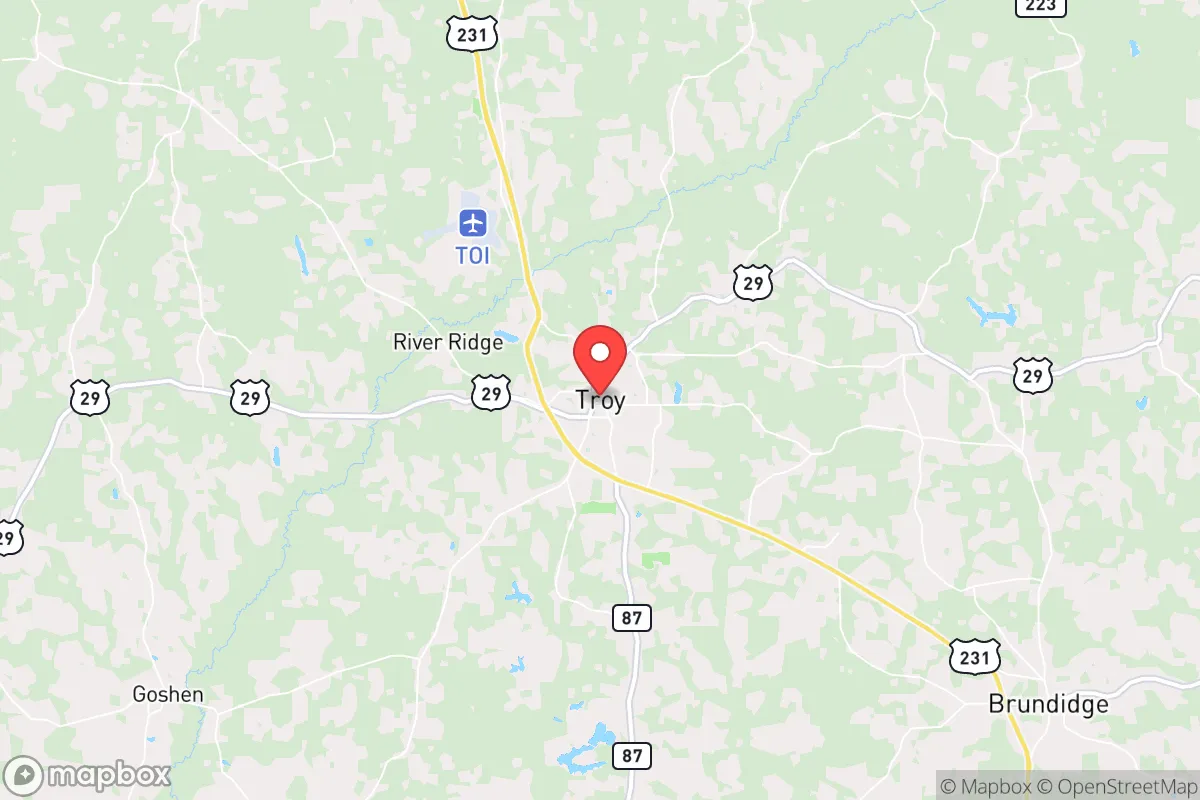
Photo: Wikipedia
Demographics of Troy, AL
Affluence Level in Troy, AL
A middle-class area roughly in line with national averages across income, home values, education, and employment.
People of Troy, AL
The people of Troy, Alabama today form a compact, majority-minority community of 17,733 residents, where Black and White populations each hold substantial shares and a small but growing Indian-subcontinent presence adds a distinctive layer. The city’s character is rooted in its role as a regional education, healthcare, and manufacturing hub, anchored by Troy University and a cluster of industrial employers. With a foreign-born rate of just 2.8% and a college-educated share of 36.5%, Troy’s population is more educated than the state average but remains culturally traditional, reflecting its Deep South location and the steady influence of the university.
How the city was settled and grew
Troy was founded in 1824 on land ceded by the Creek Nation, drawing its first wave of settlers—primarily yeoman farmers and small planters from Georgia and the Carolinas—who established cotton plantations along the Conecuh River basin. The arrival of the Mobile and Girard Railroad in the 1850s transformed Troy into a cotton-shipping and trading center, attracting merchants, craftsmen, and a small free Black population that settled in what is now Historic Downtown Troy and the adjacent Colonial Village area. After the Civil War, freedmen concentrated in neighborhoods like South Troy and East Troy, building churches, schools, and mutual-aid societies that anchored the Black community for generations. The early 20th century brought a second wave: textile mills and a growing state normal school (later Troy University) drew White families from surrounding rural counties into North Troy and West Troy, while Black migration from the countryside continued into South Troy. By 1950, Troy’s population had reached roughly 8,000, split roughly evenly between Black and White residents, with a tiny foreign-born enclave of Greek and Lebanese merchants near the courthouse square.
Modern era (post-1965)
The post-1965 period reshaped Troy’s demographics through two main forces: the expansion of Troy University and the rise of manufacturing. The university’s growth, especially after it became a four-year institution in 1967, drew faculty and students from across the South and, increasingly, from abroad. The University Park neighborhood, developed in the 1970s and 1980s around the campus, became home to a mix of White professionals and Black academics, while the South Troy area saw a gradual outmigration of middle-class Black families to newer subdivisions like Pine Ridge. The 1990s and 2000s brought a notable influx of Indian-subcontinent professionals—engineers, doctors, and IT specialists—recruited by Troy University and local hospitals. These families concentrated in University Park and the Colonial Village area, forming a small but visible community that now accounts for 1.5% of the population. Meanwhile, the White share declined from roughly 60% in 1990 to 51.4% today, driven by outmigration of younger White families to larger metros and a lower birth rate. The Black share held steady near 40%, while East/Southeast Asian residents (1.8%) and Hispanic residents (2.1%) arrived in small numbers, mostly as university students or workers in poultry processing and construction. Troy’s foreign-born rate of 2.8% remains well below the national average, reflecting limited immigration outside the Indian-subcontinent professional niche.
The future
Troy’s population is likely to remain stable or grow slowly over the next 10–20 years, with gradual diversification driven by the university and healthcare sectors. The Indian-subcontinent community, while small, is expected to grow modestly as Troy University continues recruiting international faculty and as regional hospitals attract specialists. The Black and White shares will likely converge further, with the White share dipping below 50% within a decade as younger White residents continue to leave for larger job markets. Hispanic and East/Southeast Asian populations may grow slightly but will remain below 5% each, as Troy lacks the industrial base or agricultural demand that drives larger immigrant inflows in other Alabama cities. The city is not tribalizing into distinct enclaves—neighborhoods like University Park and Pine Ridge are increasingly mixed—but South Troy and East Troy remain predominantly Black, while North Troy and West Troy are predominantly White. The biggest wildcard is Troy University’s enrollment trends: a sustained decline would slow in-migration and accelerate the aging of the White population, while growth could attract more international students and faculty, further diversifying the city.
Troy is becoming a more educated, slightly more diverse, and slowly shrinking-in-relative-terms small city, where the university and hospital anchor a stable but not booming economy. For someone moving in now, the city offers a tight-knit, traditional community with a growing professional class, but limited ethnic diversity outside the Indian-subcontinent enclave and little prospect of rapid demographic change. The practical choice is between the older, historically Black neighborhoods of South and East Troy and the newer, mixed subdivisions near the university—each offering a different social fabric but the same underlying stability.

* Values derived from national, state, county, city and local statistics and may differ in a specific area. Last updated: 2026-04-19T19:09:06.000Z
Narrative content on this page is AI-generated and may contain mistakes. Verify any details that matter before acting on them.
ReloMaps may earn a commission from affiliate links at no extra cost to you.

