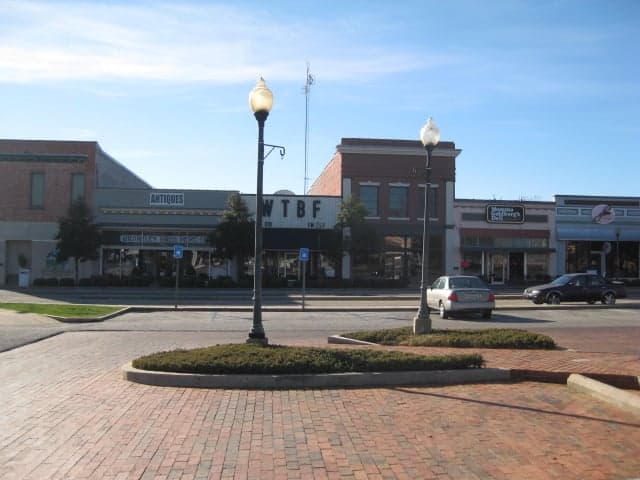
Photo: Wikipedia
Strategic Assessment of Troy, AL
Workable tactical position. Some exposure to population density or targets, but generally defensible in a crisis.
What does the Strategic Assessment tell us?
Our Strategic Assessment grades tactical survivability of an area. Major population centers, military targets, fallout zones, natural disasters, and border exposure all drive risk — lower exposure means a more defensible position in a crisis.
This is heavily inspired by Joel Skousen's Strategic Relocation book. Highly recommended you checkout the book ($)What does this tell us?
Our Strategic Assessment grades tactical survivability of an area. Major population centers, military targets, fallout zones, natural disasters, and border exposure all drive risk — lower exposure means a more defensible position in a crisis.
This is heavily inspired by Joel Skousen's Strategic Relocation book. Highly recommended you checkout the book ($)Strategic Pillars

Key Distances
Regional Safe Places
Below is our recommended "safe zones" in Alabama and the surrounding area based on our strategic heuristics. For most people, it's unrealistic to live in a “safe zone” full-time due to work, family or other personal reasons. They tend to be more rural. However, many of these areas are perfect for second homes and retreat properties that double as a vacation home or even a short-term rental.
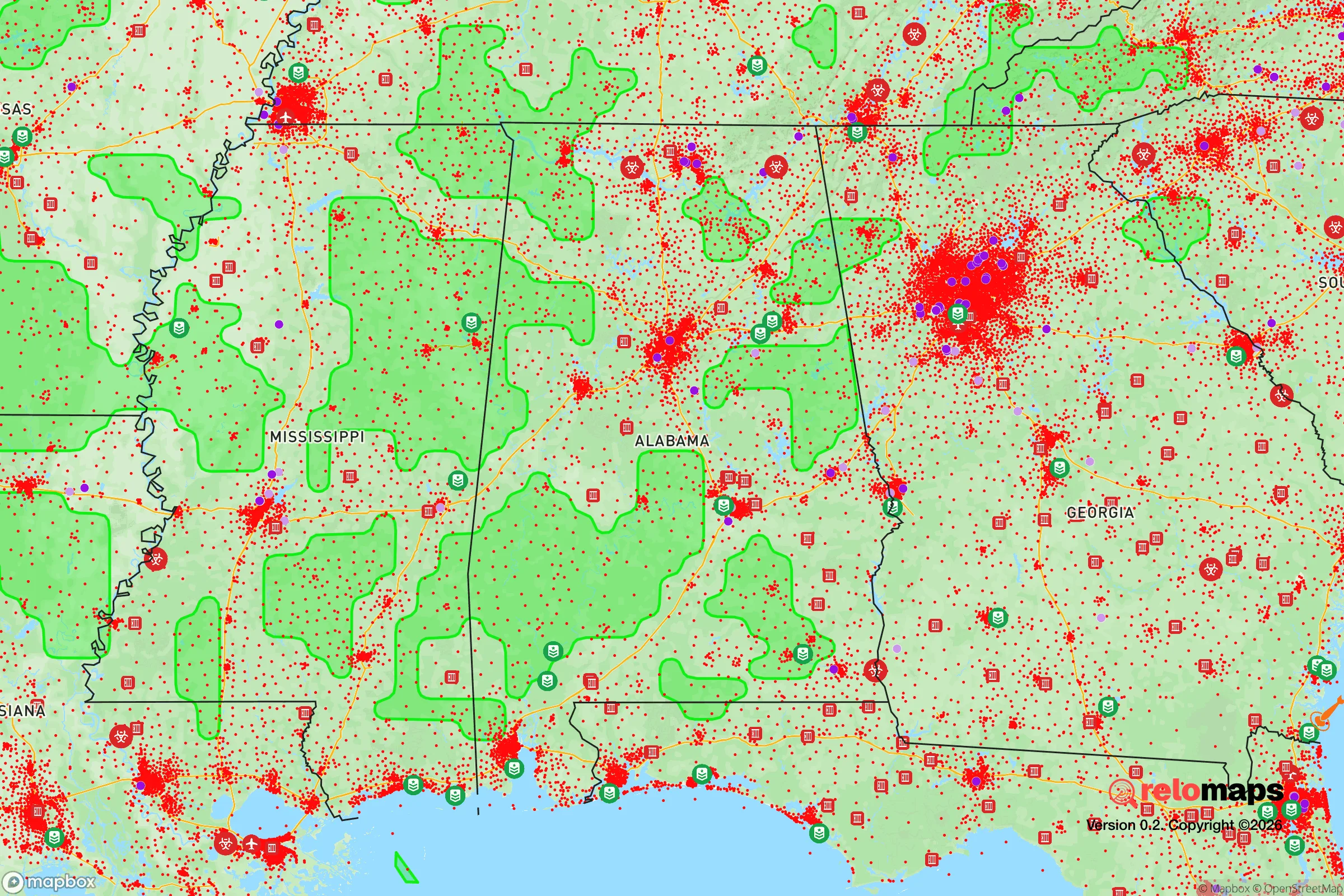
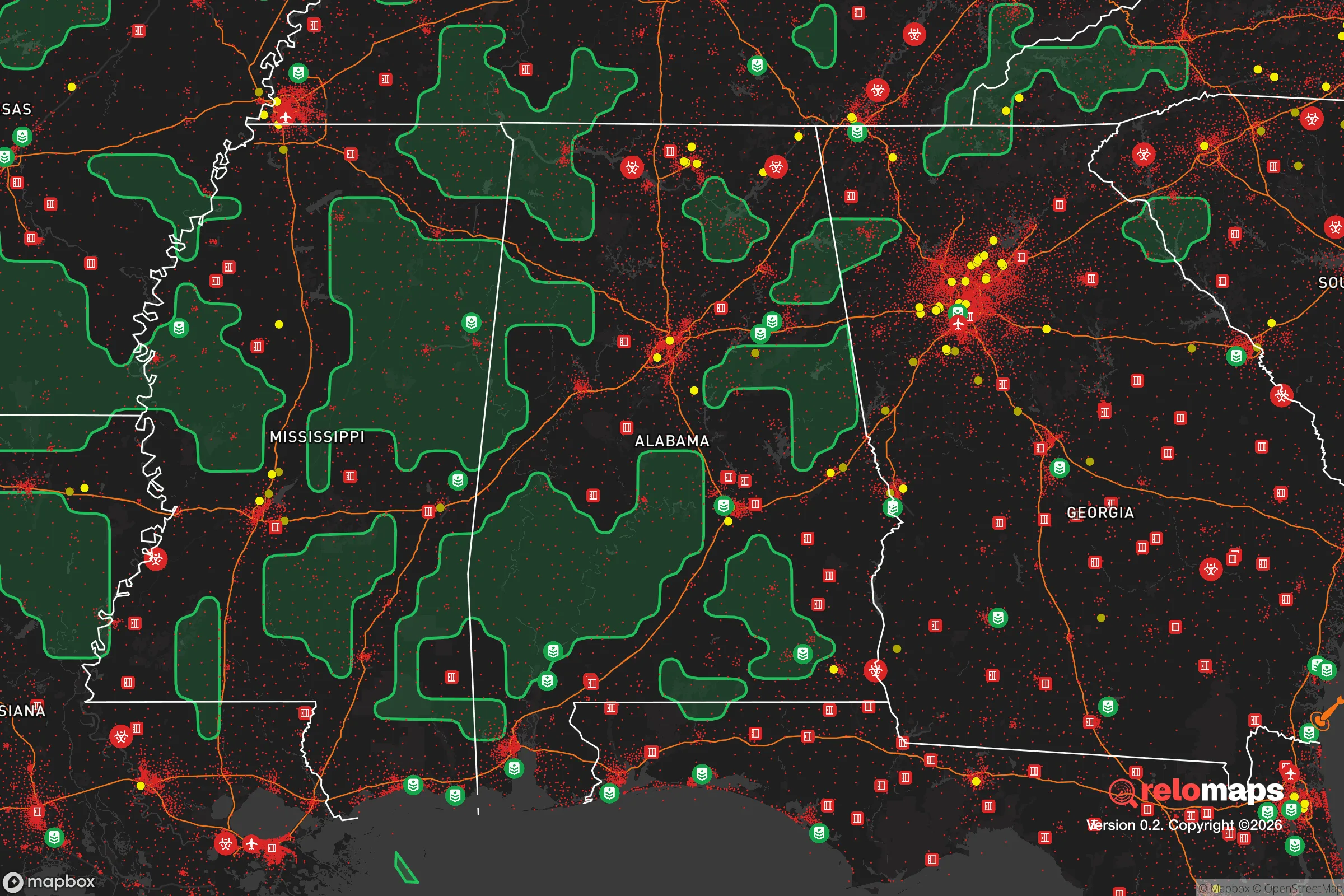


Important Note: For informational purposes only. This does not mean nothing bad ever happens in the green zones. Please use common sense. This is based on public data and modeled with AI. We tried to take a conservative approach but mistakes happen. We update this regularly as new information becomes available.
Solar Generator Recommendations
Backup power matters more here than in safer locations. We've picked three solar generators across budgets and capacity tiers — start with the budget unit if you only need a few essentials, or step up if you want to run a fridge and HVAC for days at a time.

Jackery Portable Power Station Explorer 300
Budget OptionPower on the Go: Weighing only 11 lbs, it's convenient to set up and store with book-sized foldable solar panels

BLUETTI Portable Power Station AC180
Designed for both indoor and outdoor scenarios, AC180 is highly capable as it has a robost capacity and continuous output power.

EF ECOFLOW DELTA Pro Ultra Power Station
Upgraded PickEcoFlow DELTA Pro Ultra is a whole-home energy system designed to grow with your family. Integrated with the Smart Home Panel 2, it scales to meet your evolving energy needs — keeping your home powered, intelligent, and secure through every stage of life.
We earn a commission, at no additional cost to you.
Strategic Assessment Analysis
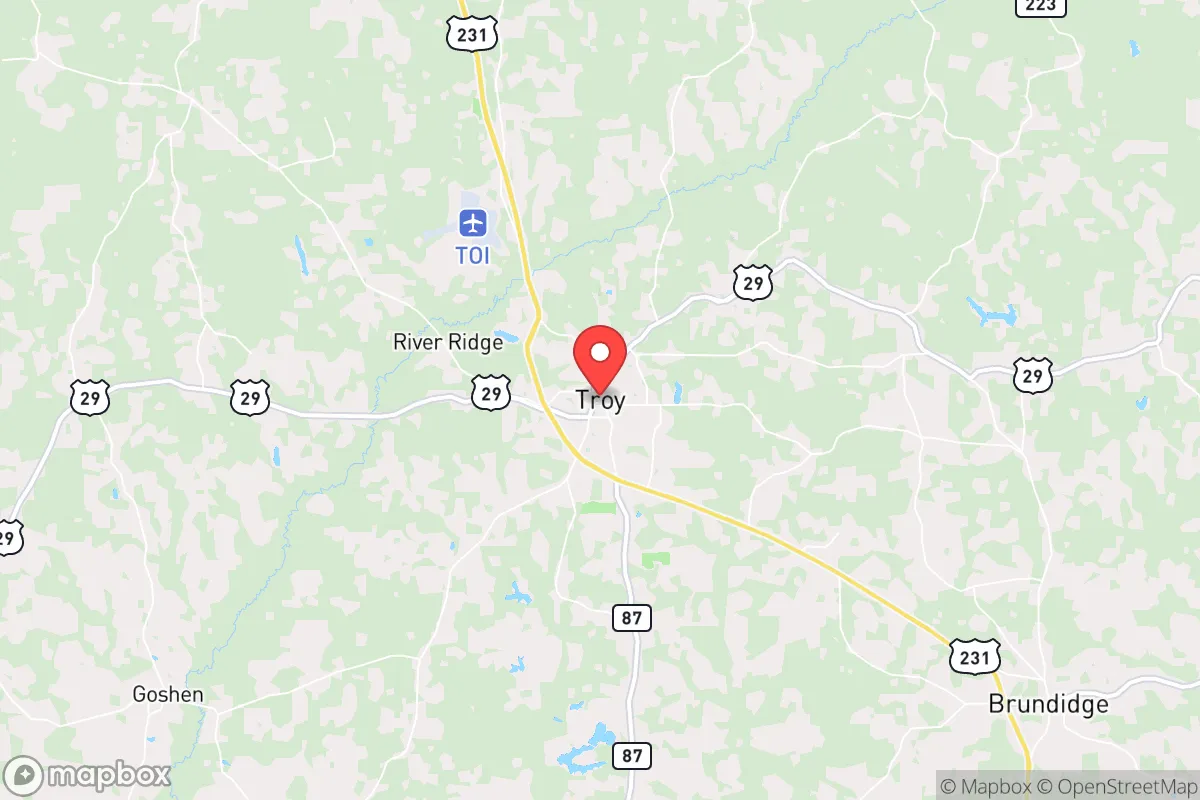
Troy, Alabama, sits in a part of the Deep South that often flies under the radar, but for someone thinking about strategic relocation, that low profile is exactly the point. The city anchors Pike County roughly 50 miles southeast of Montgomery and 100 miles southwest of Columbus, Georgia, placing it far enough from major metropolitan blast zones while still offering access to regional supply chains and medical infrastructure. The area's economic resilience is rooted in a diversified base—Troy University provides institutional stability, while manufacturing employers like Lockheed Martin's Pike County Operations and the nearby Hyundai Motor Manufacturing plant in Montgomery offer steady employment that isn't tied to a single boom-bust cycle. For a relocator with a prepper mindset, the key takeaway is that Troy isn't a target-rich environment for civil unrest or strategic strikes, yet it maintains enough economic gravity to avoid the hollowing-out that plagues more remote rural towns.
Geographic position and natural advantages for long-term security
Troy's location offers a blend of accessibility and buffer that's hard to find in the modern Southeast. The city sits at the intersection of U.S. Highway 231 and U.S. Highway 29, providing two major north-south and east-west evacuation or supply routes that don't require funneling through a single chokepoint. The Conecuh River runs just west of town, and the region sits atop the Southeastern Coastal Plain aquifer system, meaning groundwater is generally accessible at reasonable depths for well drilling—a critical factor if municipal water systems become compromised. The terrain is gently rolling, with enough tree cover and agricultural land to support subsistence gardening and small livestock operations without the extreme topography that makes some rural areas difficult to defend or cultivate. The climate is humid subtropical, with a growing season that stretches from March through November, allowing for year-round food production with proper planning. For someone concerned about supply chain disruptions, the ability to grow a significant portion of your own calories within a 20-mile radius of Troy is a concrete advantage that many suburban and exurban areas simply cannot match.
Risks, exposures, and proximity to fallout-relevant landmarks
No location is without vulnerabilities, and Troy has several that a strategic relocator must weigh carefully. The most obvious risk is proximity to Montgomery—50 miles is close enough that a major civil unrest event or coordinated attack on the state capital could send refugees, supply shortages, or secondary effects rippling south along Highway 231. The Hyundai plant and the Amazon fulfillment center in Montgomery are both potential targets for economic disruption, and while Troy itself isn't a primary target, it sits within the secondary fallout zone of any major incident in the capital. Additionally, the city is roughly 120 miles from Maxwell Air Force Base in Montgomery and 150 miles from Fort Moore (formerly Fort Benning) in Georgia—both are high-value military installations that could become targets in a conflict scenario. The good news is that prevailing winds in this region generally blow from the west and southwest, meaning airborne fallout from a strike on Montgomery would likely move northeast, away from Troy. The city also lies outside the 50-mile radius of any nuclear power plant—the nearest is the Joseph M. Farley Nuclear Plant near Dothan, about 70 miles southeast, which is far enough to avoid direct blast effects but close enough to warrant monitoring for radiological release scenarios. Tornado risk is real, with Pike County averaging 14 tornadoes per decade, but the flat terrain means warning times are generally adequate if you have a NOAA weather radio and a basement or storm shelter.
Practical resilience for a relocator: food, water, energy, and defensibility
For someone serious about self-sufficiency, Troy offers a surprisingly strong baseline. The agricultural heritage of Pike County means that local farmers' markets, feed stores, and agricultural supply houses are common—you can buy seeds, tools, fencing, and livestock feed without driving to a big-box retailer that might be empty during a crisis. The city's water utility draws from the Conecuh River and several groundwater wells, but a private well drilled to 150-200 feet typically yields 10-20 gallons per minute, enough for a household and a modest garden. Solar potential is good, with the region averaging 5.2 peak sun hours per day, and local installers are familiar with off-grid setups because of the rural customer base. Natural gas is available in town, but propane delivery is common in the surrounding county, and wood-burning stoves are a realistic backup heat source given the abundant pine and hardwood forests within a 30-minute drive. Defensibility is a mixed bag: the city itself has a typical small-town layout with a grid of streets and a downtown core, but the surrounding rural areas offer better options for a retreat property with standoff distance. Properties along County Road 22 or County Road 33, east of town, provide good visibility and limited access points. The local sheriff's office is responsive but small—Pike County has about 30 sworn deputies for 672 square miles—so you cannot rely on rapid law enforcement response in a widespread emergency. That said, the community culture in Pike County is heavily oriented toward hunting, fishing, and outdoor skills, meaning neighbors are more likely to be competent in a crisis than in a suburban subdivision where no one owns a chainsaw or a firearm.
The overall strategic picture for Troy is one of moderate risk with high practical resilience. You are far enough from major population centers to avoid the worst of civil unrest and strategic targeting, but close enough to access medical care, supply chains, and employment that keeps the local economy from collapsing. The climate and soil support serious food production, the water table is accessible, and the community has a rural self-reliance ethos that aligns with a prepper mindset. The downsides are real—tornadoes, proximity to Montgomery's potential instability, and a law enforcement footprint that won't save you in a fast-moving crisis—but these are manageable with proper planning. For a conservative relocator who wants to be prepared for the worst while still living a normal life in a functioning small city, Troy deserves a serious look. It's not a bunker, but it's a solid base of operations for whatever comes next.

* Values derived from national, state, county, city and local statistics and may differ in a specific area. Last updated: 2026-04-19T19:09:06.000Z
Narrative content on this page is AI-generated and may contain mistakes. Verify any details that matter before acting on them.
ReloMaps may earn a commission from affiliate links at no extra cost to you.

