Photo: Wikipedia
Demographics of Troy, MI
Affluence Level in Troy, MI
An upper-middle-class area. Household wealth, education levels, and homeownership run ahead of national benchmarks.
People of Troy, MI
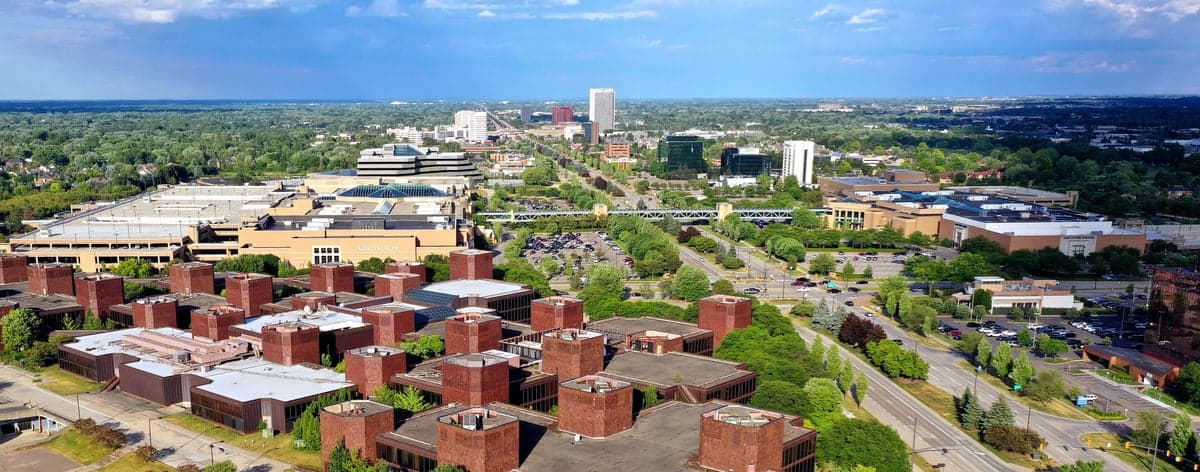
Troy, Michigan, is a city of 87,307 residents defined by its high educational attainment — 64.1% hold a college degree — and a distinctive demographic profile that blends a historically white, middle-class suburban base with one of the largest Indian-subcontinent populations in the Midwest. The city is predominantly white (62.6%), but its Asian (East/Southeast Asian, 9.8%) and Indian-subcontinent (16.3%) communities are substantial and growing, while Black (4.1%) and Hispanic (2.7%) populations remain comparatively small. Troy’s character today is that of an affluent, family-oriented suburb where professional-class immigrants and native-born residents coexist in largely separate neighborhoods, creating a city that is diverse in census data but often tribal in daily life.
How the city was settled and grew
Troy’s original population was drawn by the land itself. The area was first settled in the 1820s by Yankee farmers from New York and New England, who cleared the dense oak forests for agriculture. The 1830s saw a wave of German immigrants, who established small farms and built the St. Paul’s Lutheran Church (1848) in what is now the Old Troy Historic District near Livernois and Wattles. These early settlers were Protestant, Republican-leaning, and deeply rooted in rural self-sufficiency. The city remained a sleepy farming hamlet through the 19th century, with a population under 1,000 as late as 1900. The first major shift came with the automobile boom: Detroit’s auto plants drew European immigrants — Poles, Italians, and Belgians — who settled in the South Troy area along Rochester Road, building modest bungalows and working at nearby Chrysler and Ford plants. By 1950, Troy’s population had reached just 4,000, still overwhelmingly white and native-born.
Modern era (post-1965)
The 1965 Hart-Cellar Immigration Act and the construction of the I-75 corridor transformed Troy’s population. The city’s first major non-white influx came in the 1970s and 1980s, when East/Southeast Asian professionals — primarily Chinese and Korean engineers and doctors — moved into North Troy neighborhoods near Big Beaver and John R, drawn by Troy’s top-rated public schools and proximity to Detroit’s auto-engineering firms. The 1990s brought a much larger wave: Indian-subcontinent immigrants, many with H-1B visas in IT and engineering, who settled heavily in the area around Square Lake Road and Crooks Road, an enclave now marked by Indian grocery stores, temples, and restaurants. This community grew from a negligible share in 1990 to 16.3% of the city’s population by 2020. Meanwhile, domestic white flight from Detroit accelerated in the 1970s and 1980s, with middle-class families moving into the Somerset Park and Maplelawn subdivisions in central Troy. The result is a city where white and Indian-subcontinent residents occupy largely separate residential zones, with limited social mixing despite shared school and civic spaces.
The future
Troy’s population is likely to continue its trajectory toward a white-Indian-subcontinent majority, with the East/Southeast Asian share stabilizing and the Black and Hispanic shares growing only slowly. The Indian-subcontinent community is not plateauing: it is still being replenished by new H-1B arrivals and family reunification, and its children are increasingly staying in Troy as adults, buying homes in the newer subdivisions near Wattles and Coolidge. The white population, while still the largest group, is aging and declining in absolute numbers as older residents downsize or move to warmer climates. The city is not homogenizing; rather, it is tribalizing into distinct enclaves — Indian-subcontinent families cluster in the southeast, East/Southeast Asian families in the north, and white families in the central and western subdivisions. The next 10-20 years will likely see Troy become a majority-minority city, with Indian-subcontinent residents as the largest single group, but with little integration across group lines. The public schools will remain the primary point of contact between communities.
For someone moving in now, Troy offers a safe, well-run suburb with excellent schools and a strong tax base, but it is not a melting pot. New residents should expect to live among people who look like them, in neighborhoods that reflect their own community’s institutions and social networks. The city’s future is one of stable, prosperous tribalism — not assimilation, but not conflict either.

* Values derived from national, state, county, city and local statistics and may differ in a specific area. Last updated: 2026-04-19T09:24:15.000Z
Narrative content on this page is AI-generated and may contain mistakes. Verify any details that matter before acting on them.
ReloMaps may earn a commission from affiliate links at no extra cost to you.

