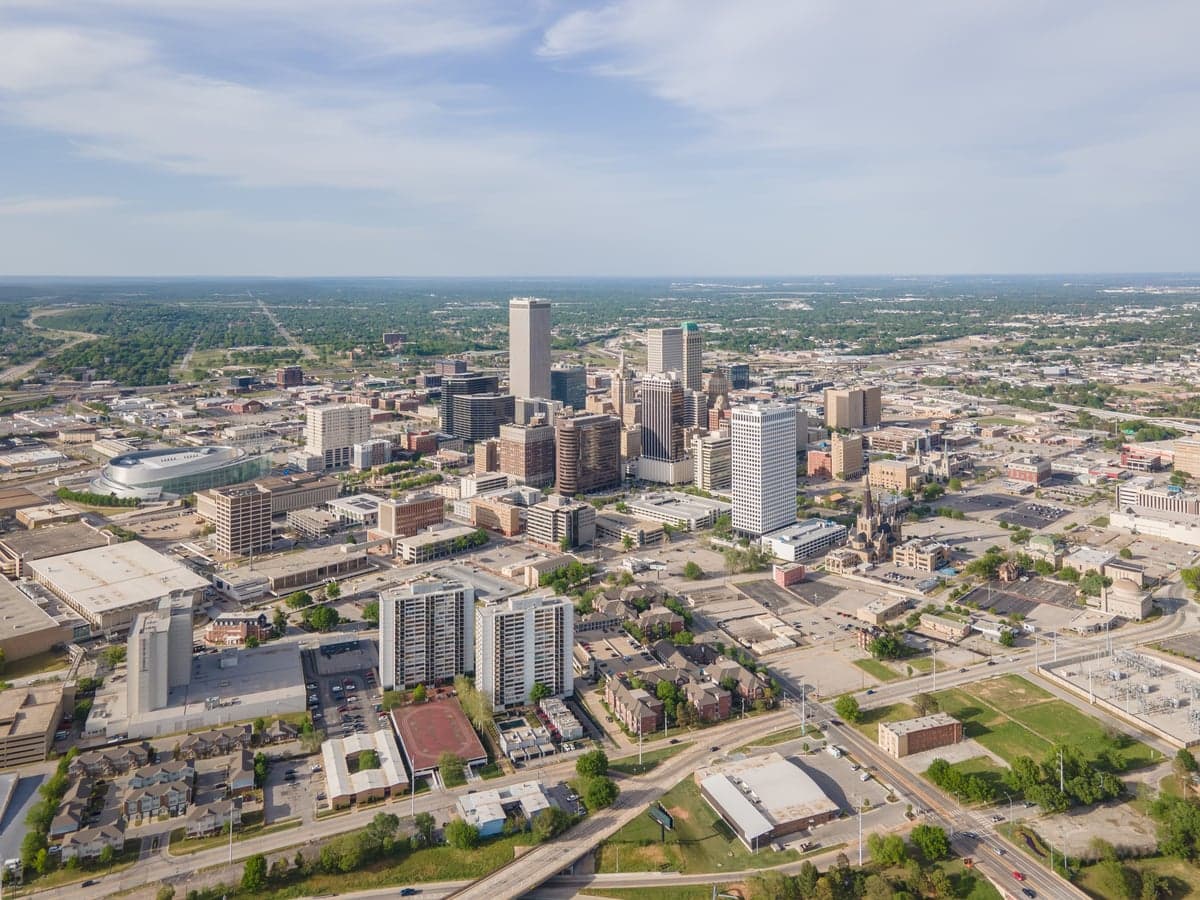
Photo: Wikipedia
Personal Sovereignty in Tulsa, OK
Strong independent fundamentals that actively favor personal liberty and low regulation.
What does Personal Sovereignty tell us?
Personal Sovereignty measures your capacity for self-reliance and independence with minimal government friction. Higher scores mean fewer barriers between you and the way you want to live... but it assumes you have the space you need and good neighbors.
What does this tell us?
Personal Sovereignty measures your capacity for self-reliance and independence with minimal government friction. Higher scores mean fewer barriers between you and the way you want to live... but it assumes you have the space you need and good neighbors.
State Policy
Energy independence: Net exporter (180% of energy produced in-state)
Personal Liberty
Homesteading

Personal Liberty Analysis
Tulsa, Oklahoma, offers a notably high degree of personal sovereignty compared to many urban centers in the United States, particularly for those who prioritize minimal government interference in daily life. The city operates within a state framework that consistently ranks among the most freedom-oriented in the nation, with a legal and regulatory environment that generally defers to individual choice over collective mandates. For the survivalist or prepper mindset, Tulsa represents a strategic balance: it provides the infrastructure and economic opportunities of a mid-sized city while maintaining a political culture that is skeptical of federal overreach and protective of Second Amendment, property, and parental rights. This analysis examines the specific pillars of autonomy that matter most to those seeking to live with maximum personal liberty and minimum bureaucratic friction.
Tax burden and regulatory posture: how Tulsa keeps government off your back
Oklahoma’s tax structure is deliberately designed to leave more money in your pocket and less in the state’s coffers. The state levies a flat income tax of 4.75%, with ongoing legislative efforts to reduce it further, and no tax on Social Security benefits. Tulsa County’s combined sales tax rate hovers around 8.5%, which is moderate for the region, but the absence of a state-level property tax on intangible assets and a relatively low effective property tax rate (roughly 0.9% of assessed home value) means your land and improvements are not a perpetual revenue stream for local government. More importantly, Oklahoma’s regulatory climate is among the least restrictive in the country. The state has a right-to-work law, meaning you cannot be forced to join a union as a condition of employment, and occupational licensing requirements are far less burdensome than in coastal states. For the prepper, this translates to fewer hurdles when starting a side business, building a workshop, or engaging in trades like welding, construction, or firearms manufacturing. Zoning in Tulsa is generally permissive for residential uses, though the city does have a unified development code; however, the overall ethos is one of “leave me alone” rather than “permit me to exist.”
Self-defense and gun law specifics: what the Second Amendment looks like in Tulsa
Oklahoma is a constitutional carry state, meaning no permit is required to carry a firearm openly or concealed for any law-abiding adult 21 or older. Tulsa fully aligns with this posture. There are no magazine capacity restrictions, no “assault weapon” bans, and no firearm registration requirements at the state or local level. The state preempts all local gun ordinances, so Tulsa cannot enact its own restrictions stricter than state law—a critical protection against city council overreach. Stand-your-ground laws are in full effect, with no duty to retreat in any place you are lawfully present. For the survivalist, this means your home, vehicle, and person are legally fortified without needing to navigate a patchwork of local bans or waiting periods. Additionally, Oklahoma has a strong firearm preemption statute that explicitly nullifies any local attempts to regulate firearms, ammunition, or accessories. This legal environment is a direct counter to the trend seen in states like California, New York, or Illinois, where municipal governments routinely erode Second Amendment rights. For those stockpiling ammunition, training on private land, or building a defensive armory, Tulsa’s legal climate offers near-total freedom from government interference in your self-defense preparations.
Self-reliance and homesteading viability: lot sizes, zoning, and off-grid feasibility
Tulsa’s metropolitan area includes significant rural and semi-rural pockets where self-reliance is not just tolerated but encouraged. Within the city limits, standard residential lots range from 6,000 to 10,000 square feet, but many neighborhoods in the outskirts—such as those near the Arkansas River or in the southern parts of the city—offer acreage parcels of one to five acres. Zoning in Tulsa County is generally favorable for small-scale agriculture, including keeping chickens, goats, and even larger livestock on properties of sufficient size, though you should verify specific neighborhood covenants. Off-grid living is legally feasible in unincorporated areas of the county, where building codes are minimal and there is no requirement to connect to municipal water or sewer. Rainwater collection is legal and encouraged, and Oklahoma law explicitly protects the right to capture rainwater for non-potable uses. Solar panel installation is straightforward, with no state-level permitting hurdles beyond standard electrical work. For the prepper seeking to reduce dependency on the grid, Tulsa’s outskirts offer a realistic path: you can own a modest acreage, drill a well, install solar, and raise food without running afoul of zoning inspectors or environmental regulators. The city’s relatively low land prices (median home price around $230,000 as of 2025) make this accessible to many who would be priced out of similar setups in Colorado, Texas, or the Pacific Northwest.
Personal liberties: parental rights, medical autonomy, speech, and property
Oklahoma has been a battleground for parental rights, and the state has consistently sided with families over government. The Parents’ Bill of Rights, enacted in 2022, affirms that parents have the fundamental right to direct the upbringing, education, and healthcare of their children. This includes the right to opt out of any school curriculum or activity, to access all educational records, and to be notified of any medical or mental health services provided to their child. In Tulsa Public Schools, this has practical implications: parents can challenge instructional materials, request alternative assignments, and maintain oversight of their child’s medical decisions without school administrators acting as gatekeepers. On medical autonomy, Oklahoma has passed laws restricting vaccine mandates for private employers and government contractors, and it prohibits the state from requiring vaccine passports. The state also has strong conscience protections for healthcare providers and individuals who decline medical procedures based on religious or moral beliefs. Free speech protections are robust, with no hate speech laws that criminalize political or social commentary, and property rights are reinforced by a strong eminent domain statute that requires just compensation and a public purpose. For the individualist, Tulsa offers a legal environment where you can speak your mind, raise your children according to your values, refuse medical interventions you disagree with, and defend your property without the state second-guessing your choices.
In the broader context of American personal sovereignty, Tulsa stands out as a city where the state’s conservative legal framework effectively insulates residents from the worst excesses of federal and municipal overreach. Compared to cities like Portland, Seattle, or Denver, where local governments actively restrict firearm ownership, impose vaccine mandates, and regulate land use to the point of prohibiting self-sufficiency, Tulsa offers a refuge for those who prioritize autonomy. The combination of constitutional carry, low taxes, permissive zoning, strong parental rights, and a culture of self-reliance makes it a strategic relocation target for the survivalist or prepper who wants urban infrastructure without sacrificing personal freedom. While no location is perfect—Oklahoma’s weather extremes and occasional infrastructure challenges are real—the legal and regulatory climate here is deliberately designed to leave you alone. For those watching the erosion of liberties elsewhere, Tulsa represents a place where the government still largely trusts its citizens to make their own decisions, for better or worse.

* Values derived from national, state, county, city and local statistics and may differ in a specific area. Last updated: 2026-04-13T06:21:49.000Z
Narrative content on this page is AI-generated and may contain mistakes. Verify any details that matter before acting on them.
ReloMaps may earn a commission from affiliate links at no extra cost to you.

