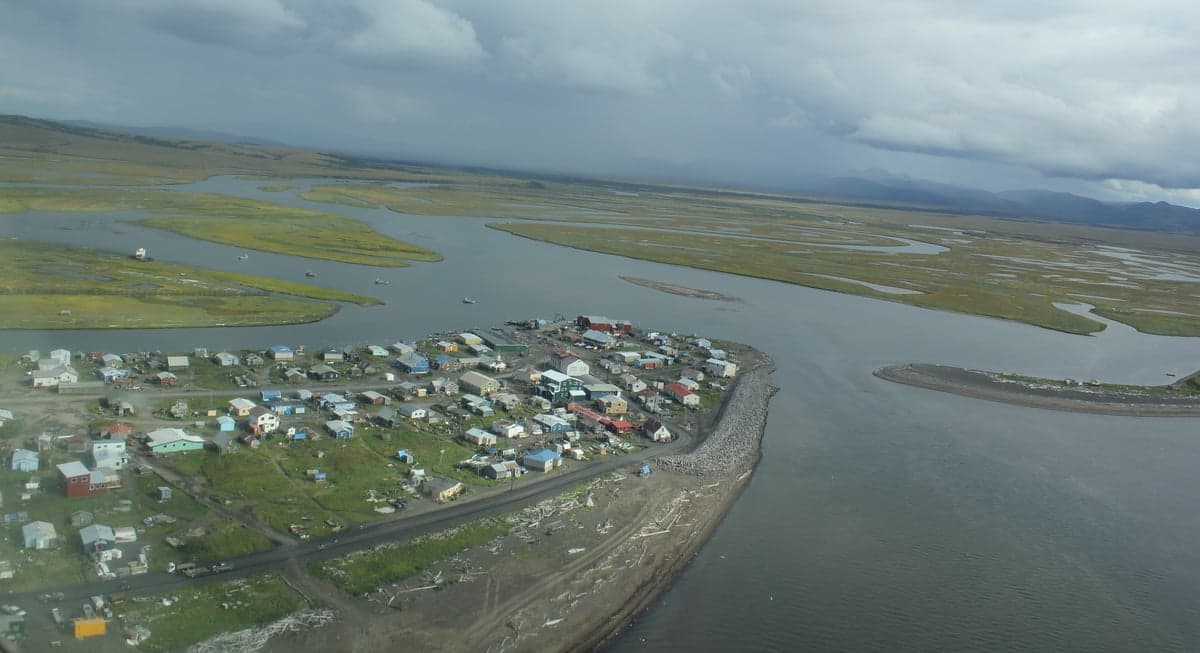
Photo: Wikipedia
Political ClimatePolitical Climate in Unalakleet, AK
District shown is the primary district for this city’s centroid. Cities may span multiple districts.
Inherited from parent state — no local data available.
Local Political AnalysisPolitical Analysis of Unalakleet, AK
Unalakleet has always been a place where folks value their independence and self-reliance, and that’s reflected in its political leanings. The area carries a Cook PVI of R+6, meaning it’s reliably Republican by a solid margin, but it’s not as deep red as some of the more remote, heavily conservative villages further up the Norton Sound. In the past, you could count on the community to vote its conscience, usually favoring candidates who promised to keep government out of local affairs and respect the traditional ways of life. Lately, though, there’s been a subtle shift—some younger folks and newcomers are starting to flirt with progressive ideas, especially around environmental regulations and social programs, which has a lot of us long-time residents watching closely.
How it compares
If you drive or fly over to Nome, about 150 miles northwest, you’ll find a similar R+6 lean, but Nome has a more mixed political scene because of the university presence and seasonal tourism. Unalakleet, by contrast, is more homogenous—most folks here are subsistence hunters, fishers, or work for local tribal entities, and they tend to vote with a practical, conservative mindset. Head south to Bethel, and you’re looking at a D+8 area, where progressive policies on land use and social welfare have taken a stronger hold. That’s a world of difference. In Unalakleet, we still remember when the state tried to impose stricter fishing quotas a few years back, and the whole community pushed back hard, arguing it was government overreach into our traditional rights. That kind of resistance is what keeps us from sliding into the kind of top-down control you see in more liberal areas.
What this means for residents
For the people living here, the political climate means a lot of day-to-day freedoms are still intact—you can hunt, fish, and live off the land without a mountain of permits and red tape, at least for now. But the creeping threat of progressive ideology is real. There’s been talk of expanding federal land designations that would restrict access to traditional hunting grounds, and some local leaders are pushing for more state-funded social programs that come with strings attached. If that trend continues, we could see a loss of the personal autonomy that makes Unalakleet a great place to raise a family. The R+6 lean gives us some buffer, but it’s not a guarantee—especially when outside money and influence start flowing into local elections. Residents need to stay engaged and vote for candidates who prioritize local control over distant bureaucratic mandates.
Culturally, Unalakleet is still grounded in Iñupiaq traditions, and that’s a big part of why the conservative mindset sticks. The community values hard work, family, and respect for elders, and there’s a strong distrust of government programs that try to replace those bonds with handouts. One policy distinction that stands out is the local stance on resource development—most folks here support responsible oil and gas exploration in the region, seeing it as a path to economic independence, while progressive groups push for a total ban. That’s the kind of divide that defines us. Looking ahead, I’d say the next five to ten years will be critical. If we can keep the progressive influence at bay and hold onto our R+6 advantage, Unalakleet will stay the kind of place where you can live free. If not, we’ll end up like Bethel, and nobody wants that.

State Political ClimatePolitical Climate in Alaska
State Political AnalysisPolitical Environment in the State
Alaska has long been a unique political outlier—a state where a fierce libertarian streak and a deep-seated distrust of federal overreach coexist with a pragmatic, resource-driven conservatism. For the past two decades, the state has leaned reliably Republican in presidential elections, with Donald Trump winning it by 10 points in 2020 and 13 points in 2024, but its state-level politics are far more volatile, often swinging between hardline conservatives and moderate independents. The big story over the last 10-20 years is the slow erosion of the old “Alaska First” consensus—where oil revenue funded no-income-tax government—replaced by bitter fights over the Permanent Fund dividend, budget cuts, and a growing cultural clash between Anchorage’s suburban sprawl and the Bush’s traditional values.
Urban vs. rural divide
The political map of Alaska is starkly divided between a few population centers and everything else. Anchorage, home to 40% of the state’s population, is the swing region—its more liberal Assembly districts in midtown and the Hillside area lean Democratic, while the Chugiak-Eagle River suburbs and South Anchorage are reliably red. In 2022, Anchorage’s mayoral race saw a moderate conservative win by just 1,200 votes, showing how tight the city is. Fairbanks, the interior hub, is a conservative stronghold, with the surrounding Fairbanks North Star Borough voting +18 R in 2024, driven by military families and resource workers. Juneau, the capital, is the state’s most liberal city—its downtown and Douglas Island precincts vote 2-to-1 Democratic, fueled by state employees and environmental activists. The real red wall is the Mat-Su Borough (Wasilla, Palmer), which voted +35 R in 2024 and is the fastest-growing conservative enclave in the state, full of ex-Californians and homesteaders. Rural villages in the Bush, like Barrow (Utqiaġvik) and Bethel, vote heavily Democratic due to tribal ties and federal dependency, but their turnout is low and shrinking.
Policy environment
Alaska’s policy environment is a mixed bag for conservatives. On the plus side, there is no state income tax and no statewide sales tax—a massive freedom win. The state’s constitutional budget reserve and the Permanent Fund dividend (PFD) are sacred cows, though the amount has been slashed from $2,000 per person in 2015 to around $1,300 in 2024 due to legislative fights. Gun rights are strong: Alaska has constitutional carry, no permit required, and preemption laws that block local gun bans. Education policy is a flashpoint—the state has no school choice program, and the teachers’ union in Anchorage has blocked charter expansion, though the Mat-Su Borough has aggressively built new charter schools. Healthcare is dominated by the state’s Medicaid expansion (accepted in 2015 under then-Governor Bill Walker), which has strained budgets. Election laws are a sore spot: in 2020, Alaska adopted ranked-choice voting via ballot initiative, which many conservatives see as a tool to dilute their votes—it helped elect Democrat Mary Peltola to Congress in 2022. The state also has no voter ID law, which rankles many. Regulatory posture on oil and mining is generally pro-development, but the Biden administration’s restrictions on ANWR and the Arctic National Wildlife Refuge have created constant friction.
Trajectory & freedom
Alaska is in a tug-of-war between expanding and contracting freedom. On the positive side, 2024 saw the passage of Senate Bill 89, which expanded parental rights in education—requiring schools to notify parents of any curriculum involving sexuality or gender identity, and giving parents the right to opt their kids out. This was a major win for conservatives. Gun rights were solidified with the 2023 repeal of a 100-year-old law requiring a permit to carry a concealed firearm in Anchorage, aligning state law with constitutional carry. However, ranked-choice voting (RCV), passed in 2020, has been a persistent threat to conservative representation—it allowed a Democrat to win a House seat in a red state, and efforts to repeal it in 2024 fell short by just 4,000 votes. Property rights are under pressure from the state’s land-use planning in the Mat-Su, where new zoning rules have limited rural subdivisions. Medical autonomy took a hit in 2023 when the state legislature expanded Medicaid coverage for gender transition procedures for minors, overriding parental consent—a move that sparked massive backlash and a pending lawsuit. The Permanent Fund dividend has been cut by nearly 40% since 2016, a direct loss of economic freedom for families. Overall, the state is becoming less free on fiscal and cultural fronts, but remains a bastion on guns and taxes.
Civil unrest & political movements
Alaska has seen its share of political flashpoints. The 2020 “Borough Rebellion” in the Mat-Su saw thousands of residents protest the governor’s COVID-19 mandates, including a 14-day quarantine for travelers, which many saw as federal overreach. The Alaska Independence Party, a secessionist group that advocates for a vote on leaving the U.S., still fields candidates and gets 3-5% of the vote in statewide races—a fringe but persistent voice. Immigration politics are muted because Alaska has a tiny foreign-born population (7%), but the state has no sanctuary policies and local law enforcement cooperates with ICE. Election integrity is a hot topic: after the 2020 RCV implementation, the 2022 election saw widespread confusion and allegations of ballot harvesting in rural precincts, leading to a 2023 legislative audit that found no fraud but recommended tighter chain-of-custody rules. Environmental activism is the main left-wing movement—groups like the Alaska Wilderness League have staged protests in Anchorage and Juneau against oil drilling, including a 2023 blockade of the Trans-Alaska Pipeline that resulted in 12 arrests. A new resident would notice the ubiquitous “Save the PFD” signs in yards across the Mat-Su and Fairbanks, a constant reminder of the fight over the dividend.
Projection
Over the next 5-10 years, Alaska is likely to become more polarized and less stable. The demographic shift is real: the Mat-Su Borough is growing at 3% annually, drawing conservative families from California and Texas, while Anchorage is losing population due to high crime and housing costs. This will push the state’s center of gravity further right, but the RCV system will continue to frustrate conservatives by allowing moderate Republicans and Democrats to form coalitions. The PFD fight will intensify—if oil revenues decline (and they are projected to drop 20% by 2030), the state will face a choice between cutting services or raising taxes, which could break the no-income-tax tradition. School choice is the next big battle: a 2025 ballot initiative to create education savings accounts is likely, and if it passes, it could transform the state’s education landscape. Gun rights are safe for now, but federal pressure on red flag laws could create a showdown. The biggest wildcard is the Arctic: if oil drilling resumes in ANWR, it could bring a boom that stabilizes the budget and reinforces the resource-driven conservative model. If not, the state will drift toward a more urban, service-economy liberalism in Anchorage and Juneau. Someone moving in now should expect a state that is still free on paper but increasingly contested—the battles over the PFD, RCV, and parental rights will define the next decade.
For a new resident, the bottom line is this: Alaska offers unmatched personal freedom on taxes and guns, but you’ll have to fight to keep it. The state’s political climate is a daily grind of local activism—showing up at borough assembly meetings, voting in every RCV round, and defending the PFD. If you’re looking for a place where your vote counts and your voice matters, the Mat-Su or Fairbanks are your best bets. If you want a quiet life with minimal political drama, stick to the rural Bush or the Kenai Peninsula. Just know that the Alaska you’re moving to is not the Alaska of 20 years ago—it’s a state in transition, and your presence will help decide which direction it goes.
* Values derived from national, state, county, city and local statistics and may differ in a specific area. Last updated: 2026-04-19T19:39:39.000Z
Narrative content on this page is AI-generated and may contain mistakes. Verify any details that matter before acting on them.
ReloMaps may earn a commission from affiliate links at no extra cost to you.

