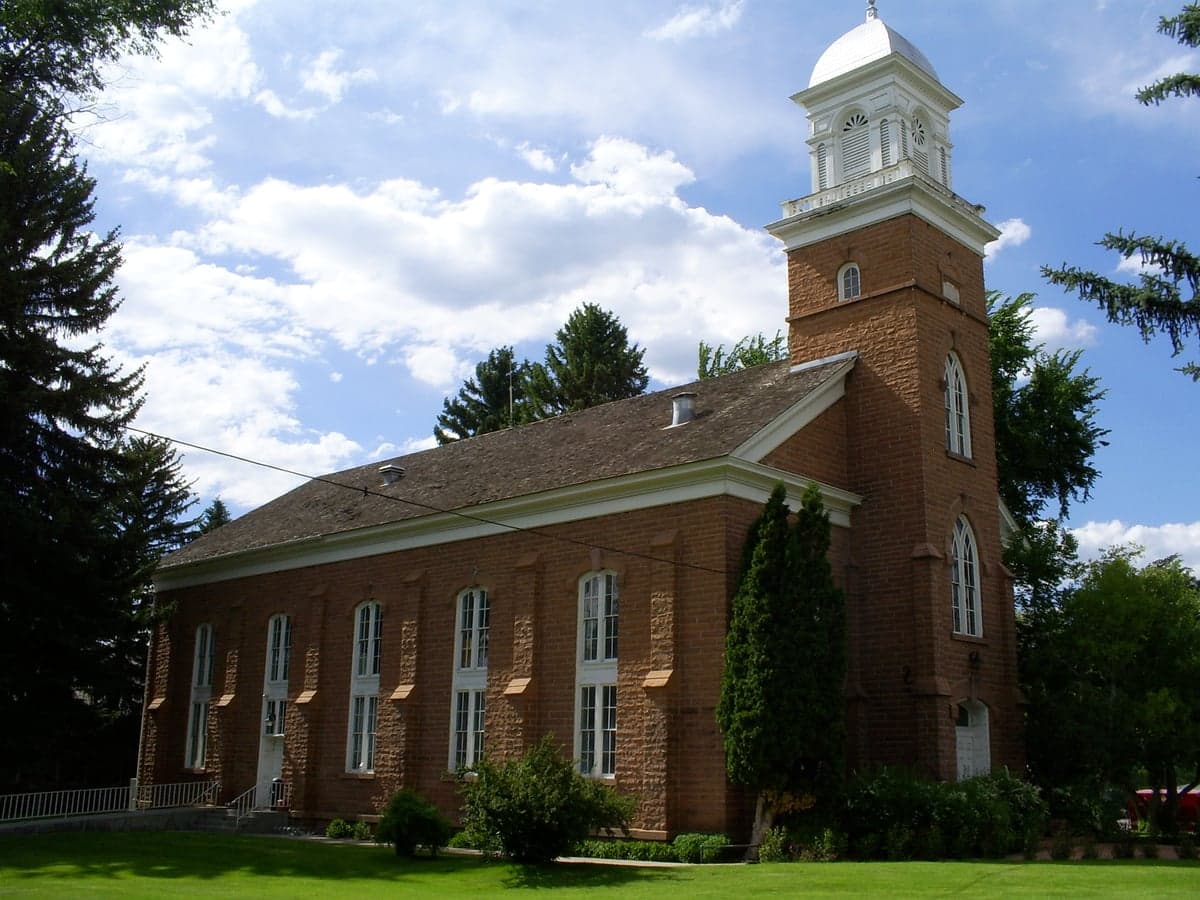
Photo: Wikipedia
Demographics of Wasatch County
Affluence Level in Wasatch County
An upper-middle-class area. Household wealth, education levels, and homeownership run ahead of national benchmarks.
People of Wasatch County
The people of Wasatch County, Utah, today number 35,808 and form one of the most culturally and politically homogeneous counties in the Intermountain West, with 81.5% of residents identifying as non-Hispanic white and a Hispanic population of 14.4% that is the county’s largest and fastest-growing minority group. The county’s identity is deeply shaped by its Mormon pioneer heritage, a strong outdoor-recreation economy centered on Heber City and Midway, and a recent wave of domestic migration from California and the Front Range that is slowly diversifying the population. With a foreign-born share of just 4.7% and a college-attainment rate of 47.7%, Wasatch County is both highly educated and overwhelmingly native-born, reflecting a community that remains culturally insular even as it grows.
Settlement & growth (pre-1960)
Before Euro-American settlement, the Wasatch County area was part of the traditional territory of the Ute people, specifically the Timpanogots band, who lived in seasonal camps along the Provo River and the shores of what is now Jordanelle Reservoir. The Utes were displaced by Mormon pioneers beginning in the late 1850s, when Brigham Young directed settlers to establish farming communities in the Heber Valley. The first permanent settlement was Heber City, founded in 1859 by Mormon families from Salt Lake City and Provo who were drawn by the valley’s abundant water, fertile soil, and isolation from non-Mormon influences. Midway followed in 1860, settled largely by Swiss and German Mormon converts who brought dairy-farming traditions that still define the town’s character. Charleston and Daniel were established in the 1860s as agricultural outposts, while Wallsburg (originally called “Snake Creek”) was settled in the 1870s by ranchers seeking summer pasture in the upper Provo River drainage.
These early settlers were almost exclusively members of the Church of Jesus Christ of Latter-day Saints (LDS Church), and the county’s population remained overwhelmingly Mormon and of Northern European descent through the early 20th century. The arrival of the Denver and Rio Grande Western Railroad in the 1890s brought a small influx of non-Mormon merchants and railroad workers, but the county’s isolation and lack of industrial development kept growth slow. By 1900, the population was just over 4,000, and it remained below 5,000 until the 1940s. The construction of the Deer Creek Reservoir in the 1930s and the Jordanelle Dam in the 1990s were the first major infrastructure projects to alter the local economy, but the county’s population did not exceed 10,000 until the 1970s. The pre-1960 population was thus a stable, homogeneous, LDS-majority farming and ranching community, with no significant immigration from outside the United States and no non-white population to speak of.
Modern era (post-1965)
The post-1965 era in Wasatch County is defined not by international immigration but by domestic migration and suburbanization. The Hart-Cellar Act of 1965 had minimal direct impact here: the foreign-born share remains just 4.7%, and the county has no established immigrant enclaves. Instead, the major demographic shift has been the arrival of white, college-educated families from California, Colorado, and the Salt Lake City suburbs, drawn by the county’s proximity to world-class ski resorts (Park City, Deer Valley, and Sundance) and its reputation as a quieter, more affordable alternative to Summit County. This wave began in earnest in the 1990s, accelerated after the 2002 Winter Olympics, and has intensified since 2020, with Heber City and Midway absorbing most of the new housing developments.
The Hispanic population, now 14.4%, is the county’s most notable minority group and has grown steadily since the 1990s, driven by labor demand in construction, hospitality, and landscaping. Most Hispanic residents are of Mexican origin and live in Heber City, where a small but visible Spanish-speaking community has formed around the St. Lawrence Catholic Church and the Heber Valley Elementary School. The Asian population (East and Southeast Asian) stands at 1.4%, concentrated among a small number of professionals working in tech-adjacent fields or in the ski-resort economy, with no distinct ethnic enclave. The Black population is negligible at 0.1%, and the Indian-subcontinent population is effectively zero. The county’s racial and ethnic composition thus remains overwhelmingly white, with the Hispanic share growing slowly but steadily as the county’s overall population expands.
Suburbanization has reshaped the built environment dramatically. Heber City has grown from a town of 3,000 in 1990 to over 16,000 today, with master-planned subdivisions like Lake Creek and River Road Estates replacing farmland. Midway has seen a similar transformation, with luxury homes and vacation properties clustering around the Homestead Resort and the Wasatch Mountain Golf Course. The unincorporated areas of Daniel and Charleston have also absorbed new residents, though they retain a more rural character. This growth has brought increased traffic on U.S. Highway 40 and rising housing costs, but the county remains significantly more affordable than neighboring Summit County, where median home prices exceed $1.5 million.
The future
The population of Wasatch County is projected to continue growing at a rapid pace, with the Utah Governor’s Office of Economic Opportunity estimating a population of over 50,000 by 2040. This growth will be driven overwhelmingly by domestic migration from higher-cost states, particularly California, Washington, and Colorado, as well as by natural increase among the county’s young, family-oriented population. The Hispanic share is likely to rise slowly, potentially reaching 18-20% by 2040, as the construction and service sectors continue to attract immigrant labor. The Asian and Black populations are expected to remain small, as the county lacks the urban amenities and job diversity that attract these groups to larger metropolitan areas.
Culturally, Wasatch County is becoming more politically and religiously diverse, though it remains a conservative stronghold. The influx of out-of-state migrants has brought a small but growing number of non-Mormon and politically moderate residents, particularly in Heber City and Midway, where new subdivisions are less likely to be dominated by LDS families. However, the county’s rural outposts—Wallsburg, Daniel, and Charleston—remain deeply traditional and LDS-majority. The tension between growth and preservation is the central demographic story: new residents want the county’s natural beauty and small-town feel, but their arrival is eroding the very character that attracted them.
For someone moving in now, Wasatch County offers a high quality of life for those who value outdoor recreation, strong schools, and a safe, family-oriented environment. The trade-off is a lack of racial and ethnic diversity, a dominant LDS cultural influence, and a housing market that is increasingly unaffordable for local workers. The county is becoming more suburban and less rural, but it remains a place where the pioneer-era values of self-reliance, community, and faith still shape daily life.

* Values derived from national, state, county, city and local statistics and may differ in a specific area. Last updated: 2026-10-14T19:01:05.000Z
Narrative content on this page is AI-generated and may contain mistakes. Verify any details that matter before acting on them.
ReloMaps may earn a commission from affiliate links at no extra cost to you.

