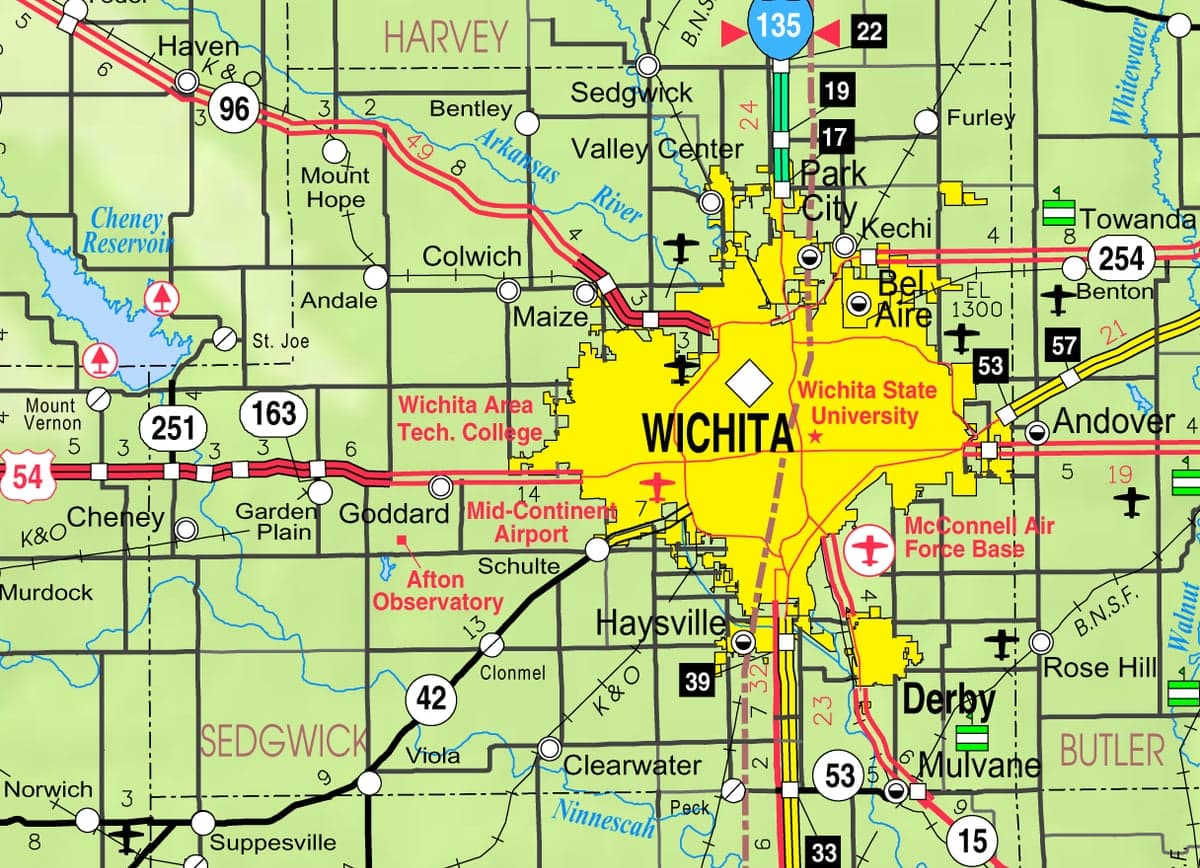
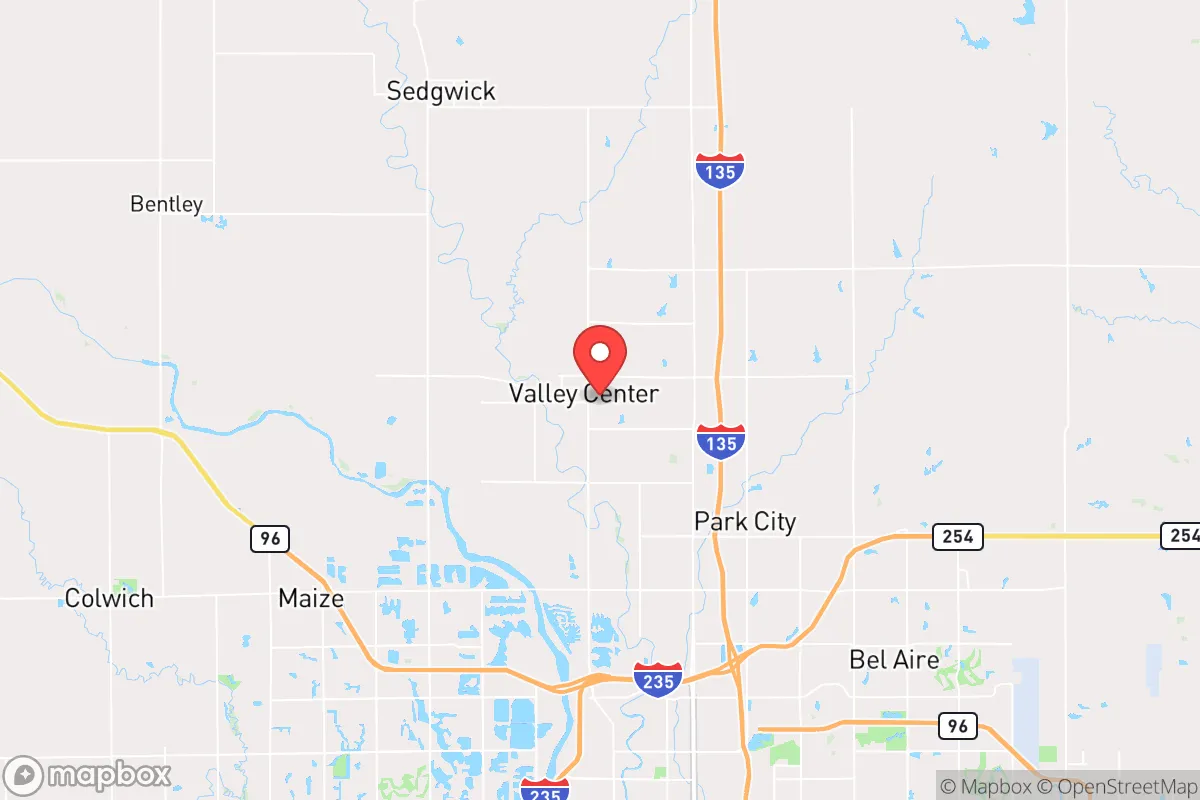
Photo: Wikipedia
Demographics of Valley Center, KS
Affluence Level in Valley Center, KS
A middle-class area roughly in line with national averages across income, home values, education, and employment.
People of Valley Center, KS
The people of Valley Center, Kansas, today form a predominantly white, family-oriented community of 8,937 residents, characterized by a strong sense of local identity and a notably low foreign-born population of just 0.9%. With 87.4% of residents identifying as white and a Hispanic population of 5.3%, the city is less diverse than the broader Wichita metro area, yet it maintains a distinct small-town character with a higher-than-average college attainment rate of 36.0%. The community’s identity is rooted in its agricultural past and its role as a quiet, affordable suburb, where generational families live alongside newer arrivals seeking lower taxes and a slower pace of life.
How the city was settled and grew
Valley Center’s human history begins with its founding in 1871 as a railroad town along the Atchison, Topeka and Santa Fe Railway. The original settlers were primarily Anglo-American farmers and merchants drawn by the promise of fertile land along the Little Arkansas River and the economic opportunity of the rail line. The earliest residential area, now known as Old Town Valley Center around Main Street and Meridian Avenue, was built by these pioneer families, who constructed simple wood-frame homes and established grain elevators and general stores. A second wave arrived in the early 1900s, composed of German and Czech immigrants who purchased farmland to the north and east, settling in what is now the Northridge Addition and Eastside Farms areas. These groups built the area’s first churches, including St. Mary’s Catholic Church, and established a tight-knit agricultural community that remained largely homogeneous through the mid-20th century. The city’s population grew slowly, reaching roughly 1,500 by 1950, as the economy remained tied to wheat, corn, and livestock.
Modern era (post-1965)
After 1965, Valley Center began to suburbanize as Wichita’s postwar expansion pushed middle-class families northward. The 1970s and 1980s saw the development of Greenbrier Estates and Prairie Hills, subdivisions that attracted white-collar workers employed at Wichita’s aircraft manufacturers, such as Boeing and Cessna. These neighborhoods, with their larger lots and newer homes, absorbed the bulk of domestic in-migration from Sedgwick County and other parts of Kansas. The city’s population more than doubled between 1970 and 2000, reaching 6,500. During this period, the Hispanic population grew modestly, from near zero to about 3% by 2000, with families settling primarily in the Westside Addition near 77th Street West, drawn by affordable housing and work in construction and agriculture. The Black population remained minimal, at 0.5%, and East/Southeast Asian communities registered at 0.0%, reflecting the city’s limited pull for immigrant groups compared to Wichita proper. The Indian-subcontinent population, at 0.8%, is a very recent and small presence, concentrated in a handful of professional households in Stone Creek, a newer subdivision built after 2010.
The future
Valley Center’s population is projected to grow slowly, likely reaching 10,000–10,500 by 2040, driven by continued suburban spillover from Wichita and the city’s reputation for low crime and good schools. The white share is expected to remain dominant, though the Hispanic population may rise to 8–10% as second-generation families from Wichita seek more space and lower housing costs. The foreign-born share is unlikely to increase significantly, given the city’s lack of industrial or service-sector jobs that typically attract new immigrants. The city is not tribalizing into distinct ethnic enclaves; rather, new Hispanic residents are dispersing across existing neighborhoods like Westside Addition and Prairie Hills, while the small Indian-subcontinent population remains scattered. The biggest demographic shift may be generational: younger families are replacing aging farmers and retirees, particularly in newer developments like Stone Creek and Meadowbrook, which are attracting Wichita commuters in their 30s and 40s.
For someone moving in now, Valley Center is becoming a stable, slowly diversifying bedroom community where the population is homogenizing around a middle-class, family-oriented lifestyle rather than fragmenting into distinct cultural enclaves. The city offers a predictable, low-density environment with a strong public school system and easy access to Wichita’s jobs, but little ethnic or cultural variety. New residents should expect a community where generational ties run deep and newcomers are welcomed primarily through school and church networks, not through any organized diversity initiatives.

* Values derived from national, state, county, city and local statistics and may differ in a specific area. Last updated: 2026-10-10T16:29:14.000Z
Narrative content on this page is AI-generated and may contain mistakes. Verify any details that matter before acting on them.
ReloMaps may earn a commission from affiliate links at no extra cost to you.

